
Details
Artist
Styles
Original Lithograph in black on gold and silver - Suite: Happy Meeting - Hand Signed In Pencil Lower Right // Karel Appel's The Woman with Golden Eye (1974) is a striking lithograph that combines his signature abstract expressionism with surreal elements. The artwork, part of the Happy Meeting suite, is printed in black on a reflective gold and silver background, creating a contrast that enhances its bold and dynamic forms. The image depicts a fantastical, abstract figure with exaggerated features and a singular golden eye that captures attention. Appel’s loose, energetic lines and expressive style evoke a sense of movement and spontaneity, inviting viewers to interpret the surreal composition. The hand-signed piece is a testament to Appel’s playful and unconventional approach to visual storytelling.
The Woman with Golden Eye, 1974
form
Medium
Size
66 x 48.9 cm
- Inches
- Centimeters
Edition
Price
Details
Artist
Styles
Original Lithograph in black on gold and silver - Suite: Happy Meeting - Hand Signed In Pencil Lower Right // Karel Appel's The Woman with Golden Eye (1974) is a striking lithograph that combines his signature abstract expressionism with surreal elements. The artwork, part of the Happy Meeting suite, is printed in black on a reflective gold and silver background, creating a contrast that enhances its bold and dynamic forms. The image depicts a fantastical, abstract figure with exaggerated features and a singular golden eye that captures attention. Appel’s loose, energetic lines and expressive style evoke a sense of movement and spontaneity, inviting viewers to interpret the surreal composition. The hand-signed piece is a testament to Appel’s playful and unconventional approach to visual storytelling.
- Recently Added
- Price (low-high )
- Price (high-low )
- Year (low-high )
- Year (high-low )

Karel Appel
Nesting Bird, 1978
Limited Edition Print
Lithograph
USD 990

Karel Appel
A Group Of 3 Screenprints, 1975 / 1978
Limited Edition Print
Screen-print
USD 2,700

Karel Appel
Two Figures, c. 1980
Limited Edition Print
Lithograph
USD 1,000

Karel Appel
Composition , 1969
Limited Edition Print
Lithograph
USD 950

Karel Appel
Serie Personages, 1969
Limited Edition Print
Lithograph
USD 780

Karel Appel
Cats, 1979
Limited Edition Print
Lithograph
USD 8,250

Karel Appel
Il Pagliacci, 1984
Limited Edition Print
Lithograph
USD 2,150

Karel Appel
Fighting Cat, 1979
Limited Edition Print
Lithograph
USD 750

Karel Appel
Cat In The Night, 1979
Limited Edition Print
Lithograph
USD 750

Karel Appel
Luminous Cat, 1979
Limited Edition Print
Lithograph
USD 750

Karel Appel
Resting Cat, 1979
Limited Edition Print
Lithograph
USD 750

Karel Appel
Devil Cat, 1979
Limited Edition Print
Lithograph
USD 750

Karel Appel
Sad Cat, 1979
Limited Edition Print
Lithograph
USD 750

Karel Appel
Stalking Cat, 1979
Limited Edition Print
Lithograph
USD 750

Karel Appel
Blue Cat, 1979
Limited Edition Print
Lithograph
USD 750

Karel Appel
Smiling Cat, 1979
Limited Edition Print
Lithograph
USD 750

Karel Appel
Green Cat, 1979
Limited Edition Print
Lithograph
USD 750

Karel Appel
House Cat, 1979
Limited Edition Print
Lithograph
USD 750

Karel Appel
Sunshine Cat, 1979
Limited Edition Print
Lithograph
USD 750

Karel Appel
Sound, 1979
Limited Edition Print
Mixed Media
USD 1,400

Karel Appel
Face, 1979
Limited Edition Print
Mixed Media
USD 1,400

Karel Appel
Lying In Red, 1979
Limited Edition Print
Mixed Media
USD 1,400

Karel Appel
Deux Personnages, 1978
Limited Edition Print
Mixed Media
USD 1,570

Karel Appel
The Bear
Limited Edition Print
Lithograph
USD 775

Karel Appel
About A Cat, 1979
Limited Edition Print
Lithograph
USD 750

Karel Appel
Frightened Cat, 1979
Limited Edition Print
Lithograph
USD 750

Karel Appel
Walking Cat, 1979
Limited Edition Print
Lithograph
USD 750

Karel Appel
Innocent Cat, 1979
Limited Edition Print
Lithograph
USD 750

Karel Appel
Pink Cat, 1979
Limited Edition Print
Lithograph
USD 750

Karel Appel
Once I Was The Sun, 1978
Limited Edition Print
Lithograph
USD 1,100

Karel Appel
Obra Gráfica, 1974
Limited Edition Print
Serigraph
EUR 1,550

Karel Appel
Kool Luke Singing Hands, 1978
Limited Edition Print
Silkscreen
USD 1,700

Karel Appel
Red Cat Singing Hands, 1978
Limited Edition Print
Silkscreen
USD 1,700

Karel Appel
Floating Flower Passion, 1978
Limited Edition Print
Silkscreen
USD 1,700

Karel Appel
Green Floating Passion , 1975
Limited Edition Print
Silkscreen
USD 1,700

Karel Appel
Flying Head Over Ocean, 1972
Limited Edition Print
Lithograph
USD 800

Karel Appel
Sunshine People, 1974
Limited Edition Print
Silkscreen
USD 1,700

Karel Appel
Putting Green Kiss , 1978
Limited Edition Print
Silkscreen
USD 1,750

Karel Appel
Como El Viento, 1988
Limited Edition Print
Etching And Aquatint
EUR 1,700

Karel Appel
Los Pájaros, 1988
Limited Edition Print
Aquatint
EUR 1,700

Karel Appel
Tete Montagne I, 1976
Limited Edition Print
Aquatint
EUR 2,350

Karel Appel
Flower With Blue Eyes, 1977
Sculpture / Object
Wood
Currently Not Available
Related Artists


Related Articles
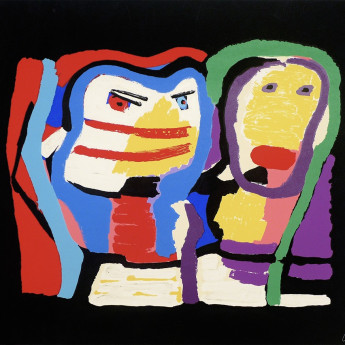
Art Movements - November 21, 2022
Botch, Blotch and Splotch: The Exuberant Maelstrom of the Cobra Art Movement.
Explore the CoBrA movement’s bold creativity, blending raw expression and experimentation. Discover its impact on post-war art and avant-garde traditions. Read More

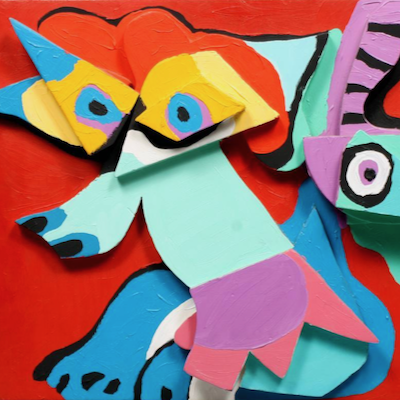
What is the CoBrA movement?
CoBrA stands for Copenhagen, Brussels, and Amsterdam; the group was formed with a desire to break away from the existing art movements of the time. Their critique of Western society led them to experiment and evolve into a significant international movement. CoBrA was founded on November 8, 1948, at the Notre Dame Café in Paris, where its manifesto was signed by Karel Appel, Joseph Noiret, Corneille, Christian Dotremont, Constant, and Asger Jorn. The group was united by a shared commitment to freedom in both form and color, and their work emphasized experimentation and spontaneity.