Details
Artist
Styles
Screenprint on wove paper - Signed, numbered, and dated in pencil along right edge; printer's chop mark, lower left - Printed by Durham Press, Durham - Reference: Keith Haring - Editions on Paper 1982-1990, Littmann, page 183. // Keith Haring's Untitled (Plate 17) from The Blueprint Drawings (1990) is a striking black-and-white screen print that features Haring's recognizable use of bold, simplified human figures. The central figure in this piece is depicted crawling on hands and knees, set against a background of a dotted, textured surface with a prominent pyramid and a simplified, dog-like figure to the right. The pyramid, in stark black, creates a sense of mystery and adds depth to the otherwise flat composition. The minimalistic forms, thick outlines, and Haring’s signature energetic lines invite contemplation of themes such as struggle, existence, or even playfulness. Signed and numbered by Haring, this limited-edition print is part of a series that emphasizes accessibility and social commentary through simplicity of form.
Untitled (Plate 17) from The Blueprint Drawings, 1990
form
Medium
Size
107 x 117 cm
- Inches
- Centimeters
Edition
Range
- USD
- EUR
- GBP
Details
Artist
Styles
Screenprint on wove paper - Signed, numbered, and dated in pencil along right edge; printer's chop mark, lower left - Printed by Durham Press, Durham - Reference: Keith Haring - Editions on Paper 1982-1990, Littmann, page 183. // Keith Haring's Untitled (Plate 17) from The Blueprint Drawings (1990) is a striking black-and-white screen print that features Haring's recognizable use of bold, simplified human figures. The central figure in this piece is depicted crawling on hands and knees, set against a background of a dotted, textured surface with a prominent pyramid and a simplified, dog-like figure to the right. The pyramid, in stark black, creates a sense of mystery and adds depth to the otherwise flat composition. The minimalistic forms, thick outlines, and Haring’s signature energetic lines invite contemplation of themes such as struggle, existence, or even playfulness. Signed and numbered by Haring, this limited-edition print is part of a series that emphasizes accessibility and social commentary through simplicity of form.
- Recently Added
- Price (low-high )
- Price (high-low )
- Year (low-high )
- Year (high-low )
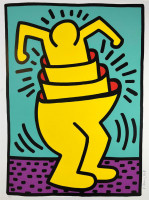
Keith Haring
Untitled (Cup Man), 1989
Limited Edition Print
Screen-print
USD 90,000 - 120,000

Keith Haring
Pop Shop IV (C), 1989
Limited Edition Print
Silkscreen
USD 40,000 - 50,000

Keith Haring
Icons (B) - Barking Dog, 1990
Limited Edition Print
Silkscreen
USD 55,000 - 65,000

Keith Haring
Icons (A) - Radiant Baby, 1990
Limited Edition Print
Silkscreen
USD 55,000 - 70,000

Keith Haring
Pop Shop I (D), 1987
Limited Edition Print
Silkscreen
USD 40,000 - 50,000

Keith Haring
Pop Shop IV (A), 1989
Limited Edition Print
Silkscreen
USD 50,000 - 60,000

Keith Haring
Best Buddies, 1987
Limited Edition Print
Silkscreen
USD 60,000 - 80,000

Keith Haring
Fight Aids Worldwide, 1990
Limited Edition Print
Lithograph
Inquire For Price

Keith Haring
Untitled (Plate 16) From The Blueprint Drawings, 1990
Limited Edition Print
Screen-print
USD 35,000 - 45,000

Keith Haring
Untitled (Plate 17) From The Blueprint Drawings, 1990
Limited Edition Print
Screen-print
USD 35,000 - 45,000

Keith Haring
Three Lithographs: One Plate, 1985
Limited Edition Print
Lithograph
USD 30,000 - 40,000

Keith Haring
Icons (C) - Winged Angel, 1990
Limited Edition Print
Silkscreen
USD 29,000

Keith Haring
Apocalypse 1, 1988
Limited Edition Print
Mixed Media
EUR 12,250

Keith Haring
Apocalypse 3, 1988
Limited Edition Print
Screen-print
EUR 12,250

Keith Haring
Untitled (w/ Sean Kalish) #9, 1989
Limited Edition Print
Etching
USD 3,600

Keith Haring
Untitled (w/ Sean Kalish) #7, 1989
Limited Edition Print
Etching
USD 3,600

Keith Haring
Untitled (w/ Sean Kalish) #11, 1989
Limited Edition Print
Etching
USD 3,600

Keith Haring
Untitled (w/ Sean Kalish) #10, 1989
Limited Edition Print
Etching
USD 3,600

Keith Haring
Untitled (w/ Sean Kalish) #6, 1989
Limited Edition Print
Etching
USD 3,600

Keith Haring
Untitled (w/ Sean Kalish) #5, 1989
Limited Edition Print
Etching
USD 3,600

Keith Haring
Untitled (w/ Sean Kalish) #4, 1989
Limited Edition Print
Etching
USD 3,600

Keith Haring
USA 19-82, 1982
Limited Edition Print
Lithograph
USD 40,000 - 50,000

Keith Haring
Untitled - Baby Pin (18kt Gold), 1989
Sculpture / Object
Metal
GBP 11,400
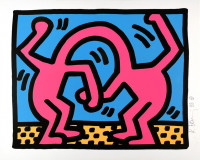
Keith Haring
Pop Shop II (D), 1988
Limited Edition Print
Silkscreen
USD 45,000 - 50,000
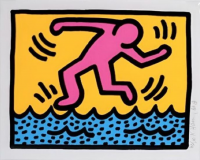
Keith Haring
Pop Shop II Plate 3, 1988
Limited Edition Print
Screen-print
Inquire For Price
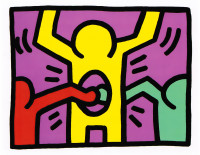
Keith Haring
Pop Shop I (C), 1987
Limited Edition Print
Silkscreen
USD 30,000 - 50,000

Keith Haring
The Story Of Red And Blue #5, 1989–90
Limited Edition Print
Screen-print
USD 4,500

Keith Haring
The Story Of Red And Blue #2, 1989-1990
Limited Edition Print
Screen-print
USD 4,500

Keith Haring
Poster For Nuclear Disarmament, 1982
Limited Edition Print
Offset Print
USD 11,000 - 15,000

Keith Haring
Untitled (w/ Sean Kalish) - Set, 1989
Limited Edition Print
Etching
USD 35,000 - 45,000

Keith Haring
Untitled (w/ Sean Kalish) #3, 1989
Limited Edition Print
Etching
USD 3,600

Keith Haring
Untitled (w/ Sean Kalish) #1, 1989
Limited Edition Print
Etching
Inquire For Price

Keith Haring
Story Of Red And Blue #19, 1989
Limited Edition Print
Lithograph
USD 6,150

Keith Haring
Story Of Red And Blue #17, 1989
Limited Edition Print
Lithograph
USD 5,500

Keith Haring
Story Of Red And Blue #13, 1989
Limited Edition Print
Lithograph
USD 4,950

Keith Haring
Private Listing
Painting
Mixed Media
Request Info
Keith Haring
Private Listing
Drawing / Watercolor
Chalk
Request Info
Keith Haring
Private Listing
Drawing / Watercolor
Marker
Request Info

Keith Haring
New Year's Invitation '88 (Nude) (TP), 1988
Limited Edition Print
Screen-print
USD 8,500

Keith Haring
Pyramid (gold 1), 1989
Limited Edition Print
Screen-print
GBP 60,000 - 70,000

Keith Haring
Untitled (drawing), 1983
Drawing / Watercolor
Marker
Inquire For Price

Keith Haring
Barking Dog (from White Icons), 1990
Limited Edition Print
Embossing
USD 10,900

Keith Haring
Story Of Red And Blue #6, 1989
Limited Edition Print
Lithograph
USD 5,700

Keith Haring
Story Of Red And Blue #20, 1989
Limited Edition Print
Lithograph
USD 4,850

Keith Haring
Story Of Red And Blue #16, 1989
Limited Edition Print
Lithograph
USD 7,400

Keith Haring
Story Of Red And Blue #15, 1989
Limited Edition Print
Lithograph
USD 7,200

Keith Haring
Story Of Red And Blue #18, 1989
Limited Edition Print
Lithograph
USD 6,200

Keith Haring
Story Of Red And Blue #4, 1989
Limited Edition Print
Lithograph
USD 4,850

Keith Haring
Story Of Red And Blue #8, 1989
Limited Edition Print
Lithograph
USD 5,400

Keith Haring
Story Of Red And Blue #3, 1989
Limited Edition Print
Lithograph
USD 4,800

Keith Haring
White Icons (C) - Winged Angel, 1990
Limited Edition Print
Embossing
USD 15,000 - 20,000

Keith Haring
Story Of Red And Blue #10, 1989
Limited Edition Print
Lithograph
USD 4,800

Keith Haring
Story Of Red And Blue #9, 1989
Limited Edition Print
Lithograph
USD 5,850
Keith Haring
Private Listing
Painting
Mixed Media
Request Info
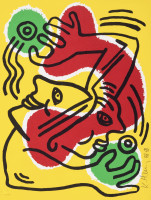
Keith Haring
International Volunteer Day, 1988
Limited Edition Print
Lithograph
USD 14,300

Keith Haring
Flowers II (Pink), 1990
Limited Edition Print
Screen-print
USD 50,000 - 60,000

Keith Haring
Flowers III (Yellow), 1990
Limited Edition Print
Screen-print
USD 45,000 - 55,000
Keith Haring
Private Listing
Drawing / Watercolor
Collage
Request Info

Keith Haring
Flowers IV, 1990
Limited Edition Print
Screen-print
USD 42,500

Keith Haring
Untitled 2 (from Free South Africa), 1985
Limited Edition Print
Lithograph
USD 35,900

Keith Haring
Untitled 1 (from Free South Africa), 1985
Limited Edition Print
Lithograph
Inquire For Price

Keith Haring
Keith Haring Table Lamp, 1988
Sculpture / Object
Mixed Media
USD 2,900

Keith Haring
Untitled (Crowd - Plate 2), 1987
Limited Edition Print
Lithograph
USD 30,500

Keith Haring
Portrait Of Joseph Beuys, 1986
Limited Edition Print
Screen-print
USD 10,850

Keith Haring
Untitled (Cockfight), 1985
Limited Edition Print
Lithograph
USD 42,900

Keith Haring
International Youth Year, 1985
Limited Edition Print
Lithograph
USD 15,800

Keith Haring
Untitled (Free South Africa), 1985
Limited Edition Print
Lithograph
USD 90,000 - 100,000

Keith Haring
Untitled From ''The Valley'', 1989
Limited Edition Print
Etching
USD 7,100

Keith Haring
White Icons (D) - X-Man, 1990
Limited Edition Print
Embossing
USD 15,500

Keith Haring
White Icons (A) - Radiant Baby, 1990
Limited Edition Print
Embossing
USD 20,000 - 25,000

Keith Haring
Untitled - Scissors (from Pop Shop III), 1989
Limited Edition Print
Screen-print
Currently Not Available

Keith Haring
Untitled (Man On Dolphin), 1987
Limited Edition Print
Lithograph
Currently Not Available
Related Artists


Related Articles

Art Movements - June 23, 2023
Graffiti Time Lines on Urban Murals: Uncovering a Street Art Makeover
Explore the evolution of graffiti and street art, from urban murals to mainstream galleries. Discover artists and works reshaping public spaces worldwide. Read More


What is graffiti art?
Graffiti art refers to drawings and writings that are painted, scratched, or scribbled on walls or other surfaces, typically in public spaces. This art form ranges from small tags to elaborate wall paintings. Graffiti has been in existence since ancient times, with examples dating back to the Roman Empire, Ancient Greece, and Ancient Egypt.