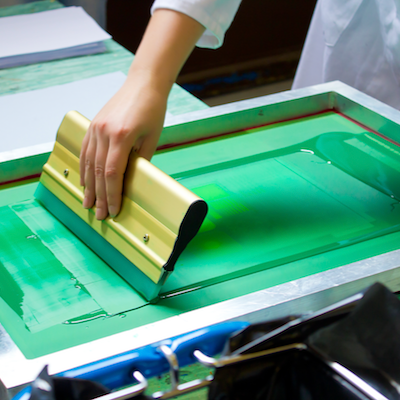
What is a screen-print?
Screen printing is a technique where ink is transferred through a mesh onto a substrate, with areas blocked by a stencil to prevent ink from passing through. This method, also known as serigraphy or silkscreen printing, is commonly used to produce prints on posters, T-shirts, vinyl, stickers, wood, and other materials. The process is a type of stencil printing, allowing for vibrant, detailed designs on various surfaces.
Show All
- Show All
- Established
- Discoveries
A,B,C
ARTWORKS RELATED TO SCREEN-PRINT

Keith Haring
Pop Shop VI , 1989
Limited Edition Print
Screen-print
EUR 17,750

Helen Frankenthaler
Untitled, 1967
Limited Edition Print
Screen-print
Inquire For Price

Andy Warhol
Marilyn Monroe, 1967
Limited Edition Print
Screen-print
Inquire For Price

Andy Warhol
African Elephant, from Endangered Species (F. & S. 293), 1983
Limited Edition Print
Screen-print
Currently Not Available

Robert Motherwell
Untitled 10 from The Basque Suite, 1970-71
Limited Edition Print
Screen-print
USD 2,650

Robert Motherwell
Untitled 9 from The Basque Suite, 1970-71
Limited Edition Print
Screen-print
USD 2,650

Robert Motherwell
Untitled 8 from The Basque Suite, 1970-71
Limited Edition Print
Screen-print
USD 2,650

Robert Motherwell
Untitled 7 from The Basque Suite, 1970-71
Limited Edition Print
Screen-print
USD 2,650

Robert Motherwell
Untitled 6 from The Basque Suite, 1970-71
Limited Edition Print
Screen-print
USD 2,650

Robert Motherwell
Untitled 5 from The Basque Suite, 1970-71
Limited Edition Print
Screen-print
USD 2,650

Robert Motherwell
Untitled 4 from The Basque Suite, 1970-71
Limited Edition Print
Screen-print
USD 2,650

Robert Motherwell
Untitled 3 from The Basque Suite, 1970-71
Limited Edition Print
Screen-print
USD 2,650

Robert Motherwell
Untitled 2 from The Basque Suite, 1970-71
Limited Edition Print
Screen-print
USD 2,650

Robert Motherwell
Untitled 1 from The Basque Suite, 1970-71
Limited Edition Print
Screen-print
Artwork On Hold

Adolph Gottlieb
Black Field, 1972
Limited Edition Print
Screen-print
USD 3,600

Tom Wesselmann
Monica with Tulips, 1989
Limited Edition Print
Screen-print
USD 12,950
Related Articles

Collecting - May 01, 2022
Collecting prints and multiples: a brief introduction on how to start
Learn how to start collecting prints and multiples. Discover tips on editions, artist proofs, and choosing prints that combine value, creativity, and affordability. Read More

Grupo Frente was a movement founded in 1954 in Brazil by teaching artist Ivan Serpa. The movement included many students from the Rio de Janeiro Museum of Modern Art and sought to reject the nationalism and figuration present in the modernist forms of Brazilian painting. Grupo Frente emphasized experimentation and abstraction, aiming to explore new artistic possibilities beyond traditional constraints.

Viennese Actionism was a short-lived but intense art movement in the 20th century, emerging as part of the broader action art efforts of the 1960s. Known for its violent and provocative performances, the movement sought to break traditional art boundaries. Key figures in this movement included Arnulf Rainer and Hermann Nitsch.