Details
Artist
Styles
// Green Floating Passion by Karel Appel, a limited edition silkscreen print, showcases the artist’s flair for abstraction and expressive use of color. Set against a deep green background, the artwork features a combination of fluid, organic shapes in yellow, blue, red, and white. The central form appears like a whimsical face or flower with flowing lines, evoking a sense of movement and vitality. The blue and red elements, reminiscent of leaves or petals, contrast boldly with the dark background, amplifying the composition’s dynamic energy. Appel’s work here merges playful forms with a sense of raw emotion, making it both visually compelling and richly imaginative.
Green floating passion , 1975
form
Medium
Size
76.2 x 104.1 cm
- Inches
- Centimeters
Edition
Price
- USD
- EUR
- GBP
Details
Artist
Styles
// Green Floating Passion by Karel Appel, a limited edition silkscreen print, showcases the artist’s flair for abstraction and expressive use of color. Set against a deep green background, the artwork features a combination of fluid, organic shapes in yellow, blue, red, and white. The central form appears like a whimsical face or flower with flowing lines, evoking a sense of movement and vitality. The blue and red elements, reminiscent of leaves or petals, contrast boldly with the dark background, amplifying the composition’s dynamic energy. Appel’s work here merges playful forms with a sense of raw emotion, making it both visually compelling and richly imaginative.
- Recently Added
- Price (low-high )
- Price (high-low )
- Year (low-high )
- Year (high-low )

Karel Appel
Nesting Bird, 1978
Limited Edition Print
Lithograph
USD 990

Karel Appel
A Group Of 3 Screenprints, 1975 / 1978
Limited Edition Print
Screen-print
USD 2,700

Karel Appel
Two Figures, c. 1980
Limited Edition Print
Lithograph
USD 1,000

Karel Appel
Composition , 1969
Limited Edition Print
Lithograph
USD 950

Karel Appel
Serie Personages, 1969
Limited Edition Print
Lithograph
USD 780

Karel Appel
Cats, 1979
Limited Edition Print
Lithograph
USD 8,250

Karel Appel
Il Pagliacci, 1984
Limited Edition Print
Lithograph
USD 2,150

Karel Appel
Fighting Cat, 1979
Limited Edition Print
Lithograph
USD 750

Karel Appel
Cat In The Night, 1979
Limited Edition Print
Lithograph
USD 750

Karel Appel
Luminous Cat, 1979
Limited Edition Print
Lithograph
USD 750

Karel Appel
Resting Cat, 1979
Limited Edition Print
Lithograph
USD 750

Karel Appel
Devil Cat, 1979
Limited Edition Print
Lithograph
USD 750

Karel Appel
Sad Cat, 1979
Limited Edition Print
Lithograph
USD 750

Karel Appel
Stalking Cat, 1979
Limited Edition Print
Lithograph
USD 750

Karel Appel
Blue Cat, 1979
Limited Edition Print
Lithograph
USD 750

Karel Appel
Smiling Cat, 1979
Limited Edition Print
Lithograph
USD 750

Karel Appel
Green Cat, 1979
Limited Edition Print
Lithograph
USD 750

Karel Appel
House Cat, 1979
Limited Edition Print
Lithograph
USD 750

Karel Appel
Sunshine Cat, 1979
Limited Edition Print
Lithograph
USD 750

Karel Appel
Sound, 1979
Limited Edition Print
Mixed Media
USD 1,400

Karel Appel
Face, 1979
Limited Edition Print
Mixed Media
USD 1,400

Karel Appel
Lying In Red, 1979
Limited Edition Print
Mixed Media
USD 1,400

Karel Appel
Deux Personnages, 1978
Limited Edition Print
Mixed Media
USD 1,570

Karel Appel
The Bear
Limited Edition Print
Lithograph
USD 775

Karel Appel
About A Cat, 1979
Limited Edition Print
Lithograph
USD 750

Karel Appel
Frightened Cat, 1979
Limited Edition Print
Lithograph
USD 750

Karel Appel
Walking Cat, 1979
Limited Edition Print
Lithograph
USD 750

Karel Appel
Innocent Cat, 1979
Limited Edition Print
Lithograph
USD 750

Karel Appel
Pink Cat, 1979
Limited Edition Print
Lithograph
USD 750

Karel Appel
Once I Was The Sun, 1978
Limited Edition Print
Lithograph
USD 1,100

Karel Appel
Obra Gráfica, 1974
Limited Edition Print
Serigraph
EUR 1,550

Karel Appel
Kool Luke Singing Hands, 1978
Limited Edition Print
Silkscreen
USD 1,700

Karel Appel
Red Cat Singing Hands, 1978
Limited Edition Print
Silkscreen
USD 1,700

Karel Appel
Floating Flower Passion, 1978
Limited Edition Print
Silkscreen
USD 1,700

Karel Appel
Green Floating Passion , 1975
Limited Edition Print
Silkscreen
USD 1,700

Karel Appel
Flying Head Over Ocean, 1972
Limited Edition Print
Lithograph
USD 800

Karel Appel
Sunshine People, 1974
Limited Edition Print
Silkscreen
USD 1,700

Karel Appel
Putting Green Kiss , 1978
Limited Edition Print
Silkscreen
USD 1,750

Karel Appel
Como El Viento, 1988
Limited Edition Print
Etching And Aquatint
EUR 1,700

Karel Appel
Los Pájaros, 1988
Limited Edition Print
Aquatint
EUR 1,700

Karel Appel
Tete Montagne I, 1976
Limited Edition Print
Aquatint
EUR 2,350

Karel Appel
Flower With Blue Eyes, 1977
Sculpture / Object
Wood
Currently Not Available
Related Artists


Related Articles

Popular, Art Movements - November 20, 2024
Understanding Abstract Expressionism: Emotion and Gesture
Explore the emotional depth of Abstract Expressionism! Discover how artists like Pollock and Rothko used gesture and color to convey human complexity. Read More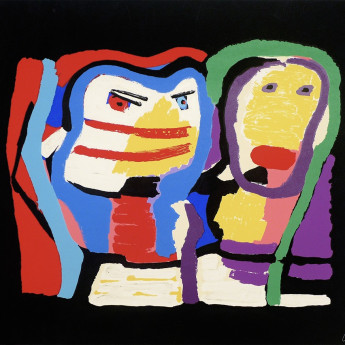


What is abstract art?
Abstract art uses form, shape, line, and color to create a visual experience without attempting to represent external reality. The composition exists independently of the world's visual references, focusing on expressing ideas and emotions through non-representational means.