Details
Artist
Styles
Published by Hermit Press, Düsseldorf. Special edition to accompany the book "Sarajevo 96" from 2001. Sarajewo 6 (2005) by Günther Uecker is a powerful and stark screenprint that forms part of a special edition series published alongside the book Sarajevo 96. Known for his evocative visual language and meditations on pain, trauma, and remembrance, Uecker uses a restrained palette and minimalist approach to render an emotionally loaded composition. At the center of a largely empty white surface, black brushstrokes converge into a chaotic cluster of marks, suggesting fragmentation, violence, or collapse. The expressive, almost violent energy of the strokes alludes to the devastation of the Bosnian War and the city of Sarajevo's tragic history. Yet within the abstraction lies a sense of motion and resilience. The image is not illustrative, but it resonates with emotional intensity. Produced in an edition of 60 by Hermit Press in Düsseldorf, each print is hand-signed and numbered by the artist, marking it as both a work of art and a quiet act of witness.
Sarajewo 6, 2005
form
Medium
Size
48 x 43 cm
- Inches
- Centimeters
Edition
Price
- USD
- EUR
- GBP
Details
Artist
Styles
Published by Hermit Press, Düsseldorf. Special edition to accompany the book "Sarajevo 96" from 2001. Sarajewo 6 (2005) by Günther Uecker is a powerful and stark screenprint that forms part of a special edition series published alongside the book Sarajevo 96. Known for his evocative visual language and meditations on pain, trauma, and remembrance, Uecker uses a restrained palette and minimalist approach to render an emotionally loaded composition. At the center of a largely empty white surface, black brushstrokes converge into a chaotic cluster of marks, suggesting fragmentation, violence, or collapse. The expressive, almost violent energy of the strokes alludes to the devastation of the Bosnian War and the city of Sarajevo's tragic history. Yet within the abstraction lies a sense of motion and resilience. The image is not illustrative, but it resonates with emotional intensity. Produced in an edition of 60 by Hermit Press in Düsseldorf, each print is hand-signed and numbered by the artist, marking it as both a work of art and a quiet act of witness.
- Recently Added
- Price (low-high )
- Price (high-low )
- Year (low-high )
- Year (high-low )

Gunther Uecker
Baum. Kunstpranger, 1984
Sculpture / Object
Mixed Media
EUR 12,950

Gunther Uecker
Helles Nagelkreuz, 2017
Sculpture / Object
Bronze
EUR 49,500

Gunther Uecker
Jahresteller, 1975
Sculpture / Object
Glass
EUR 1,620
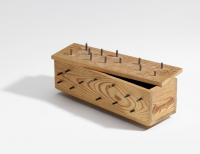
Gunther Uecker
Souvenir For Verheyen, 1989
Sculpture / Object
Mixed Media
GBP 15,000 - 20,000

Gunther Uecker
Graphein I, Gedächtnis Des Tons, 2002
Limited Edition Print
Embossing
EUR 12,000

Gunther Uecker
Graphein II, Shang Dynastie, 2002
Limited Edition Print
Embossing
EUR 12,000

Gunther Uecker
Graphein VII, Reise Kadmos, 2002
Limited Edition Print
Embossing
EUR 12,000

Gunther Uecker
Graphein XI, Ufer Des Toten Meeres, 2002
Limited Edition Print
Embossing
EUR 12,000

Gunther Uecker
Graphein XII, Kreise, Dreiecke, 2002
Limited Edition Print
Embossing
EUR 12,000

Gunther Uecker
Graphein VIII, Christen Ägypten, 2002
Limited Edition Print
Embossing
EUR 12,000

Gunther Uecker
Sarajewo 15, 2005
Limited Edition Print
Screen-print
EUR 1,280

Gunther Uecker
Sarajewo 6, 2005
Limited Edition Print
Screen-print
EUR 1,280

Gunther Uecker
Ouroboros 05, 2018
Limited Edition Print
Mixed Media
Inquire For Price

Gunther Uecker
Verletzungen-Verbindungen, 1998
Limited Edition Print
Screen-print
EUR 1,890

Gunther Uecker
Hiob Seite 24
Limited Edition Print
Silkscreen
EUR 1,800

Gunther Uecker
Hiob Seite 16
Limited Edition Print
Silkscreen
EUR 1,800

Gunther Uecker
Hiob Seite 25
Limited Edition Print
Silkscreen
EUR 1,800

Gunther Uecker
Ouroboros #12, 2018
Limited Edition Print
Sand
EUR 8,000

Gunther Uecker
Ouroboros #9, 2018
Limited Edition Print
Sand
EUR 8,000

Gunther Uecker
Ouroboros #7, 2018
Limited Edition Print
Sand
EUR 8,000

Gunther Uecker
Ouroboros #5, 2018
Limited Edition Print
Sand
EUR 8,000

Gunther Uecker
Ouroboros #3, 2018
Limited Edition Print
Sand
EUR 8,000

Gunther Uecker
Ouroboros (natural Sand), 2018
Limited Edition Print
Screen-print
EUR 22,000

Gunther Uecker
Ouroboros #11, 2018
Limited Edition Print
Sand
EUR 8,000

Gunther Uecker
Ouroboros #10, 2018
Limited Edition Print
Sand
EUR 8,000

Gunther Uecker
Medea VII, 1996
Limited Edition Print
Etching
Currently Not Available

Gunther Uecker
Hiob Seite 04
Limited Edition Print
Silkscreen
Currently Not Available

Gunther Uecker
Hiob Seite 36
Limited Edition Print
Silkscreen
Currently Not Available
Related Artists


Related Articles
Popular, Collecting - July 23, 2025
Sculpture Care and Display: From Plinths to Pedestals in Your Home
Learn how to display and care for sculpture at home—from lighting tips to material care—so your art can truly shine in any space. Read More


What is land art?
Also referred to as Earth Art, Earthworks, or Environmental Art, Land Art is a sculptural movement that involves creating artworks that integrate conceptual or physical elements of the earth or landscape into the finished piece. These works often interact directly with the environment, using natural materials and settings to explore themes related to nature, place, and time