Details
Artist
Styles
Screen print on chamois-colored paper, hand-signed // Verletzungen-Verbindungen by Günther Uecker, a 1998 screen print, showcases a dynamic network of intersecting, sharp lines in deep, earthy tones on chamois-colored paper. The chaotic crisscrossing strokes convey tension and movement, evoking themes of damage and connectivity—suggested by the title, which translates to Injuries-Connections. Uecker’s expressive style captures a sense of raw energy and rupture, yet the repetition and layering of lines hint at interwoven relationships and resilience. The piece, hand-signed by the artist, reflects his exploration of texture and abstraction, characteristic of his broader oeuvre.
Verletzungen-Verbindungen, 1998
form
Medium
Size
62 x 48 cm
- Inches
- Centimeters
Edition
Price
- USD
- EUR
- GBP
Details
Artist
Styles
Screen print on chamois-colored paper, hand-signed // Verletzungen-Verbindungen by Günther Uecker, a 1998 screen print, showcases a dynamic network of intersecting, sharp lines in deep, earthy tones on chamois-colored paper. The chaotic crisscrossing strokes convey tension and movement, evoking themes of damage and connectivity—suggested by the title, which translates to Injuries-Connections. Uecker’s expressive style captures a sense of raw energy and rupture, yet the repetition and layering of lines hint at interwoven relationships and resilience. The piece, hand-signed by the artist, reflects his exploration of texture and abstraction, characteristic of his broader oeuvre.
- Recently Added
- Price (low-high )
- Price (high-low )
- Year (low-high )
- Year (high-low )

Gunther Uecker
Baum. Kunstpranger, 1984
Sculpture / Object
Mixed Media
EUR 12,950

Gunther Uecker
Helles Nagelkreuz, 2017
Sculpture / Object
Bronze
EUR 49,500

Gunther Uecker
Jahresteller, 1975
Sculpture / Object
Glass
EUR 1,620
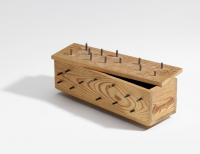
Gunther Uecker
Souvenir For Verheyen, 1989
Sculpture / Object
Mixed Media
GBP 15,000 - 20,000

Gunther Uecker
Graphein I, Gedächtnis Des Tons, 2002
Limited Edition Print
Embossing
EUR 12,000

Gunther Uecker
Graphein II, Shang Dynastie, 2002
Limited Edition Print
Embossing
EUR 12,000

Gunther Uecker
Graphein VII, Reise Kadmos, 2002
Limited Edition Print
Embossing
EUR 12,000

Gunther Uecker
Graphein XI, Ufer Des Toten Meeres, 2002
Limited Edition Print
Embossing
EUR 12,000

Gunther Uecker
Graphein XII, Kreise, Dreiecke, 2002
Limited Edition Print
Embossing
EUR 12,000

Gunther Uecker
Graphein VIII, Christen Ägypten, 2002
Limited Edition Print
Embossing
EUR 12,000

Gunther Uecker
Sarajewo 15, 2005
Limited Edition Print
Screen-print
EUR 1,280

Gunther Uecker
Sarajewo 6, 2005
Limited Edition Print
Screen-print
EUR 1,280

Gunther Uecker
Ouroboros 05, 2018
Limited Edition Print
Mixed Media
Inquire For Price

Gunther Uecker
Verletzungen-Verbindungen, 1998
Limited Edition Print
Screen-print
EUR 1,890

Gunther Uecker
Hiob Seite 24
Limited Edition Print
Silkscreen
EUR 1,800

Gunther Uecker
Hiob Seite 16
Limited Edition Print
Silkscreen
EUR 1,800

Gunther Uecker
Hiob Seite 25
Limited Edition Print
Silkscreen
EUR 1,800

Gunther Uecker
Ouroboros #12, 2018
Limited Edition Print
Sand
EUR 8,000

Gunther Uecker
Ouroboros #9, 2018
Limited Edition Print
Sand
EUR 8,000

Gunther Uecker
Ouroboros #7, 2018
Limited Edition Print
Sand
EUR 8,000

Gunther Uecker
Ouroboros #5, 2018
Limited Edition Print
Sand
EUR 8,000

Gunther Uecker
Ouroboros #3, 2018
Limited Edition Print
Sand
EUR 8,000

Gunther Uecker
Ouroboros (natural Sand), 2018
Limited Edition Print
Screen-print
EUR 22,000

Gunther Uecker
Ouroboros #11, 2018
Limited Edition Print
Sand
EUR 8,000

Gunther Uecker
Ouroboros #10, 2018
Limited Edition Print
Sand
EUR 8,000

Gunther Uecker
Medea VII, 1996
Limited Edition Print
Etching
Currently Not Available

Gunther Uecker
Hiob Seite 04
Limited Edition Print
Silkscreen
Currently Not Available

Gunther Uecker
Hiob Seite 36
Limited Edition Print
Silkscreen
Currently Not Available
Related Artists


Related Articles

Popular, Collecting - February 21, 2025
Sculpture 101: From Clay to Bronze – How Sculptures Are Made
Discover the art of sculpture! Explore traditional techniques like carving and bronze casting, plus modern innovations like 3D printing. A journey in creativity! Read More

What is land art?
Also referred to as Earth Art, Earthworks, or Environmental Art, Land Art is a sculptural movement that involves creating artworks that integrate conceptual or physical elements of the earth or landscape into the finished piece. These works often interact directly with the environment, using natural materials and settings to explore themes related to nature, place, and time