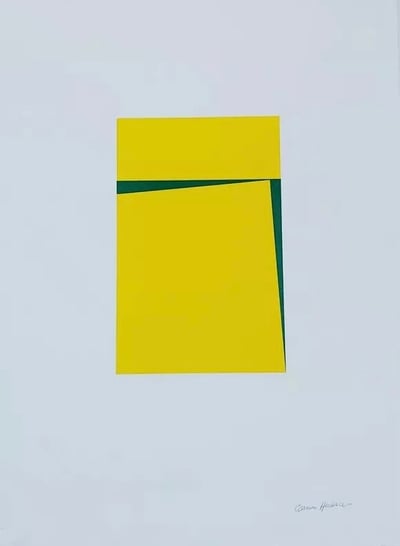
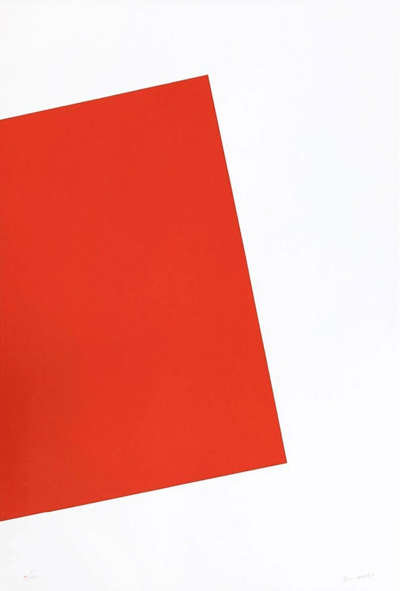
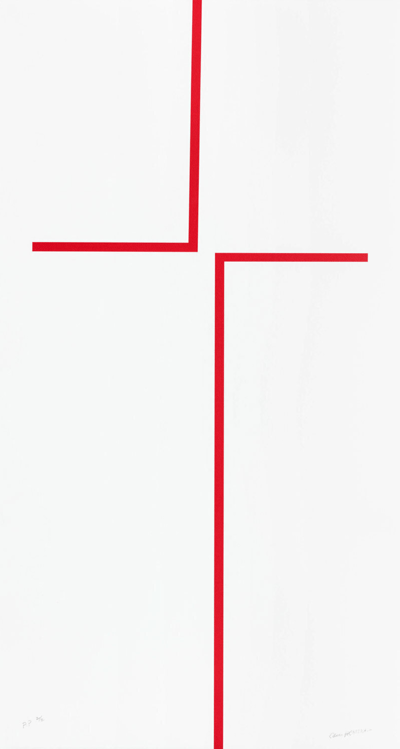
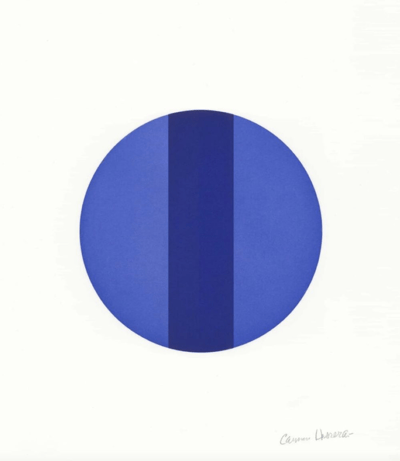
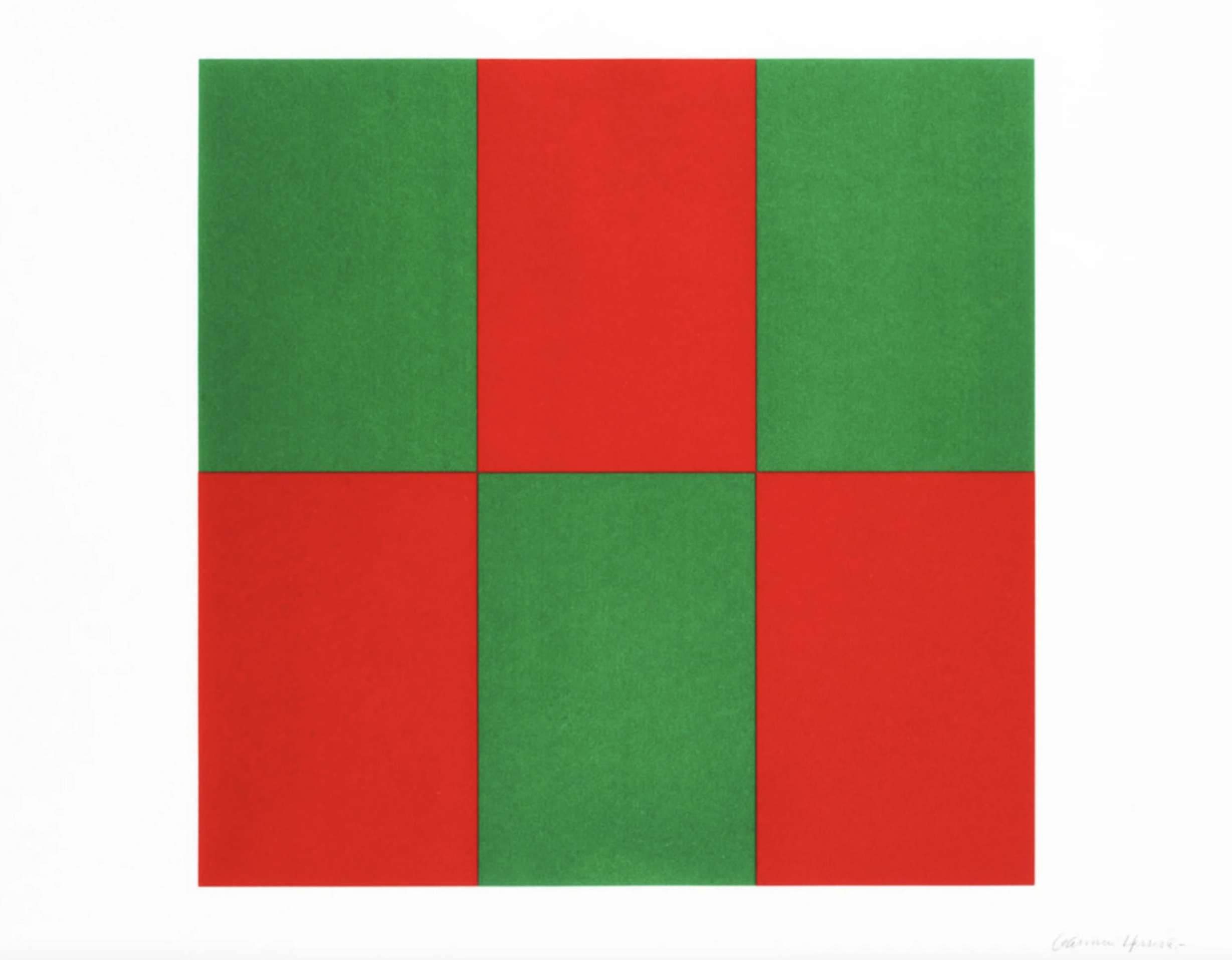
Screen print in colours on wove paper
- Signed and numbered on front;
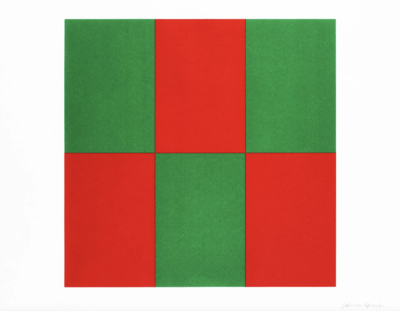
Carmen Herrera's Verde y Rojo (2019) is a limited edition screenprint that highlights her signature minimalist and geometric approach to art. The print is composed of an arrangement of alternating green and red squares, creating a balanced and harmonious pattern that exemplifies her focus on symmetry, color contrast, and simplicity. The bold use of red and green invites the viewer to engage with the piece’s visual rhythm, while the precise alignment of shapes showcases Herrera’s meticulous attention to composition and form. Printed on wove paper, the work is signed and numbered on the front, confirming its status as part of an exclusive series of 28. Verde y Rojo reflects Herrera’s consistent exploration of color and geometric abstraction, emphasizing clarity and balance within the visual field.
Carmen Herrera (Cuba/United States, 1915–2022) was a Cuban-American abstract painter and sculptor. Her minimalist, geometric works, characterized by bold colors and precise lines, gained significant recognition later in her life. Herrera's art challenged traditional boundaries, contributing notably to the development of geometric abstraction and minimalism.
Screen-printScreen printing is a technique where ink is transferred through a mesh onto a substrate, with areas blocked by a stencil to prevent ink from passing through. This method, also known as serigraphy or silkscreen printing, is commonly used to produce prints on posters, T-shirts, vinyl, stickers, wood, and other materials. The process is a type of stencil printing, allowing for vibrant, detailed designs on various surfaces.
Screen print in colours on wove paper
- Signed and numbered on front;
Carmen Herrera's Verde y Rojo (2019) is a limited edition screenprint that highlights her signature minimalist and geometric approach to art. The print is composed of an arrangement of alternating green and red squares, creating a balanced and harmonious pattern that exemplifies her focus on symmetry, color contrast, and simplicity. The bold use of red and green invites the viewer to engage with the piece’s visual rhythm, while the precise alignment of shapes showcases Herrera’s meticulous attention to composition and form. Printed on wove paper, the work is signed and numbered on the front, confirming its status as part of an exclusive series of 28. Verde y Rojo reflects Herrera’s consistent exploration of color and geometric abstraction, emphasizing clarity and balance within the visual field.
Carmen Herrera (Cuba/United States, 1915–2022) was a Cuban-American abstract painter and sculptor. Her minimalist, geometric works, characterized by bold colors and precise lines, gained significant recognition later in her life. Herrera's art challenged traditional boundaries, contributing notably to the development of geometric abstraction and minimalism.
Beauty comes from within, but it's up to us to use fashion and beauty to express who we are on the inside.
- Carmen Herrera
Carmen Herrera was born in 1915, in Cuba. After demonstrating a natural talent for art, Herrera began formal lessons at the age of 8. When she was 14 years old, her parents enrolled her in Marymount School in Paris where Carmen continued to study art. In 1937, Herrera moved to the United States with her husband and continued her education at the Art Students League in New York while also taking classes at the Brooklyn Museum of Art. Originally trained as an architect, Carmen Herrera creates artwork that features strong lines and symmetry. Her precision to detail, measurement, and scale leads to striking minimalist productions featuring very few colors with geometric form. Even after all her training, and the many works of art she has produced, Carmen Herrera was not discovered as an artist until she was 89 years old. At that time, she sold her first piece. At the age of 101, she finally had a show to display her work, in New York City's Whitney Museum.
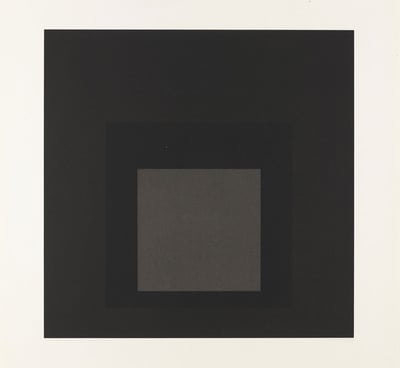
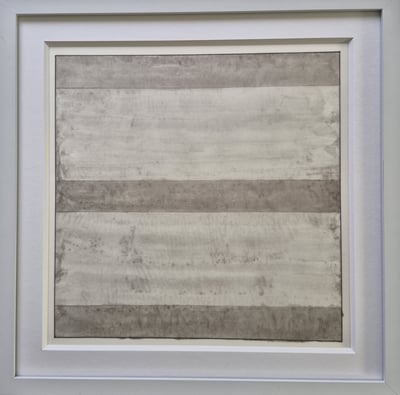
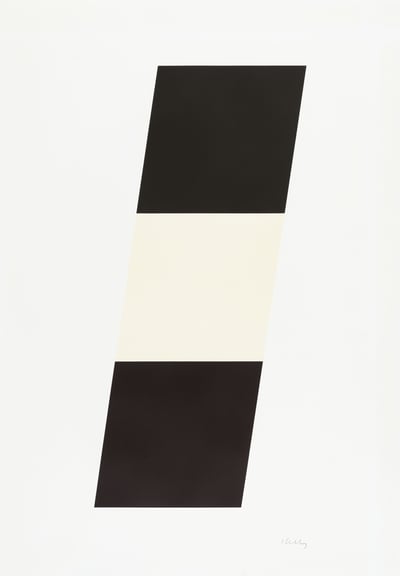
Minimalism is a style in music and visual arts characterized by pared-down designs and simplicity. It began in Western art after World War II, gaining prominence particularly in American visual arts. Minimalism draws heavily on aspects of modernism and is often viewed as a reaction against Abstract Expressionism, as well as a precursor to post-minimal art practices. Prominent minimalist artists include Agnes Martin, Donald Judd, Robert Morris, Frank Stella, and Dan Flavin.