Banksy’s Girl with Balloon, 2004: Signed vs Unsigned Prints
By Emilia Novak
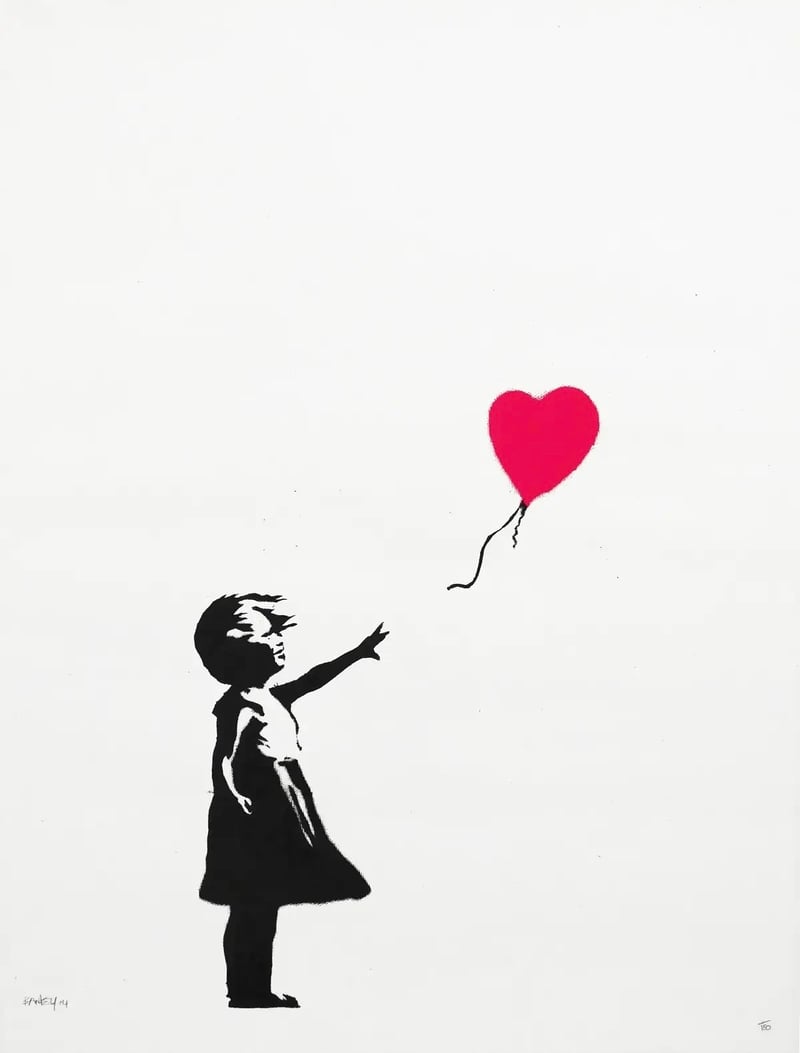
Banksy’s Girl with Balloon moved from a London stencil motif into an editioned screenprint in 2004. The standard print measures 70 × 50 cm (27.6 × 19.7 in.), was printed and published by Pictures on Walls in London, and exists in two main red-balloon editions: 150 signed impressions and 600 unsigned impressions. For collectors, understanding that structure is the starting point for assessing authentication, condition and market history.
In this article
How the signed and unsigned 2004 editions differ.
What the Pictures on Walls blindstamp and Pest Control documentation mean for collectors.
How the rare color proofs, auction history and later shredding event relate to the standard print.
From a London stencil to the 2004 screenprint
The Girl with Balloon motif first appeared as a London stencil in 2002, before Banksy adapted it for print. Early street versions established the basic composition of a child reaching toward a heart-shaped balloon, and some included the phrase “There is Always Hope.”
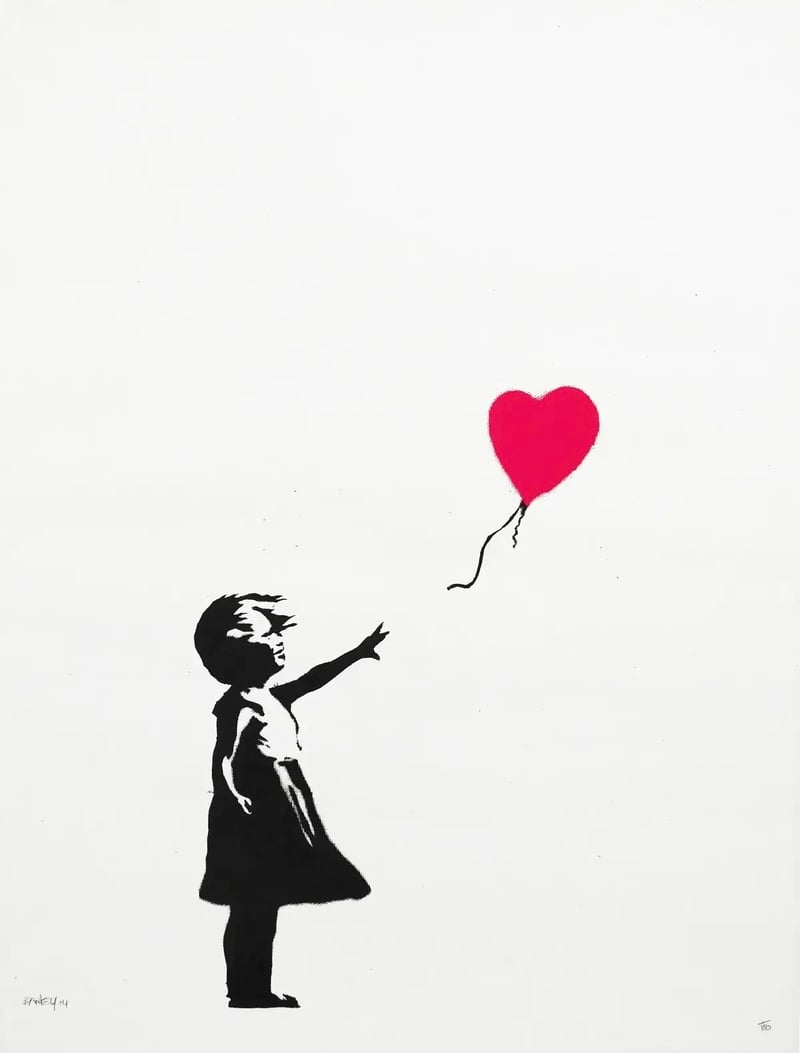
That phrase is not part of the standard 2004 screenprint. On paper, the composition is reduced to its most familiar elements: the girl in black, the red balloon and a wide area of open space between them.
Moving the image from a wall to an editioned sheet also changed the way it could circulate. A street work remained tied to a location and exposed to alteration or removal, while the screenprint became a numbered object that could be documented, authenticated and collected.
The girl, the balloon and the space between them
Much of the image’s effect comes from what Banksy leaves empty. The girl and balloon occupy relatively little of the sheet, and the unprinted space between them makes the gesture difficult to resolve.
She may be trying to catch the balloon or watching it drift away. That uncertainty allows the image to support readings around hope, loss, childhood, attachment and freedom without fixing it to one narrative.
Color plays a similarly economical role. The red balloon is the dominant accent in both standard editions, while the girl and most of the composition remain black. Other balloon colors belong to a separate group of artist’s proofs rather than to ordinary variations within the signed or unsigned editions.
Production, numbering and the Pictures on Walls blindstamp
The 2004 Girl with Balloon was printed and published by Pictures on Walls, London, which handled many of Banksy’s early print editions. The screenprinting process suited his stencil-based imagery particularly well, preserving the hard edges, silhouettes and flat areas of color associated with his street work.
The edition bears the Pictures on Walls blindstamp, an embossed publisher’s mark documented on signed and unsigned impressions. It is an important feature of the edition’s production history, although it should be considered together with the paper, numbering, signature where applicable, provenance and Pest Control documentation.
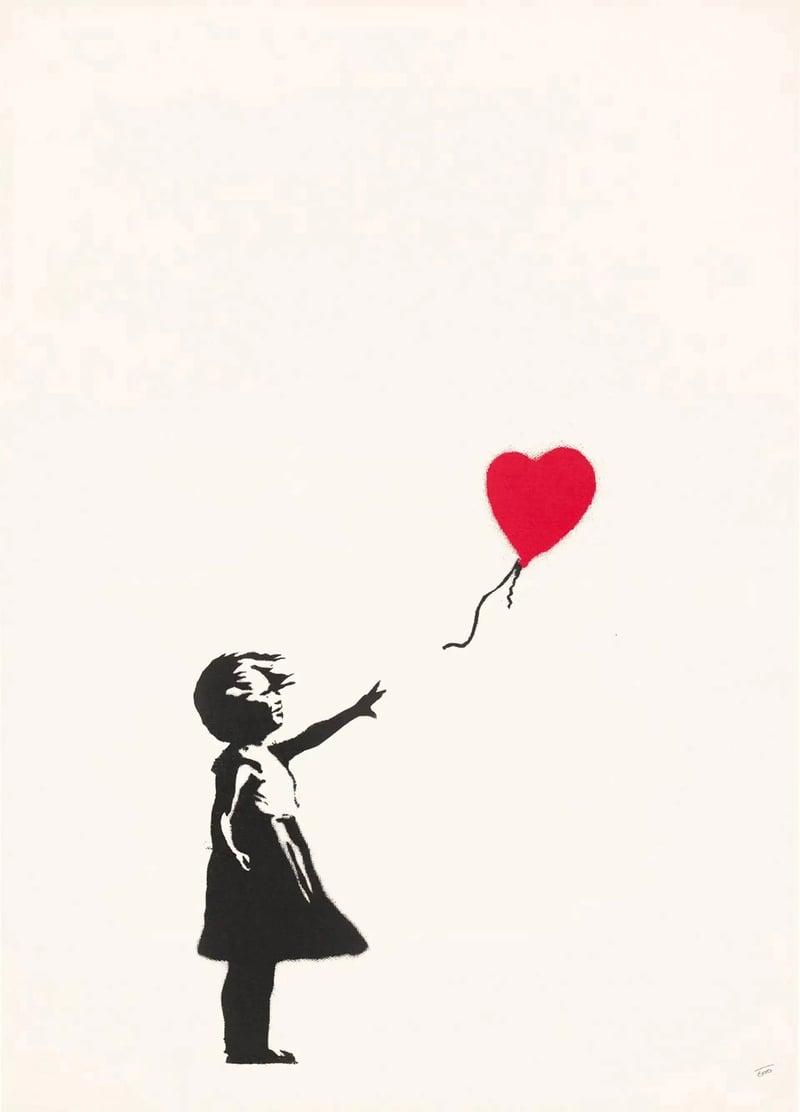
The signed edition is signed, dated and numbered in pencil. The unsigned edition is numbered in pencil but carries no artist signature, which is entirely correct for that edition. An unsigned impression is therefore not an unofficial reproduction; it is part of a distinct authorized edition issued alongside the signed prints.
Signed vs unsigned Girl with Balloon
The signed edition contains 150 impressions, while the unsigned edition contains 600. That difference in edition size is the clearest structural distinction between the two standard red-balloon versions.
For collectors, however, the presence of a signature should not become the only criterion when comparing works. The paper, publisher blindstamp, Pest Control certificate, provenance and condition of the individual impression remain important in both editions.
This is also why signed and unsigned auction results should be kept separate. A sale result for a signed print from the edition of 150 is not a direct comparison for an unsigned impression from the edition of 600, even when the image itself appears virtually identical.
Rare color artist’s proofs
In addition to the standard red editions, Banksy produced 88 signed artist’s proofs, or APs, in alternative color combinations.
Documented examples include gold, purple and dark pink balloons. These proofs form a small related group within the 2004 print history, but they sit outside the standard signed and unsigned editions and should be considered separately when discussing rarity or auction performance.
Their existence also helps explain why identifying the exact version matters: a familiar composition can belong to a very different edition structure depending on the color, numbering and proof designation.1
Pest Control authentication
Pest Control Office states that it is the only body that issues Certificates of Authenticity for Banksy works. For collectors buying on the secondary market, that makes the Pest Control COA a central part of due diligence.
Pest Control also offers a “Check Before You Buy” service for works that already have one of its certificates. Its guidance encourages buyers to confirm edition size and distinctive characteristics rather than relying on appearance alone.
For Girl with Balloon, the certificate should correspond to the specific print being offered and be considered alongside the numbering, Pictures on Walls blindstamp, provenance and, for signed impressions, the pencil signature.
Both the signed and unsigned Girl with Balloon examples offered by Composition Gallery are accompanied by Pest Control Certificates of Authenticity.
Condition considerations
Because Girl with Balloon is a work on paper, condition assessment should focus first on the sheet itself. Collectors should inspect the margins for trimming, tears, creasing, staining, foxing or discoloration, as well as signs of previous mounting such as hinges or tape residue.
The printed surface should also be checked for abrasion, scratching, fading or restoration. The red balloon is particularly exposed visually because it sits against a largely open field of paper, while pencil numbering and the signature on signed impressions should also be examined for condition.
Framing can conceal both margins and the reverse of the sheet, so a complete assessment may require viewing the print outside its frame. Condition belongs to the individual impression rather than the edition as a whole, and two authenticated examples can have very different physical histories.
Historic auction results
The market history of Girl with Balloon shows a clear distinction between signed and unsigned examples.
At Christie’s Online on 1 April 2021, a signed 2004 Girl with Balloon from the edition of 150 sold for £475,000. Christie’s reports sale results as including the hammer price plus buyer’s premium.
Unsigned impressions also reached substantial levels during the strong Banksy print market of 2020–21. Bonhams London sold an unsigned example from the edition of 600 for £300,250 including premium on 15 December 2020, while another unsigned impression sold at Phillips London for £189,000 on the same date.
These are historic auction results rather than current valuations. Condition, provenance, authentication, sale venue and broader market conditions can all produce significant differences between individual impressions.
The Girl with Balloon that shredded at Sotheby’s
The best-known auction episode involving the image concerned a different artwork, not one of the 2004 screenprints.
On 5 October 2018, Sotheby’s London sold a unique 2006 Girl with Balloon, executed in spray paint and acrylic on canvas mounted on board, for £1,042,000. Moments after the sale, part of the work passed through a shredder concealed inside its frame.
The transformed work was later titled Love is in the Bin and returned to Sotheby’s London on 14 October 2021, when it sold for £18,582,000. The event became an important part of the public history of the image, but the object itself remains completely separate from the 2004 signed and unsigned print editions.
Collecting Girl with Balloon at Composition Gallery
Composition Gallery offers both the signed and unsigned 2004 Girl with Balloon, representing the two standard red-balloon editions. Both works are accompanied by Pest Control Certificates of Authenticity.
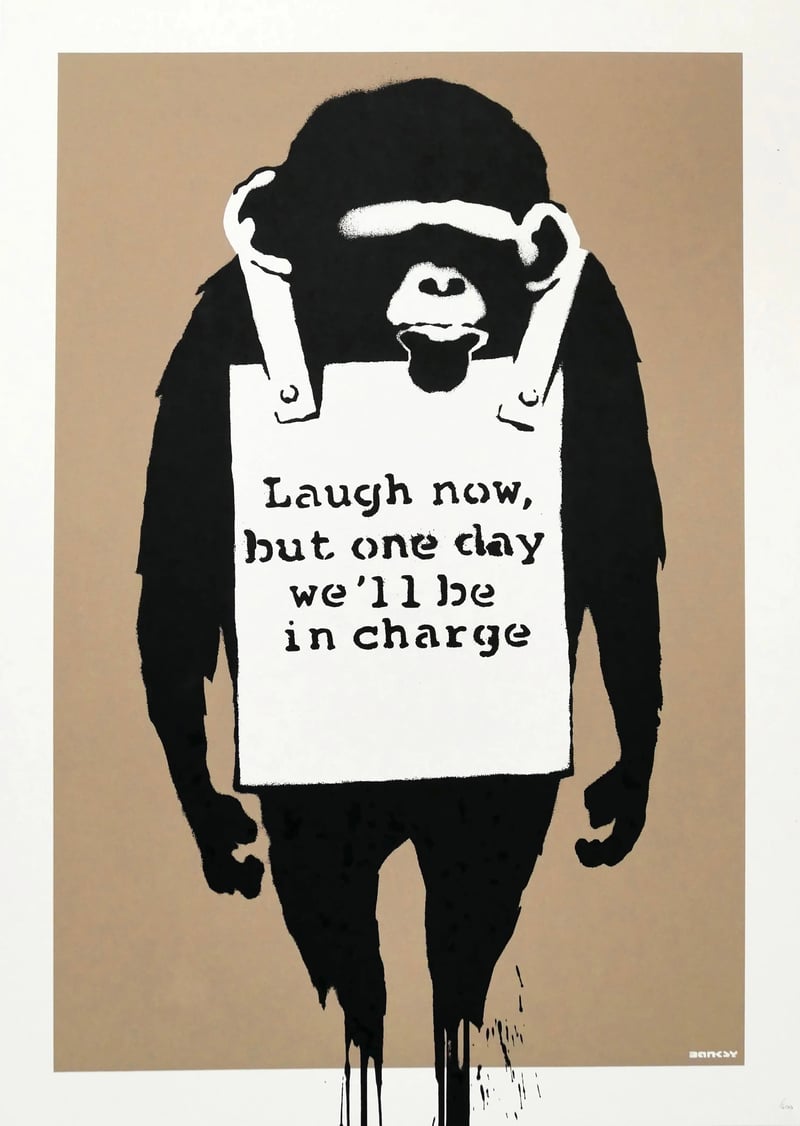
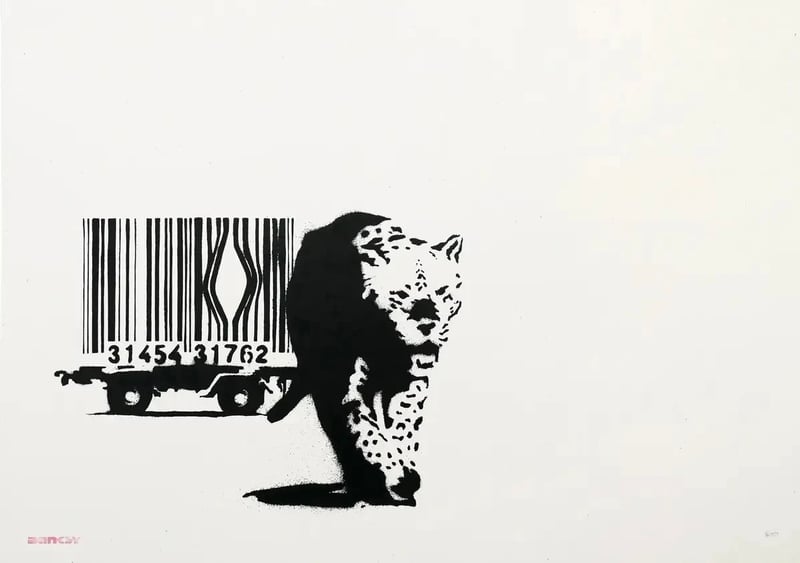
Collectors comparing the two should look beyond the signature alone and consider condition, provenance, edition structure and documentation together. Related works such as Barcode and Laugh Now (unsigned) can also help place Girl with Balloon within Banksy’s early screenprint production.
Collector FAQ
How many signed Girl with Balloon prints are there?
There are 150 signed impressions in the standard 2004 red-balloon edition. They are signed, dated and numbered in pencil.
How many unsigned Girl with Balloon prints are there?
There are 600 unsigned impressions. They are numbered in pencil and form a separate authorized edition rather than a later reproduction.
What size is the print?
The standard sheet size is 70 × 50 cm (27.6 × 19.7 in.).
Does the edition have a Pictures on Walls blindstamp?
Yes. The 2004 edition carries the Pictures on Walls blindstamp, an embossed publisher’s mark documented on signed and unsigned impressions.
Does a Banksy Girl with Balloon need a Pest Control certificate?
Pest Control is the only body that issues Banksy Certificates of Authenticity, so a Pest Control COA is a central part of secondary-market due diligence.
Are there versions with balloons in other colors?
Yes. Banksy produced 88 signed artist’s proofs in alternative colorways, with documented examples including gold, purple and dark pink.
Was the artwork shredded at Sotheby’s one of these prints?
No. The work partially shredded in 2018 was a unique 2006 canvas-based artwork, later titled Love is in the Bin, and was not part of either 2004 screenprint edition.
Related Articles
Collecting, Popular - May 01, 2022
A Guide to Print Editions Acronyms
Understand print edition acronyms like A/P, B.A.T., and H.C. Learn their meanings and how they affect the value and authenticity of collectible art prints.Read More
Related Artworks You Might Like
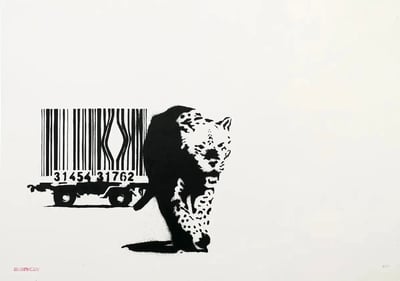
Banksy
Barcode, 2004
Limited Edition Print
Screen-print
GBP 70,000 - 90,000
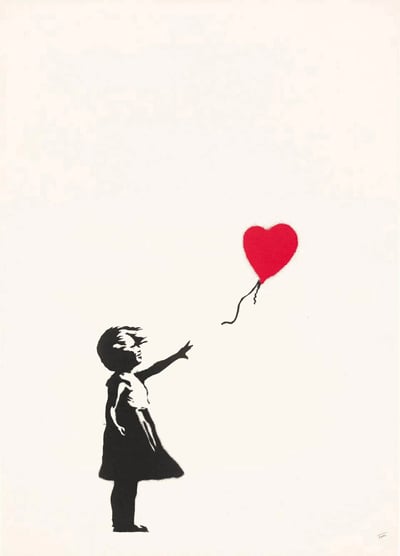
Banksy
Girl With A Balloon (unsigned), 2004
Limited Edition Print
Screen-print
GBP 90,000 - 110,000
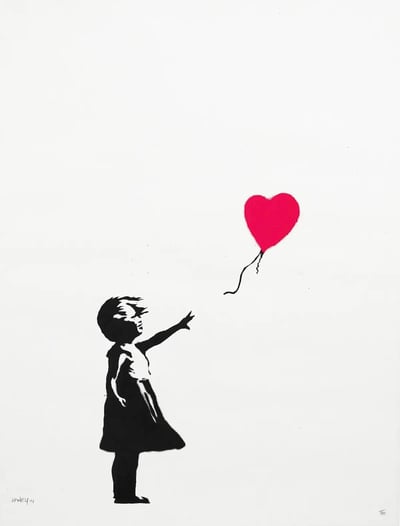
Banksy
Girl With A Balloon, 2004
Limited Edition Print
Screen-print
GBP 240,000 - 270,000
