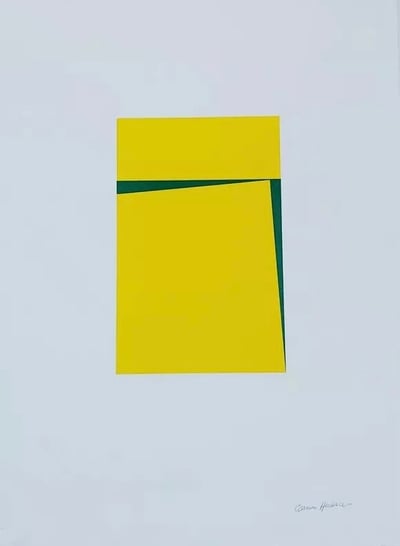
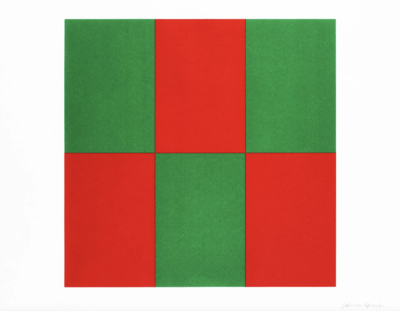
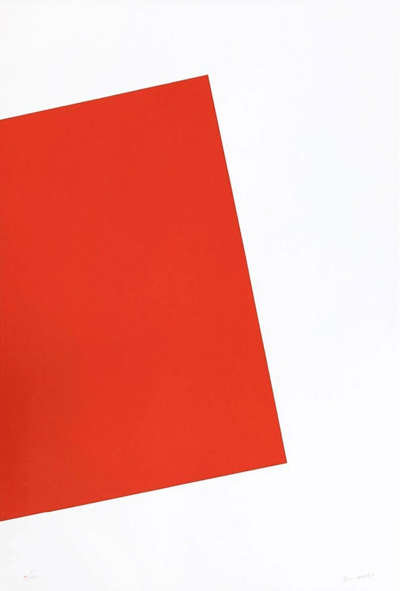
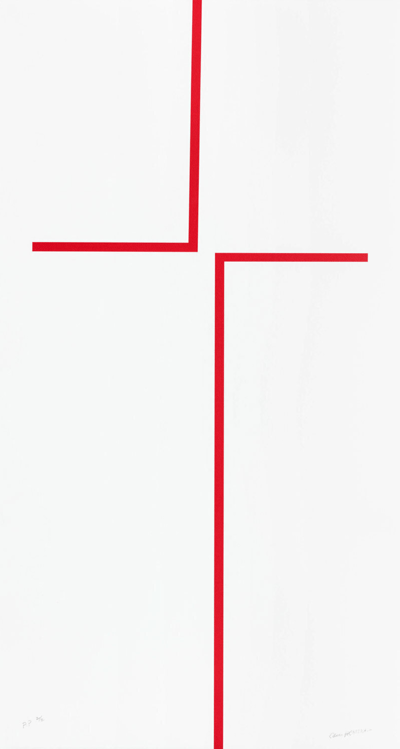
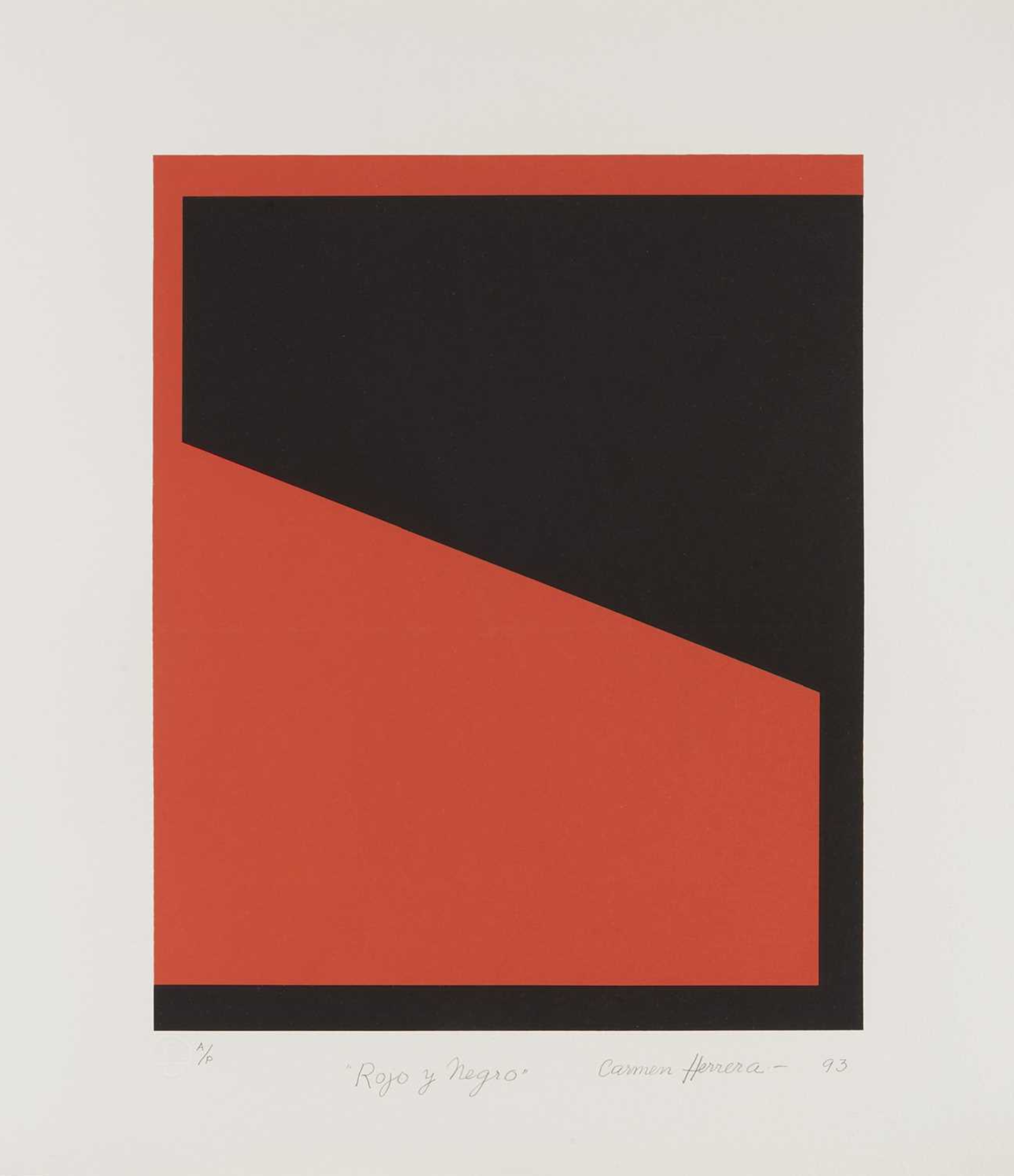
Screenprint in red and black, on wove paper, with full margins.
- Signed and numbered on front;
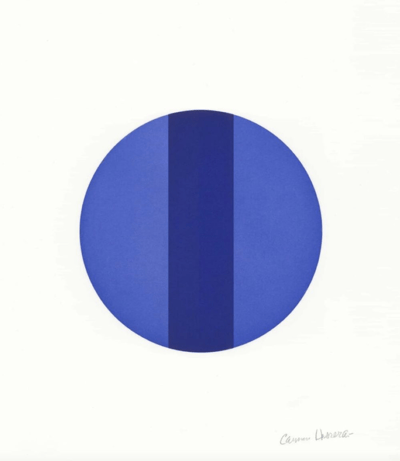
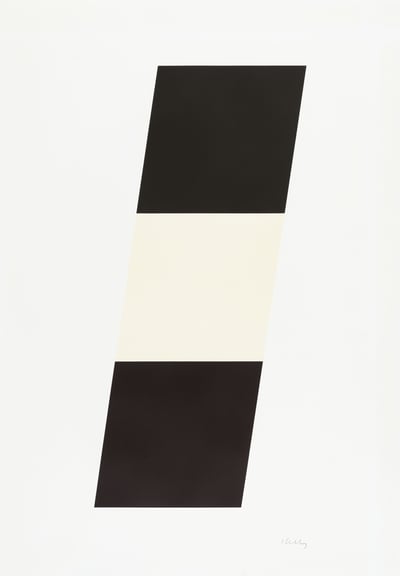
Carmen Herrera's Rojo y Negro (Red and Black) (1993) is a striking screenprint that embodies her minimalist and geometric abstraction style. The composition features bold, angular blocks of red and black, creating a dynamic interplay of shape and color. The red segment diagonally cuts through the black background, forming a sharp contrast that emphasizes balance and precision. Printed on wove paper with full margins, the simplicity of the design captures Herrera’s exploration of form and her mastery in creating tension and harmony through minimal elements. The piece is signed and numbered by the artist, highlighting its status as part of a limited edition series. Rojo y Negro exemplifies Herrera’s commitment to the purity of abstraction and her ability to convey depth and movement within a restrained visual vocabulary.
Carmen Herrera (Cuba/United States, 1915–2022) was a Cuban-American abstract painter and sculptor. Her minimalist, geometric works, characterized by bold colors and precise lines, gained significant recognition later in her life. Herrera's art challenged traditional boundaries, contributing notably to the development of geometric abstraction and minimalism.
Screen-printScreen printing is a technique where ink is transferred through a mesh onto a substrate, with areas blocked by a stencil to prevent ink from passing through. This method, also known as serigraphy or silkscreen printing, is commonly used to produce prints on posters, T-shirts, vinyl, stickers, wood, and other materials. The process is a type of stencil printing, allowing for vibrant, detailed designs on various surfaces.
Screenprint in red and black, on wove paper, with full margins.
- Signed and numbered on front;
Carmen Herrera's Rojo y Negro (Red and Black) (1993) is a striking screenprint that embodies her minimalist and geometric abstraction style. The composition features bold, angular blocks of red and black, creating a dynamic interplay of shape and color. The red segment diagonally cuts through the black background, forming a sharp contrast that emphasizes balance and precision. Printed on wove paper with full margins, the simplicity of the design captures Herrera’s exploration of form and her mastery in creating tension and harmony through minimal elements. The piece is signed and numbered by the artist, highlighting its status as part of a limited edition series. Rojo y Negro exemplifies Herrera’s commitment to the purity of abstraction and her ability to convey depth and movement within a restrained visual vocabulary.
Carmen Herrera (Cuba/United States, 1915–2022) was a Cuban-American abstract painter and sculptor. Her minimalist, geometric works, characterized by bold colors and precise lines, gained significant recognition later in her life. Herrera's art challenged traditional boundaries, contributing notably to the development of geometric abstraction and minimalism.
Beauty comes from within, but it's up to us to use fashion and beauty to express who we are on the inside.
- Carmen Herrera
Carmen Herrera was born in 1915, in Cuba. After demonstrating a natural talent for art, Herrera began formal lessons at the age of 8. When she was 14 years old, her parents enrolled her in Marymount School in Paris where Carmen continued to study art. In 1937, Herrera moved to the United States with her husband and continued her education at the Art Students League in New York while also taking classes at the Brooklyn Museum of Art. Originally trained as an architect, Carmen Herrera creates artwork that features strong lines and symmetry. Her precision to detail, measurement, and scale leads to striking minimalist productions featuring very few colors with geometric form. Even after all her training, and the many works of art she has produced, Carmen Herrera was not discovered as an artist until she was 89 years old. At that time, she sold her first piece. At the age of 101, she finally had a show to display her work, in New York City's Whitney Museum.
Geometric abstraction is a form of abstract art that uses geometric shapes arranged in a non-illusionistic space (though not always) and combined into non-representational (non-objective) compositions. Based on years of artistic research, some artists have proposed that geometric abstraction offers a solution to modern challenges by rejecting traditional illusionistic practices in favor of clarity and simplicity.