Damien Hirst’s Spot Prints and the Language of Pharmaceuticals
By Emilia Novak
Damien Hirst’s Spot prints are immediately recognizable, but they are not one uniform series of editions. Across etching, screenprint, woodcut and later pigment printing, Hirst repeatedly returned to colored circles and the clinical vocabulary of drugs and chemicals. For collectors, the differences between these works matter: format, paper, edition size and signature placement can change considerably from one Spot print to another.
From the Spot Paintings to print
Hirst’s Spot Paintings precede the prints. Gagosian’s 2012 exhibition The Complete Spot Paintings 1986–2011 traced the paintings back to a first spot work on board from 1986 and brought together more than 300 examples. Hirst described the underlying motivation in terms of color: the repeated structure gave him a framework in which color itself could become the focus.
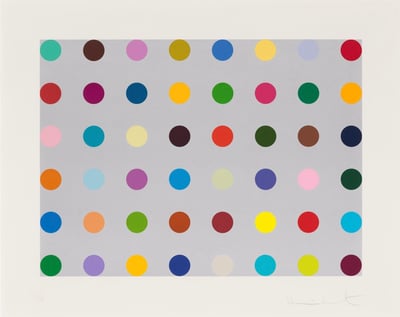
The paintings established the familiar formula of colored circles distributed across a pale field, but the editioned works developed that language through different printmaking techniques. Chemical and pharmaceutical titles became an especially persistent feature, linking apparently simple arrangements of color to medicine, laboratories and systems of classification.
Early Spot etchings
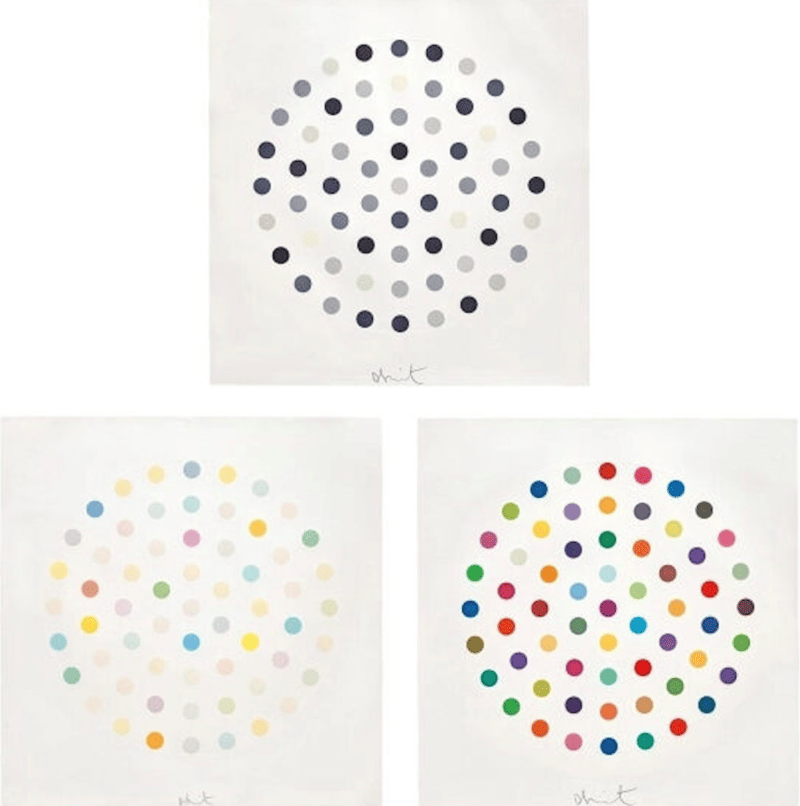
One useful starting point is the 2004 set Cinchonidine, Ciclopirox Olamine and Cineole. Composition Gallery records the three works as etchings on Hahnemühle paper, signed and numbered, from an edition of 145, with a sheet size of approximately 114.5 × 112.5 cm.
These details are independently supported by both the original publisher’s archive and auction records. The Paragon Press describes the group as three round Spot etchings, edition 145, each signed on the front and numbered on the reverse. Christie's likewise catalogued a complete set as three color etchings on Hahnemühle paper, with artist’s proofs existing outside the numbered edition.
The circular format distinguishes these works from the rectangular grids that dominate many later Spot prints. The three palettes also differ substantially, moving between greys, pastels and stronger color.
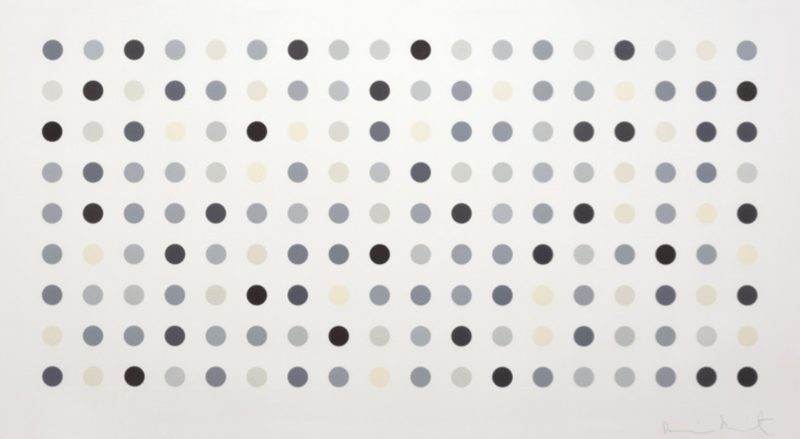
A year later, Diacetoxyscirpenol pushed the Spot format to a much larger scale. Composition’s 2005 example measures 111.5 × 200.7 cm and is catalogued as a Spot etching from an edition of 115, signed by Hirst on the front and numbered on the reverse.
Phillips records the same edition structure for other impressions of Diacetoxyscirpenol: edition 115, with 30 artist’s proofs, on Hahnemühle paper, signed on the front and numbered or marked AP on the reverse. Slight variations in recorded sheet dimensions are normal between catalogues and individual measurements.

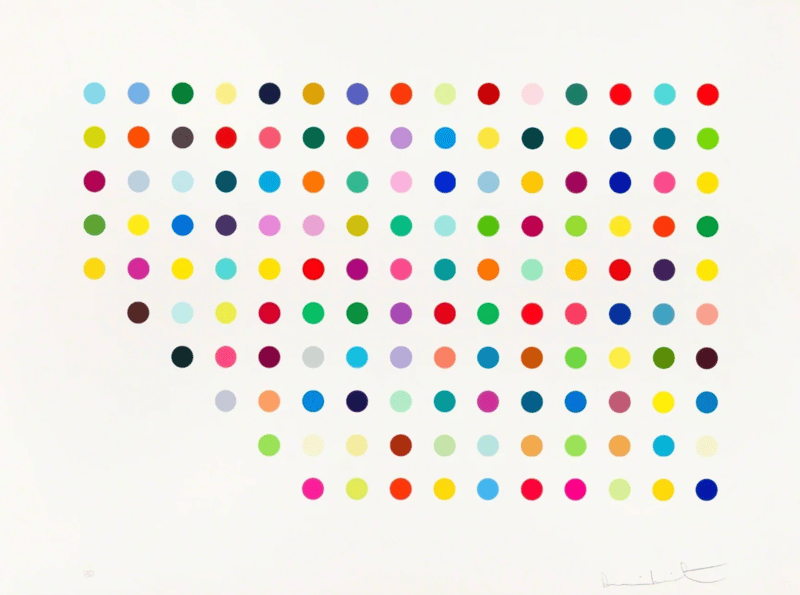
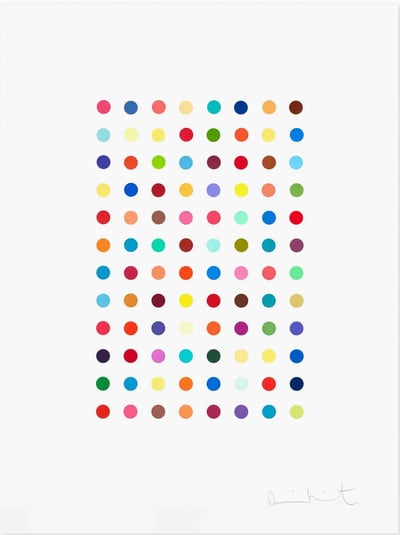
Xylene Cyanol Dye Solution, also from 2005, is more compact. Composition records an etching in colors on Hahnemühle paper measuring 96.5 × 73 cm, signed and numbered, from an edition of 65.
Phillips confirms a sheet of the same size, an edition of 65 and 20 artist’s proofs, with documented impressions signed on the front and numbered or marked AP on the reverse.
These three examples already show why “Damien Hirst Spot print” is a broad description rather than an edition specification. Works made only a year apart can differ in shape, scale and edition size.
The language of pharmaceuticals
The titles are central to the identity of many of these works. Cinchonidine, Ciclopirox Olamine, Diacetoxyscirpenol and Xylene Cyanol Dye Solution all draw on medical, pharmaceutical or chemical terminology.
This language creates a deliberate contrast with the visual experience of the prints. The spots are bright, orderly and abstract; the titles sound technical, clinical and highly specific. It is a strategy Hirst used throughout the broader Pharmaceutical body of work, connecting color with the systems through which drugs and chemical substances are named and classified.
The titles are useful clues for collectors, but they are not enough to identify an edition. A pharmaceutical name does not tell you whether the work is an etching, woodcut or screenprint, nor how many impressions were produced.
Screenprints: Histidyl, Meprobamate and Controlled Substances Key Spot
Hirst’s Spot imagery also appears in screenprint editions that are technically distinct from the earlier etchings.
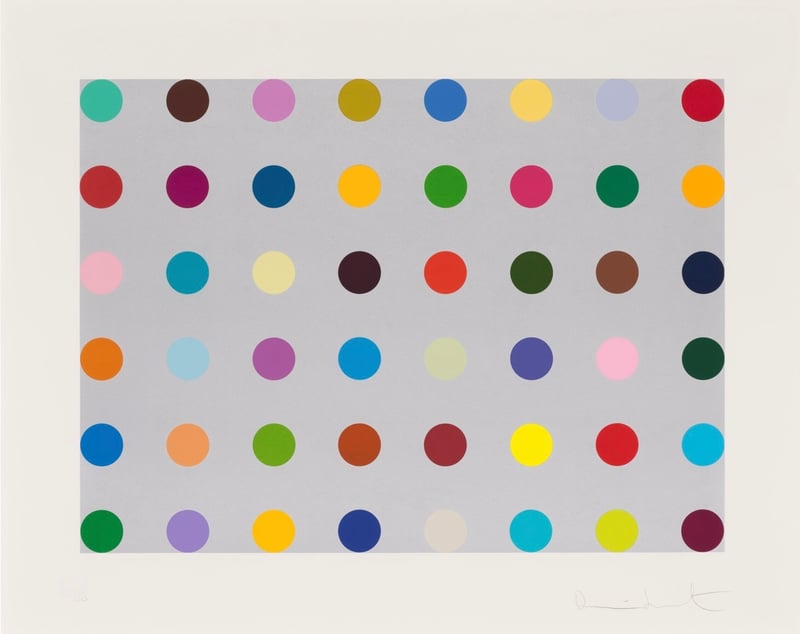
Composition’s Histidyl, 2008, is catalogued as a color screenprint with metallic silver on wove paper. It measures 75.6 × 95.2 cm, comes from an edition of 150 and is signed and numbered on the front.
Phillips records the same dimensions and edition size for Histidyl, together with 10 artist’s proofs and publication by Other Criteria.
Meprobamate, 2011, takes a related approach but uses screenprint in colors with glaze on Somerset paper. Composition records a 70 × 94 cm sheet, an edition of 150, and signature and numbering on the front. Phillips independently confirms the 150 numbered impressions, 10 artist’s proofs and the same sheet dimensions.
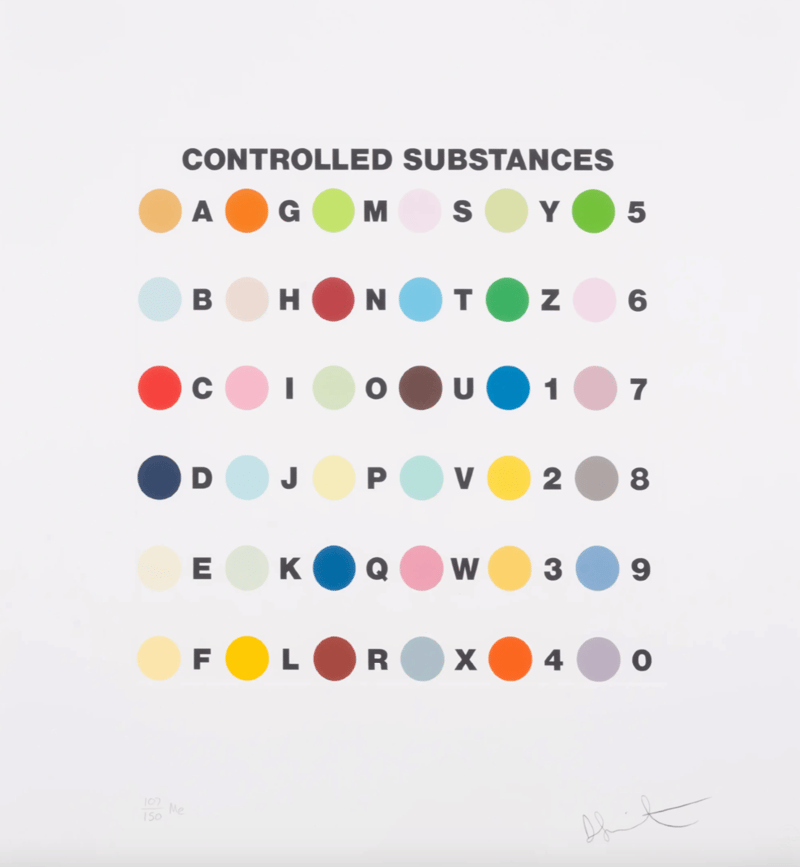
Controlled Substances Key Spot, also dated 2011, is smaller and more explicitly diagrammatic. Composition’s example measures 50.8 × 49 cm and is a screenprint in colors with glaze and debossing, hand-signed and numbered from an edition of 150.
Phillips confirms the same dimensions and numbered edition, as well as 10 artist’s proofs and publication by Other Criteria. Some auctioned examples carry additional abbreviated inscriptions associated with accompanying works, another reason to assess the particular impression rather than expect every example to be inscribed identically.
The 40 Woodcut Spots
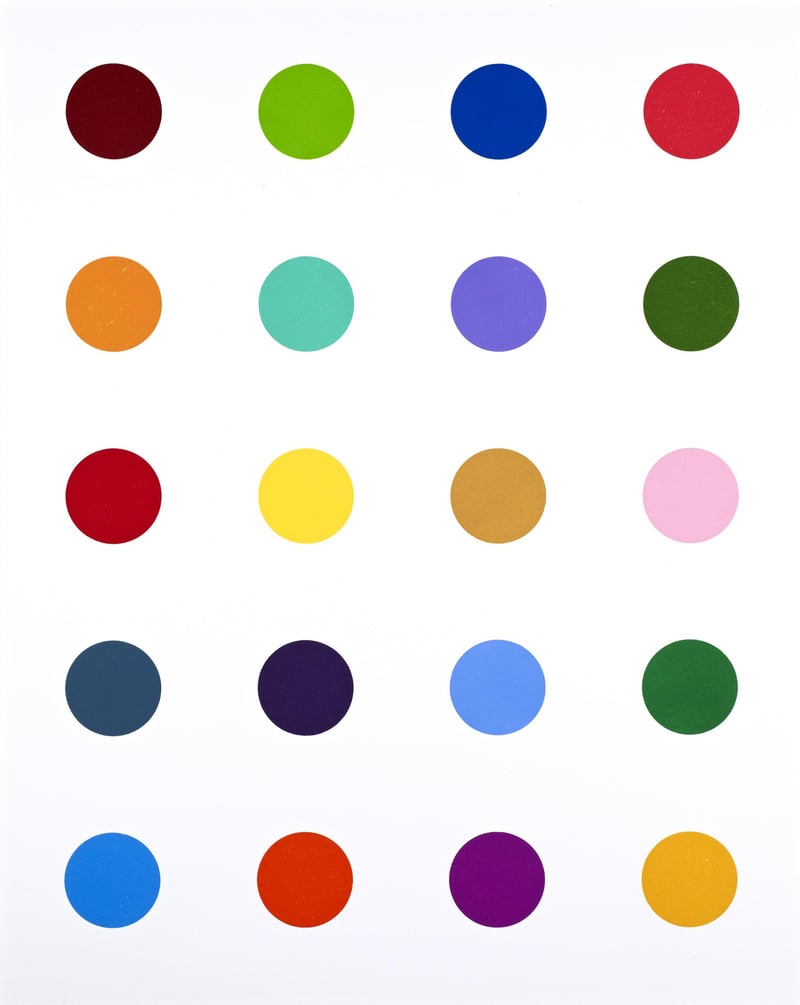
Woodcut gives the Spot vocabulary another form. The 40 Woodcut Spots group contains 40 individually titled works in widely differing dimensions, each issued in a numbered edition of 55.
Composition’s Ala Met, 2011, is one of the largest. It measures 80.2 × 63.5 cm and is printed in colors on Somerset Textured paper with full margins. Composition specifies that the work is signed on the front and numbered on the back, from an edition of 55. Phillips records the same sheet size, edition and signature placement for a separately auctioned impression, as well as 15 artist’s proofs.
At the other end of the scale, Perillartine measures only 36.8 × 45.7 cm. Composition dates its example to 2012 and records a color woodcut on Somerset paper, hand-signed and numbered, from an edition of 55. A Phillips record for Perillartine likewise dates the work to 2012, gives exactly the same sheet dimensions and edition of 55, and records the auctioned impression as signed and numbered on the reverse.
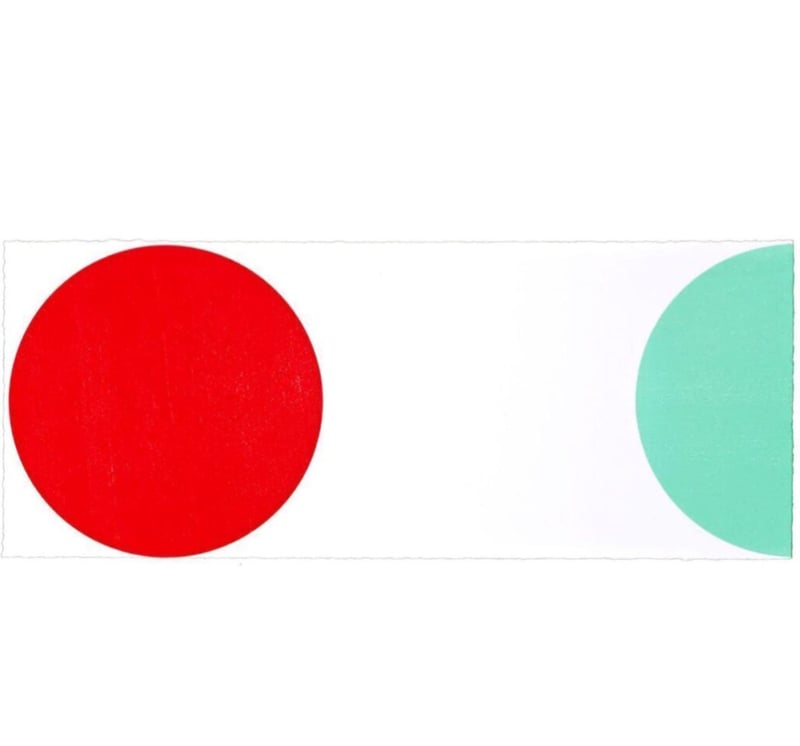
Another Composition example, Picolinic Acid, 2011, reduces the composition to just two spots on a long horizontal sheet measuring 20.3 × 50.8 cm. Composition records it as a signed and numbered woodcut from an edition of 55, while the publisher’s series archive confirms both the dimensions and its place within 40 Woodcut Spots.
Together, these works show how varied the woodcut group is despite its shared technique and edition size. Hirst changes not only the number and arrangement of spots but the proportions of the paper itself.
Beyond the Pharmaceutical grid
Later Hirst editions demonstrate that the Spot idea did not remain fixed.
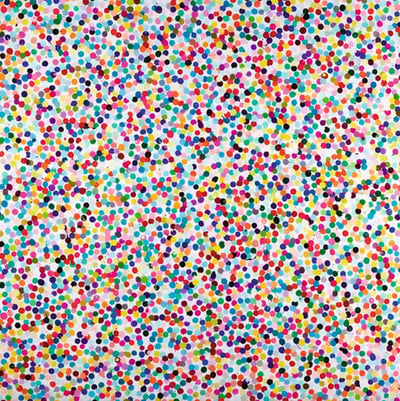
Beverly Hills (H5-2), 2018, belongs to Colour Space, a later body of work in which the spots become less regular and can touch or overlap. The edition is a Diasec-mounted giclée print on aluminum rather than a conventional print on paper. Christie's and Phillips document a size of about 90 × 90 cm, an edition of 100 plus 10 artist’s proofs, with the signature on a label on the reverse.
The title is also a departure. Instead of chemical nomenclature, Beverly Hills belongs to a group of works named after locations, signaling that the visual language of spots had expanded beyond the Pharmaceutical naming system.
More recently, Composition Gallery’s Untitled B (Spot Drawing), 2025, returns to a disciplined grid in a 12-color pigment print measuring 60 × 54 cm. Composition records an edition of 60, signed and numbered on the front.

What collectors should look at
With Damien Hirst Spot prints, identification starts with the exact title rather than the motif alone. Medium, dimensions, edition size and signature placement should be checked against documentation for that specific work.
Condition also depends on the object. For etchings, screenprints and woodcuts on paper, collectors should look at the full sheet, margins, paper tone, fading, handling marks, staining, trimming and restoration. Verso inscriptions can be important because some works carry numbering or other information on the reverse.
A mounted work such as Beverly Hills (H5-2) requires different checks, including the surface of the panel, edges, mounting and reverse label.
The appeal of Hirst’s Spot prints lies partly in their consistency: a simple vocabulary of circles and color survives across decades. But for collectors, their differences are just as important. The pharmaceutical etchings, metallic and glazed screenprints, woodcuts and later pigment editions belong to distinct productions, and each should be understood on its own terms.
Composition Gallery’s Damien Hirst inventory brings several of those strands together, from the early Cinchonidine, Ciclopirox Olamine and Cineole etchings and monumental Diacetoxyscirpenol to Histidyl, Ala Met, Controlled Substances Key Spot, Beverly Hills and the recent Untitled B (Spot Drawing).

Collector FAQs
Are Damien Hirst Spot prints reproductions of his Spot Paintings? Many are not straightforward reproductions. They are separately editioned works made in specific print techniques, including etching, screenprint and woodcut. Later editions may relate more directly to paintings and should be identified according to their individual publication history.
Do all Damien Hirst Spot prints have pharmaceutical titles? No. Chemical and pharmaceutical names dominate many early and mid-career examples, but later Spot-related editions include titles such as Beverly Hills as well as untitled works.
Is there a standard edition size for Damien Hirst Spot prints? No. The works discussed here range from editions of 55 to 150, with additional artist’s proofs documented for some publications.
Does Hirst always sign Spot prints in the same place? No. Signature placement varies. Some etchings are signed on the front and numbered on the reverse, some screenprints are signed and numbered on the front, and Beverly Hills (H5-2) is signed on a label on the reverse. The convention should be checked for the exact title.
Related Articles
Popular, Artists, Art Movements - February 29, 2024
The World's 10 Most Influential Street Artists: Urban Canvases
Explore the world’s most influential street artists who transformed urban landscapes. Discover their iconic works and lasting impact on contemporary art.Read More
Related Artworks You Might Like
Damien Hirst
Beverly Hills from Colour Space, H5-2, 2018
Limited Edition Print
Giclée printing
GBP 7,000 - 10,000
Damien Hirst
Xylene Cyanol Dye Solution, 2005
Limited Edition Print
Etching
GBP 18,000 - 23,400
Damien Hirst
Histidyl, 2008
Limited Edition Print
Screen-print
GBP 14,000 - 18,000
