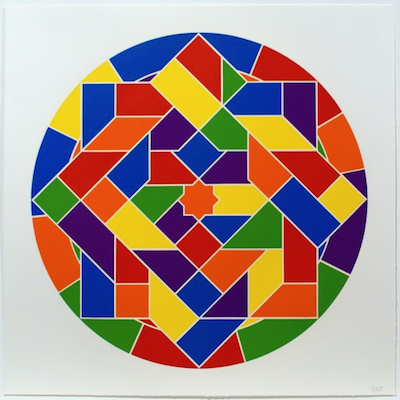
What is Generative Art?
It refers to art wholly or partly created through a special autonomous system. In this context, the autonomous system can be an independent or a non human one, capable of determining its features that would otherwise be determined by the artist. The generative system can take the creator's role or his artistic creator. Generative art is often used to refer to the algorithmically computer generated work.
Artwork by Sol LeWitt- Show All
- Established
- Discoveries
ARTWORKS RELATED TO GENERATIVE ART

Sol LeWitt
Two Asymmetrical Pyramids and Their Mirror Images (Counterpoint), 1986
Limited Edition Print
Silkscreen
EUR 1,900

Sol LeWitt
Colors with Lines in Four Directions, Within a Black Border (Red), 1990
Limited Edition Print
Screen-print
USD 2,500

Donald Judd
Untitled, 1978-79
Limited Edition Print
Aquatint
USD 8,000 - 10,000

Mel Bochner
Untitled (Four X Four X Four), 1990
Limited Edition Print
Screen-print
Inquire For Price

Sol LeWitt
Benziger Print, 1998
Limited Edition Print
Woodcut
USD 2,100

Donald Judd
Untitled (set of 6), 1980
Limited Edition Print
Aquatint
USD 47,000 - 52,000

Alighiero Boetti
Ammazzare il tempo, 1983
Limited Edition Print
Serigraph
EUR 13,000 - 17,000

Francois Morellet
Trois cubes imbriqués, 1977
Sculpture / Object
Metal
EUR 6,990

Sol LeWitt
Untitled from Kinderstern, 1989
Limited Edition Print
Screen-print
Currently Not Available

Sol LeWitt
Arcs and bands in color, 1999
Limited Edition Print
Silkscreen
Currently Not Available

Sol LeWitt
Complex Forms II, 1990
Limited Edition Print
Etching
Inquire For Price

Sol LeWitt
Steps (Form Derived from a Cubic Rectangle), 1992
Limited Edition Print
Woodcut
EUR 5,900

Francois Morellet
Untitled, 1975
Limited Edition Print
Lithograph
EUR 1,375

Francois Morellet
Untitled , 1975
Limited Edition Print
Lithograph
EUR 1,375

Sol LeWitt
Ohne Titel, 1990
Limited Edition Print
Serigraph
USD 5,250

Francois Morellet
Trames,
Limited Edition Print
Screen-print
EUR 1,400


Conté is a vivid colored, waxy crayon. Nicolas-Jacques Conte’ invented them in 1795. Artists use sanding pads to sharpen their tips for drawing details, drag them flat on their sides for shading in large areas, and them to blend colors while drawing and sketching.

Chalk is calcium carbonate, a mineral substance. In art, chalk is most often described in reference to drawing with chalk sticks. These are a mix of chalk, pigment in various colors and gum Arabic, pressed into a stick with four flat sides.
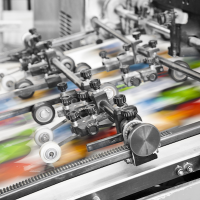
Printing technique that transfers the inked image(offsets) to rubber blanket from a plate, then later to a printing surface. Combined with lithographic process based on water and oil repulsion, this technique attracts a film that is water based to keep the non-printing area ink free. Offset lithography was initially created to cut down expenses when reproducing artwork.