Details
Artist
Styles
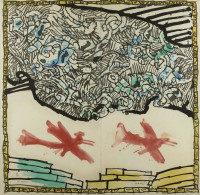
Mounted on canvas. Eau-forte in colour on Taiwanese rice paper. Published on a full page in the book: "alechinsky, travaux d'impression" Pierre Alechinsky’s Vol Augural (1990) is a large-scale etching that exemplifies his dynamic fusion of abstraction, calligraphy, and expressive color. The composition is dominated by intricate black ink lines that form a swirling, textured upper section, punctuated by splashes of blue. In contrast, the lower half presents two striking red forms, suggestive of birds or symbols of movement, set against a background of structured, yellow and green geometric shapes. The border, composed of irregular golden lines, frames the composition with an almost manuscript-like quality. Printed on Taiwanese rice paper and mounted on canvas, this piece belongs to an edition of 99, plus artist and hors commerce proofs. Alechinsky’s work, deeply rooted in the Cobra movement, reflects an energetic and freeform approach to printmaking, bridging spontaneous gesture with a sophisticated sense of structure.
Vol Augural, 1990
form
Medium
Size
185 x 188 cm
- Inches
- Centimeters
Edition
Price
- USD
- EUR
- GBP
Details
Artist
Styles
Mounted on canvas. Eau-forte in colour on Taiwanese rice paper. Published on a full page in the book: "alechinsky, travaux d'impression" Pierre Alechinsky’s Vol Augural (1990) is a large-scale etching that exemplifies his dynamic fusion of abstraction, calligraphy, and expressive color. The composition is dominated by intricate black ink lines that form a swirling, textured upper section, punctuated by splashes of blue. In contrast, the lower half presents two striking red forms, suggestive of birds or symbols of movement, set against a background of structured, yellow and green geometric shapes. The border, composed of irregular golden lines, frames the composition with an almost manuscript-like quality. Printed on Taiwanese rice paper and mounted on canvas, this piece belongs to an edition of 99, plus artist and hors commerce proofs. Alechinsky’s work, deeply rooted in the Cobra movement, reflects an energetic and freeform approach to printmaking, bridging spontaneous gesture with a sophisticated sense of structure.
- Recently Added
- Price (low-high )
- Price (high-low )
- Year (low-high )
- Year (high-low )

Pierre Alechinsky
Tête Bêche, 1987
Drawing / Watercolor
Ink
EUR 7,200

Pierre Alechinsky
Seoul, 1988
Limited Edition Print
Lithograph
EUR 1,300

Pierre Alechinsky
Sans Titre, Unknown
Limited Edition Print
Lithograph
EUR 2,500
Pierre Alechinsky
Vol Augural, 1990
Limited Edition Print
Etching
EUR 22,000

Pierre Alechinsky
Vacillations (with Watercolor), 1979
Limited Edition Print
Lithograph
Currently Not Available

Pierre Alechinsky
Ligne BVV, 1983
Limited Edition Print
Lithograph
Currently Not Available

Pierre Alechinsky
Reserve Pour L'hiver, 1988
Limited Edition Print
Etching
Currently Not Available
Related Artists


Related Articles
Art Movements - November 21, 2022
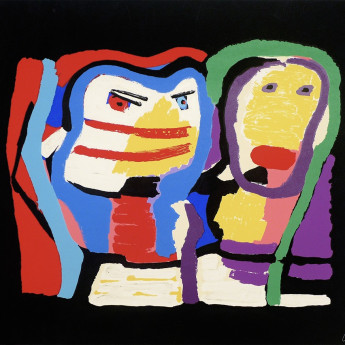
Botch, Blotch and Splotch: The Exuberant Maelstrom of the Cobra Art Movement.
Explore the CoBrA movement’s bold creativity, blending raw expression and experimentation. Discover its impact on post-war art and avant-garde traditions. Read More

What is Tachisme?
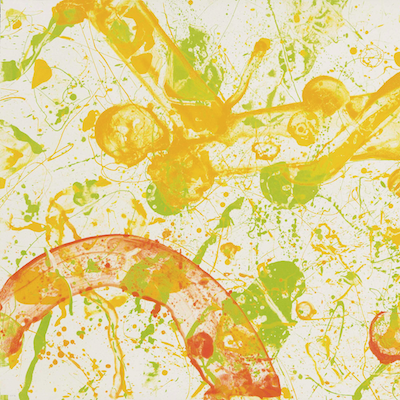
Tachisme is a French abstract painting style that gained popularity between 1940 and 1950, often seen as the European counterpart to Abstract Expressionism. However, there are stylistic differences between the two. Tachisme, which emerged from Art Informel, rejected geometric abstraction in favor of more intuitive and spontaneous expression. It was a reaction against the structured forms of Cubism and is closely related to Informalism. Tachisme emphasizes gestural brushwork, irregular forms, and a focus on the process of painting itself.