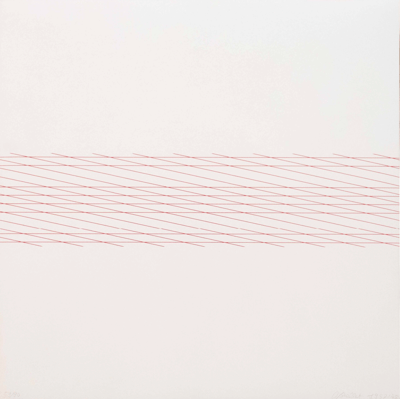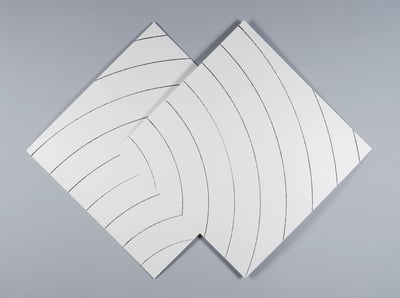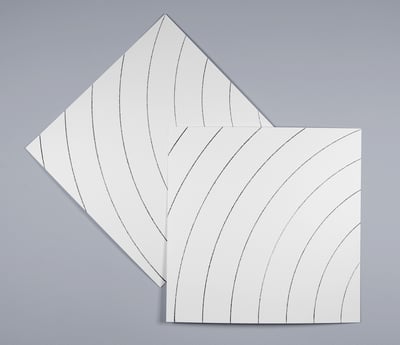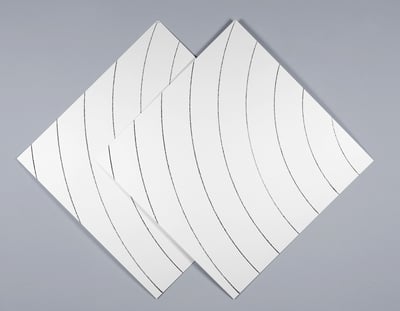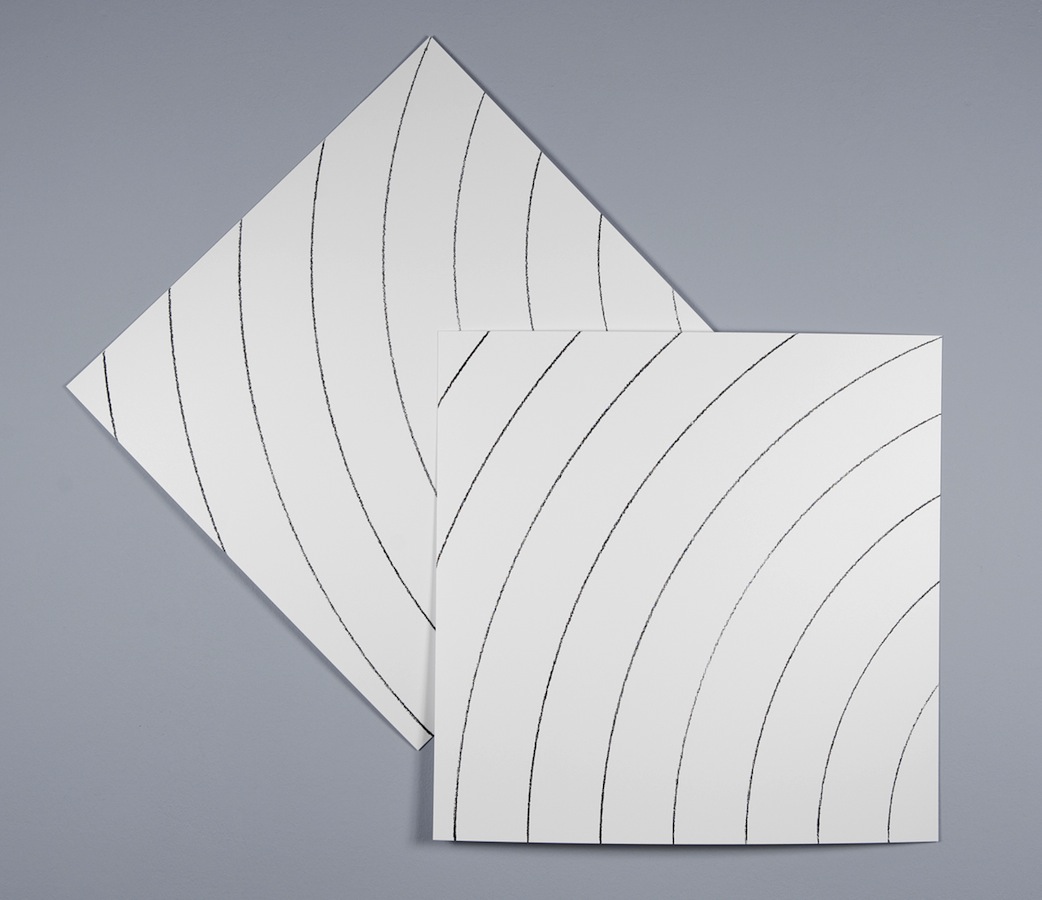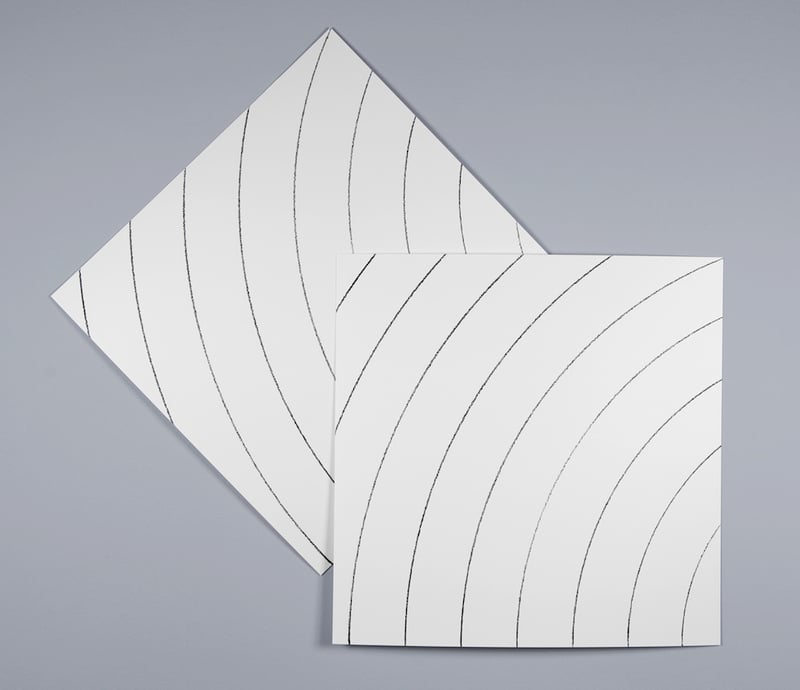
Ondes parasites 2 by François Morellet, created in 2014, is a minimalist screen print that features concentric arcs on two overlapping white PVC plates. This geometric composition utilizes slight shifts in the curvature of each plate, creating an optical effect of movement and variation as the lines interact. The design invites viewers to engage with the subtle changes in angle, generating a dynamic sense of rhythm within the simplicity of the forms. Displayed frameless, the piece has a clean and modern aesthetic. Morellet’s work often explores the intersection of precision and perception, and this artwork exemplifies his commitment to visual experimentation through structural balance and mathematical clarity.
François Morellet (France, 1926–2016) was a pivotal figure in geometric abstraction and conceptual art. Known for his precise, minimalist works, he often used systems, chance, and light to create dynamic visual effects. Morellet’s innovative use of neon and mathematically inspired compositions cemented his influence on contemporary art and kinetic aesthetics.
ScreenprintScreen printing is a technique where ink is transferred through a mesh onto a substrate, with areas blocked by a stencil to prevent ink from passing through. This method, also known as serigraphy or silkscreen printing, is commonly used to produce prints on posters, T-shirts, vinyl, stickers, wood, and other materials. The process is a type of stencil printing, allowing for vibrant, detailed designs on various surfaces.
Ondes parasites 2 by François Morellet, created in 2014, is a minimalist screen print that features concentric arcs on two overlapping white PVC plates. This geometric composition utilizes slight shifts in the curvature of each plate, creating an optical effect of movement and variation as the lines interact. The design invites viewers to engage with the subtle changes in angle, generating a dynamic sense of rhythm within the simplicity of the forms. Displayed frameless, the piece has a clean and modern aesthetic. Morellet’s work often explores the intersection of precision and perception, and this artwork exemplifies his commitment to visual experimentation through structural balance and mathematical clarity.
François Morellet (France, 1926–2016) was a pivotal figure in geometric abstraction and conceptual art. Known for his precise, minimalist works, he often used systems, chance, and light to create dynamic visual effects. Morellet’s innovative use of neon and mathematically inspired compositions cemented his influence on contemporary art and kinetic aesthetics.
Anyway, I don't care about the future of my works.
- Francois Morellet
François Morellet was a prolific French Conceptual light artist of the late 20th century. He began experimenting with his preferred medium, neon, in the early 1960s, when he and some friends formed the Groupe de Recherche d’Art Visuel (Visual Arts Research Group). As a founding member of the group, he favored a non-traditional, experimental approach to art creation. Using light to translate geometry into art was his passion, particularly emphasizing circles and lines. His philosophy of art was akin to minimalism, and he believed that an artist should be a facilitator rather than cultivate the identity of an isolated genius. In his own compositions he liked to incorporate elements of the random, as he focused more on the process of creation rather than solely on the product. Besides an obsession with light and shape, he had a whimsical sense of humor, shown in his penchant for titling his pieces with forms of wordplay such as palindromes and puns. François Morellet’s works have been shown for decades in many exhibitions all over the world, and he also had his work commissioned for public locations in France and the Netherlands. (Artist website)
Geometric abstraction is a form of abstract art that uses geometric shapes arranged in a non-illusionistic space (though not always) and combined into non-representational (non-objective) compositions. Based on years of artistic research, some artists have proposed that geometric abstraction offers a solution to modern challenges by rejecting traditional illusionistic practices in favor of clarity and simplicity.