KAWS Companion Editions: Vinyl, Four Foot and Dissected
By Emilia Novak
KAWS’s Companion began not as a unique sculpture later reproduced in miniature, but as an editioned vinyl figure. From its 1999 debut with Japanese company Bounty Hunter, the character developed through new sizes, colorways, dissected forms and collaborations. For collectors, understanding those distinctions is essential: editions that look closely related can differ substantially in scale, numbering and production marks.
In this article
How the first 1999 Companion relates to later vinyl and four-foot versions.
Which key editions were produced from 2004 to 2013, and how they differ.
What signatures, stamps, numbering and condition can tell collectors—and what they cannot.
What exactly is a KAWS Companion?
KAWS, the working name of Brian Donnelly, developed Companion from the graphic vocabulary he had already been using in graffiti and altered advertising: an X-eyed skull-like head combined with the gloves, shorts and rounded proportions associated with American cartoon figures. The character appears deliberately familiar while remaining separate from the sources it references.
That distinction matters when discussing editions. There is no single unique Companion sculpture from which all later figures are reproductions. The three-dimensional history begins with an editioned object itself. The Art Gallery of Ontario identifies Companion as the first figure in KAWS’s family of recurring characters and traces its origin to his 1999 collaboration with Bounty Hunter in Japan.
Over time, KAWS changed the figure’s height, pose, color, surface treatment and even anatomy. Some releases remained close to the standing 1999 format; others became four-foot sculptures, collaborative objects or entirely different sculptural situations. A collector therefore needs to identify the exact version, year and producer rather than relying on the word “Companion” alone.
The 1999 Bounty Hunter Companion
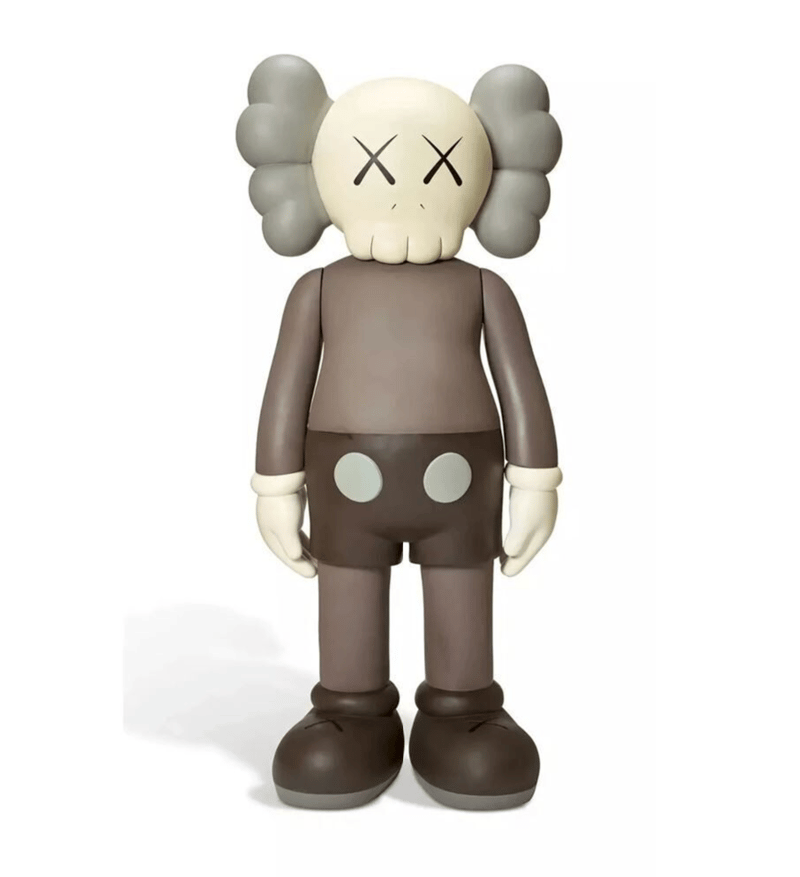
The starting point is the 1999 vinyl figure produced with Bounty Hunter. Christie’s records the first Companion release in three colorways—black, brown and grey—with 500 figures in each color, rather than 500 divided across the full set.
The scale and production context were significant. KAWS encountered Japan’s limited-run designer-toy culture during the late 1990s and recognized that a small manufactured figure could function as an editioned artwork while remaining accessible outside the conventional gallery system. The result established a model that KAWS would repeatedly revisit: a recognizable sculptural form produced in controlled quantities and circulated through both art and design channels.
Visually, Companion combines exaggerated cartoon proportions with a markedly subdued expression. The crossed-out eyes obscure direct emotional contact, while the lowered or neutral bodily attitude counters the assertive posture of many commercial action figures.
For collectors, the 1999 release should therefore be understood as an original editioned manifestation of the character—not simply an early piece of merchandise preceding the “real” sculptures.
Five Years Later: enlarging the figure
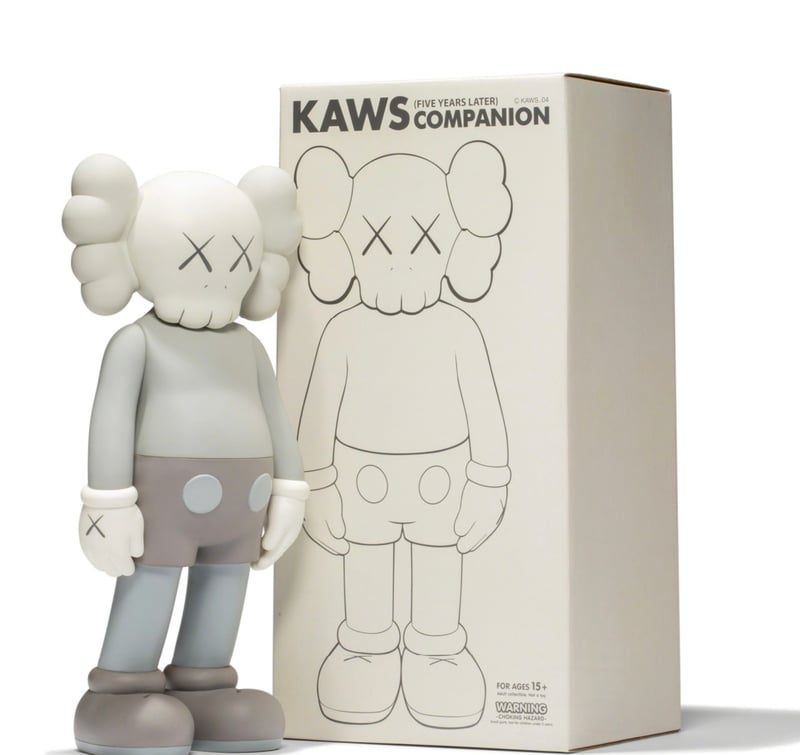
In 2004, KAWS revisited the format in Five Years Later Companion. The grey example listed by Composition Gallery measures 37.5 × 15.9 × 8.1 cm, or approximately 14¾ inches high, and is recorded as an edition of 500. It is unsigned and unnumbered, with a production mark on the underside.
The increased scale changes how the figure is encountered. It remains a collectible vinyl object, but at almost twice the height of the earliest figures it begins to occupy more physical space and to read more decisively as sculpture.
Medicom Toy was central to this phase of KAWS’s production. Auction documentation also confirms Medicom production markings and an edition structure of 500 for documented 2004 Five Years Later variants.
The 2007 Four Foot Companion
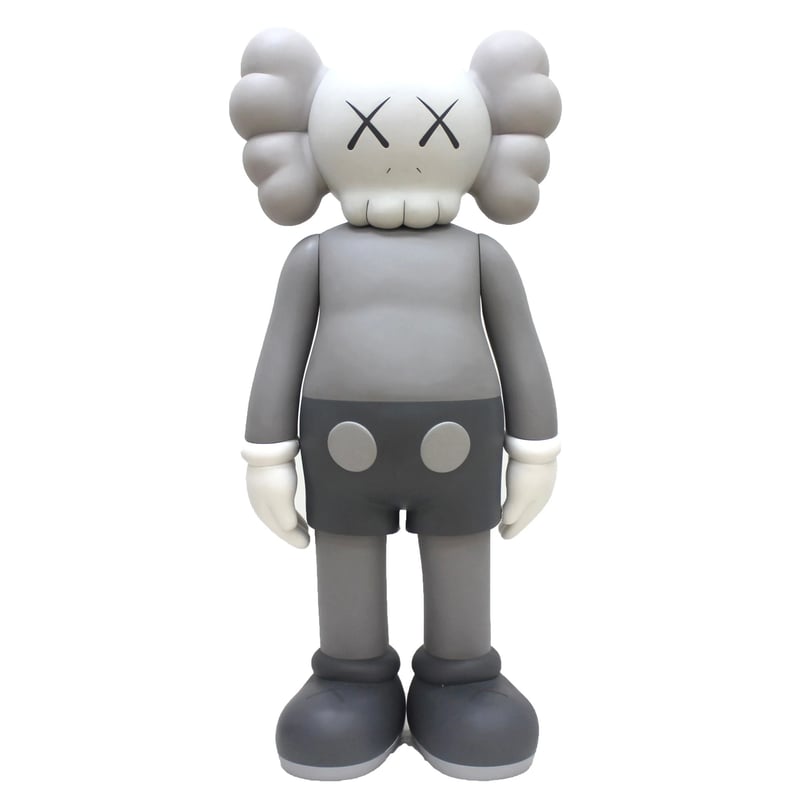
The jump to the Four Foot Companion in 2007 was more substantial. At approximately 127 cm, or 50 inches, high, the figure moves beyond shelf scale and becomes a room-sized sculptural presence.
Grey, brown and black versions are documented. Auction records describe the Four Foot Companion as painted cast vinyl from an edition of 100, with KAWS/date and Medicom Toy production markings on the undersides of the feet.
Composition Gallery offers both grey and brown examples. The brown work is recorded at 127 cm high and likewise as an edition of 100, with KAWS and Medicom production information incised underneath.

Dissecting Companion
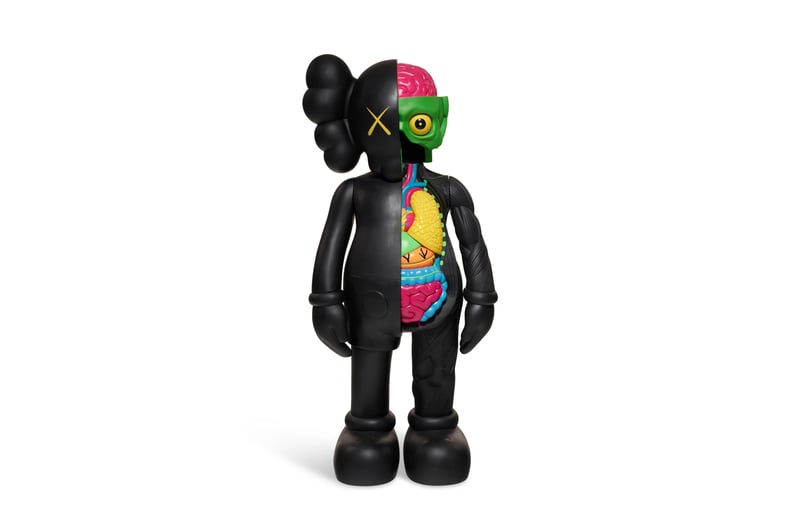
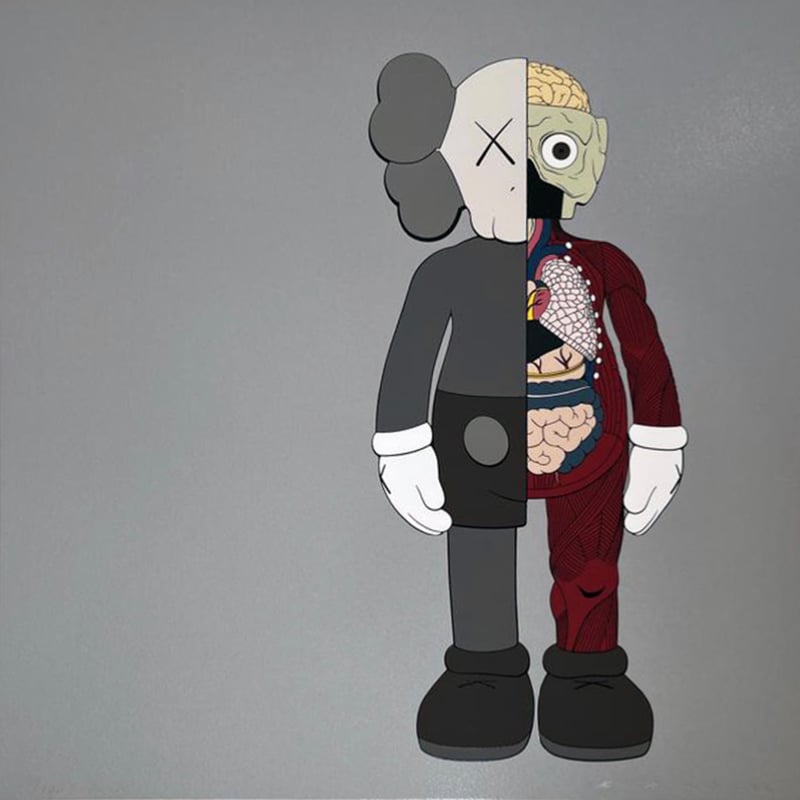
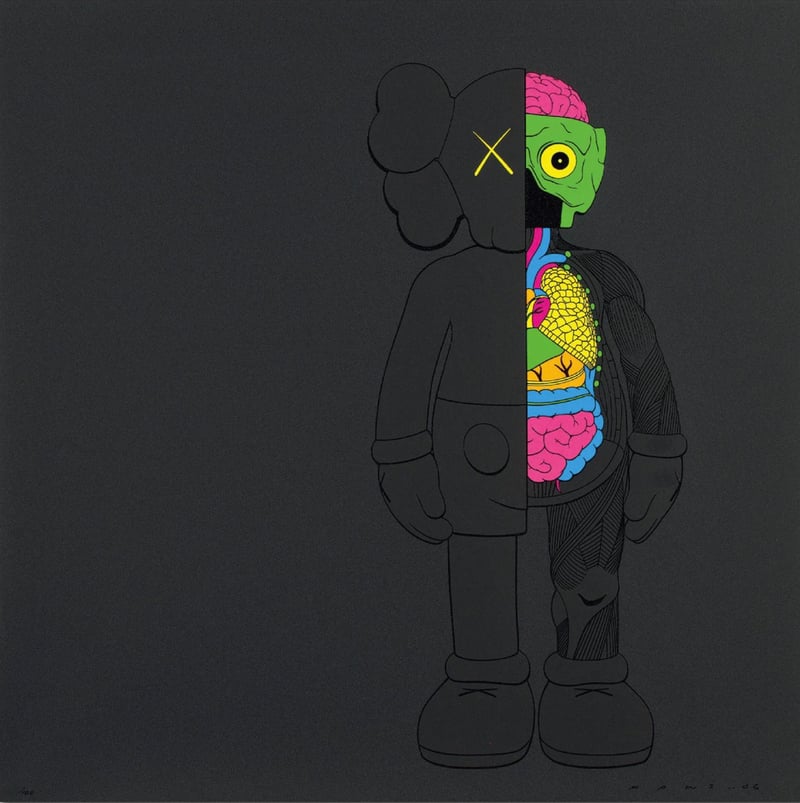
The Dissected format transforms the figure by opening one side of the body to reveal a stylized anatomical interior. Instead of simply changing a colorway, KAWS turns the surface/interior opposition into the work’s central visual device.
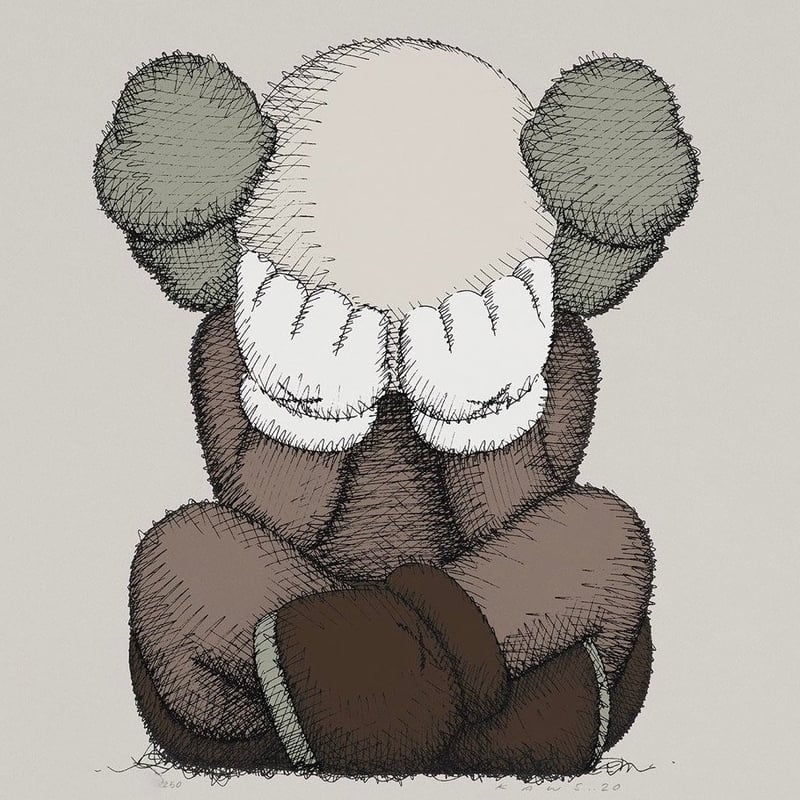
The motif was already appearing in other media before the four-foot sculptures. Composition Gallery, for example, lists a 2006 Dissected Companion (Brown) as a signed screenprint measuring 50.8 × 50.8 cm from an edition of 100. The print should be treated as a separate editioned work on paper, not as another version of the vinyl sculpture.
In 2009, the concept appeared at four-foot scale. Documented examples are painted cast vinyl, approximately 127 to 128 cm high, from editions of 100, with KAWS/date and Medicom Toy production marks underneath the feet. Brown, grey and black versions are documented.
At this size, the anatomical half becomes more than a graphic device. The contrast between the smooth external figure and its brightly articulated interior can be read from across a room, turning a motif associated with toys into a much more physically assertive sculptural experience.
Collaborations: Sorayama and Star Wars
KAWS also used Companion as a framework for collaboration.
The 2008 No Future Companion, made with Japanese artist Hajime Sorayama, replaces the familiar painted-vinyl appearance with a highly reflective, robotic surface. The silver version offered by Composition Gallery belongs to an edition of 500 and is marked and numbered underneath.
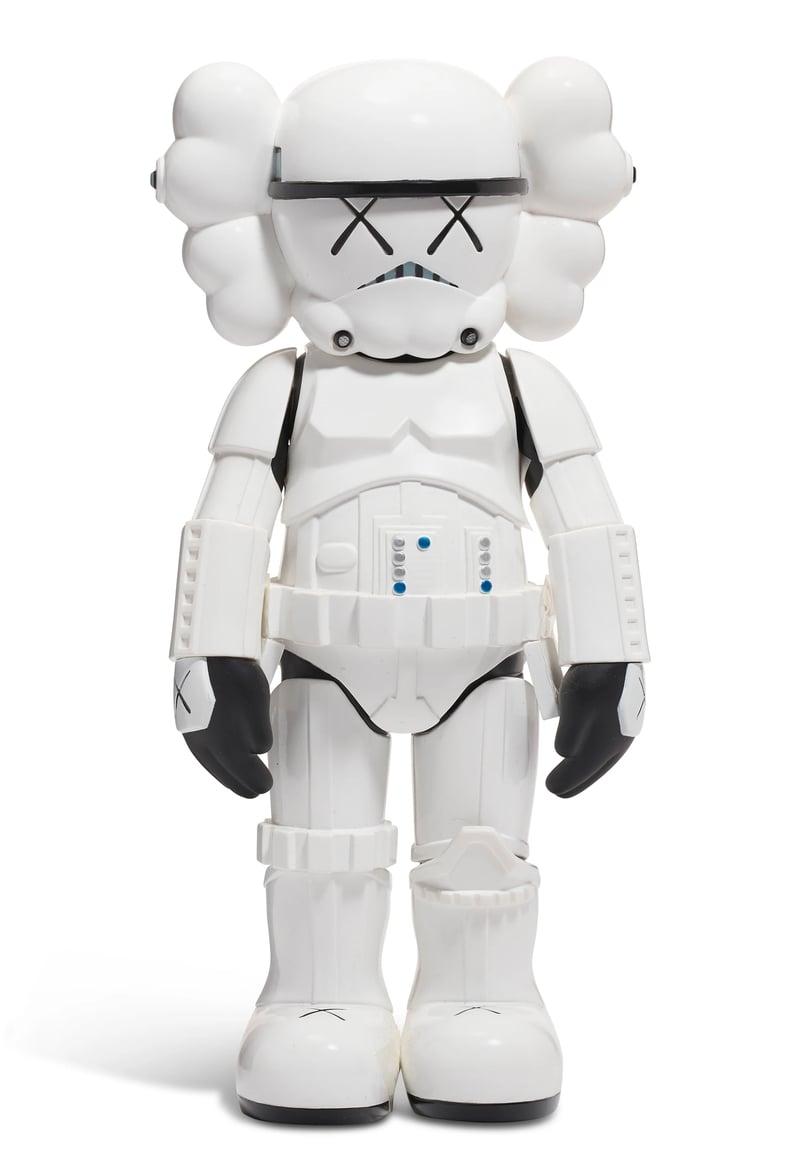
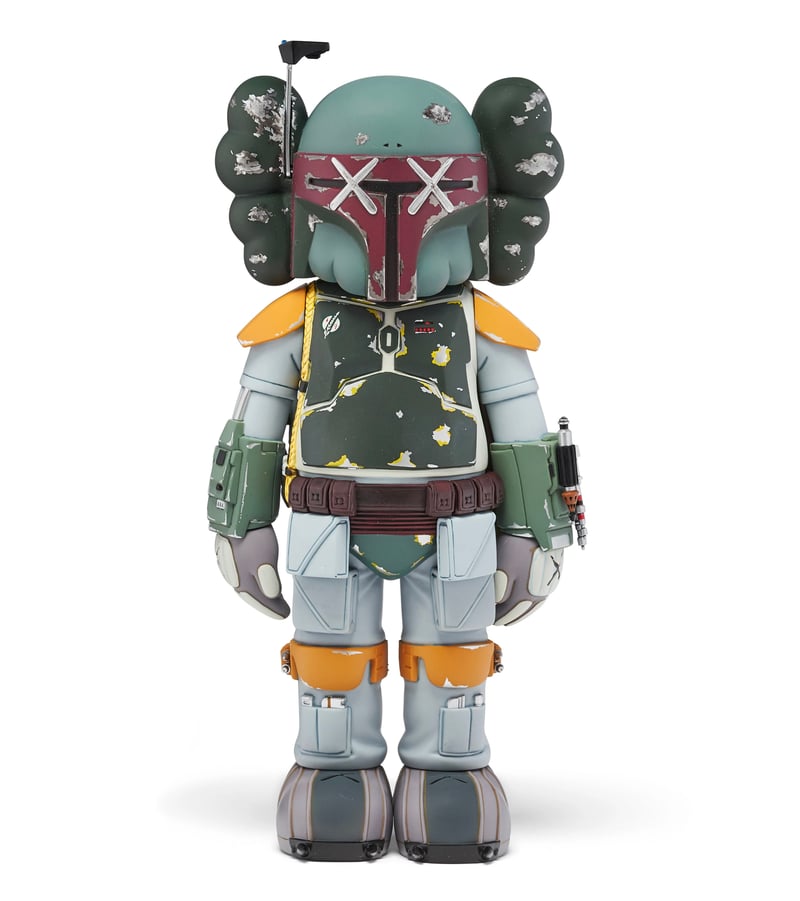
The licensed Star Wars versions adapt Companion to recognizable characters while retaining KAWS’s visual vocabulary. The Stormtrooper Companion dates from 2008 and the Boba Fett Companion from 2013. Both are documented as painted cast vinyl editions of 500, with Medicom Toy and Lucasfilm-related markings underneath.
The story continues beyond 2013
The 2013 Boba Fett release is a useful endpoint for this focused group of collectible editions, but it is not the end of Companion. KAWS continued to develop the figure through other poses, materials and scales.
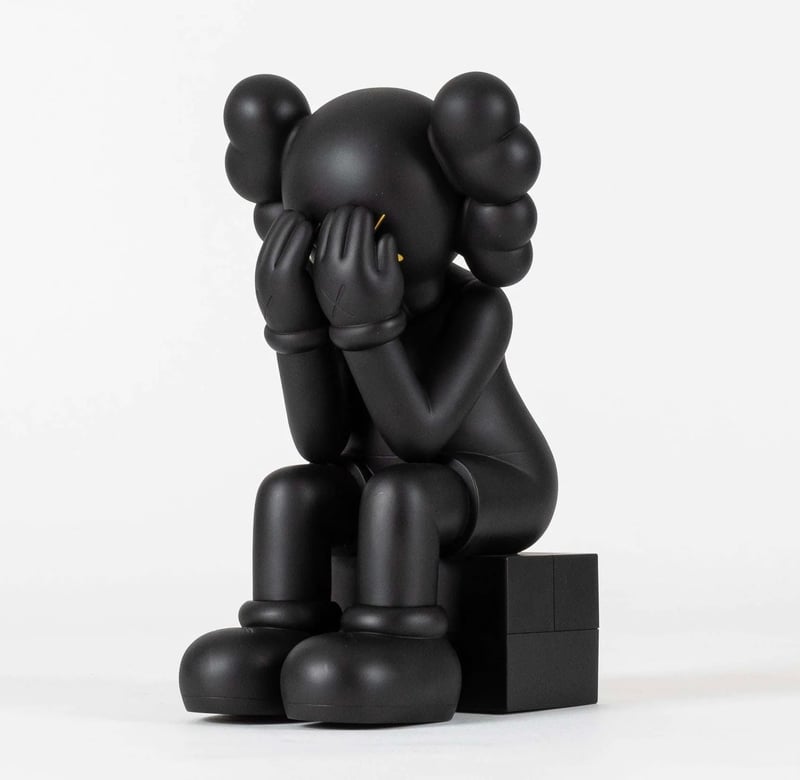
Later works include COMPANION (PASSING THROUGH), CLEAN SLATE and various HOLIDAY projects, which extend the figure into monumental and public settings. Museum presentations have also documented KAWS’s use of fiberglass, bronze, wood and other materials as the character moved beyond the format of collectible vinyl.
That continuing evolution is one reason it is more accurate to speak of a Companion family of works than a single sculpture reproduced repeatedly.
Signed, unsigned, stamped and numbered
Signature terminology is especially important with KAWS editions.
A hand-signed object carries a signature physically applied by the artist. A molded, incised or stamped “KAWS” mark produced as part of the object is different. Medicom Toy information, copyright dates and licensing text are likewise production marks, even when they contain the artist’s name.
The 2007 Four Foot Companion, for instance, is normally documented with KAWS/date and Medicom Toy marks underneath but as an unnumbered edition of 100. Some individual examples have appeared at auction with additional hand-applied signatures, demonstrating why such signatures should be documented object by object rather than assumed to be standard for the edition.
No Future Companion differs again because examples carry individual edition numbers on the underside label. Some auctioned examples have also carried additional signatures, making it particularly important to distinguish standard edition markings from added hand-signing.
For buyers, the safest description is the most literal one: signed, unsigned, stamped, incised or numbered according to what is physically present and supported by documentation.
Cultural importance and market context
Companion occupies an unusual position because the character developed simultaneously through collectible production and conventional sculpture. Museum presentations have treated that crossover as central to KAWS’s practice rather than peripheral to it, tracing the figure from its 1999 toy origins into large-scale sculpture and public installations.
The secondary market also differentiates sharply between version, scale and date. As one historical example, Phillips New York sold a 2007 grey Four Foot Companion from the unnumbered edition of 100 on November 13, 2019, reporting a “Sold For” figure of $118,750.
That result should not be used to infer a current value for another Companion. Colorway, scale, edition, condition, provenance, timing and the exact version all affect comparability.
Collecting KAWS Companion at Composition Gallery
Composition Gallery’s KAWS selection includes several points in this history, from the 2004 5 Years Later Companion – Grey and 2007 four-foot works to 2009 Dissected examples, the silver No Future Companion collaboration and the Star Wars Stormtrooper and Boba Fett editions. The broader KAWS selection also includes prints and other sculptural editions.
For a collector comparing examples, the most useful approach is not simply to ask whether an object is “a KAWS Companion,” but to establish the precise version, year, edition structure, production marks and condition first.
Collector FAQs
Was the first KAWS Companion released in 1999? Yes. Institutional and auction sources identify the 1999 Bounty Hunter collaboration as the first three-dimensional Companion toy release. Black, brown and grey versions are documented, with 500 produced in each color.
Are all KAWS Companion figures signed? No. Many standard vinyl editions are not hand-signed. They may instead carry molded, stamped or incised KAWS, Medicom Toy, date or licensing information. Some individual examples have additional signatures, so the physical object and its documentation should be checked.
Is the Four Foot Companion numbered? The documented 2007 four-foot edition consists of 100 examples per version discussed here, but standard examples are commonly catalogued as unnumbered. Edition size does not necessarily mean an individual fraction is printed or incised on each object.
How is Four Foot Dissected Companion different? The 2009 Dissected version opens one half of the standing figure to reveal stylized internal anatomy. Documented grey, brown and black four-foot versions are painted cast vinyl, with the principal editions discussed here recorded at 100 examples.
What should I check when buying a KAWS Companion? Start with the exact title, date, colorway, dimensions, material and edition structure. Compare underside marks with documented examples, examine provenance and condition, and distinguish production stamps from a genuine hand-applied signature. None of those factors should be treated as a guarantee by itself.
Companion is best understood not as one sculpture copied at different sizes, but as a recurring figure developed through distinct editions and sculptural formats. For collectors, that makes exact identification especially important: year, version, color, producer, marks and condition are more informative than the familiar silhouette alone.
Related Articles
Popular, Art Movements - October 22, 2025
Neo-Pop Art in the 21st Century: From Takashi Murakami to KAWS
Explore Neo-Pop Art with Murakami, KAWS, Kusama & more. Bold, playful, and collectible—this movement fuses pop culture with fine art today.Read More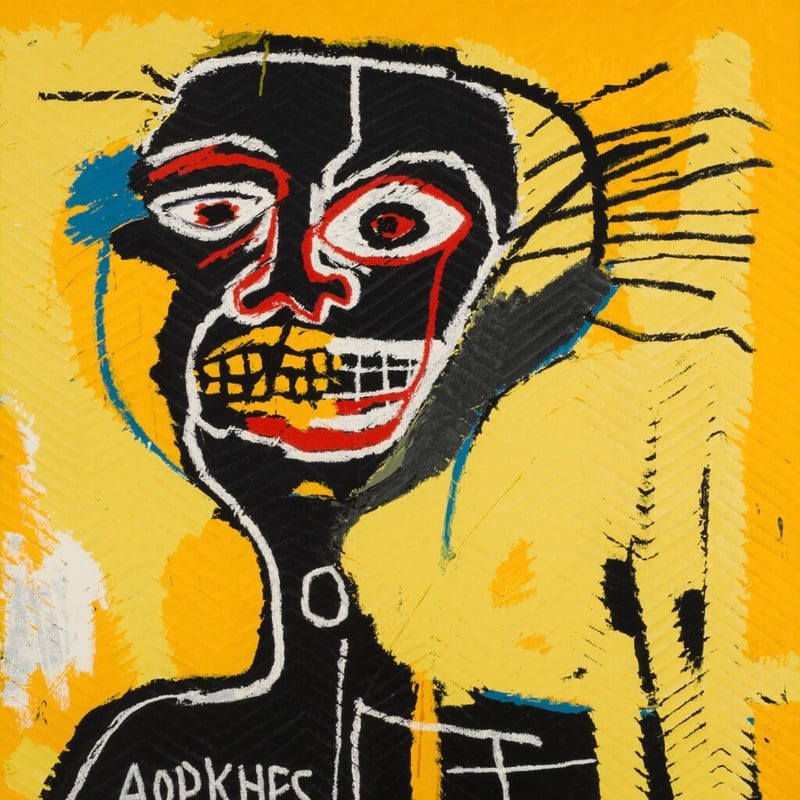
Related Artworks You Might Like
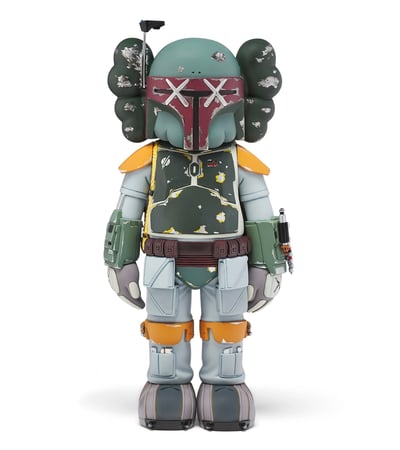
KAWS
Star Wars Boba Fett Companion, 2013
Sculpture / Object
Mixed Media
GBP 5,700
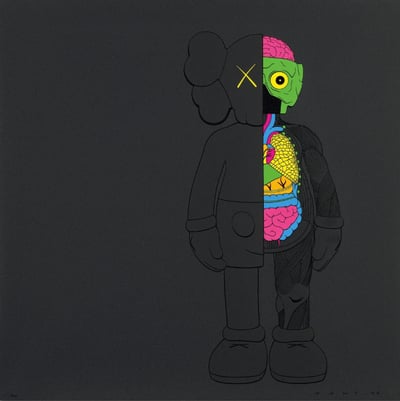
KAWS
Dissected Companion (Black), 2006
Limited Edition Print
Screen-print
GBP 8,000 - 10,000
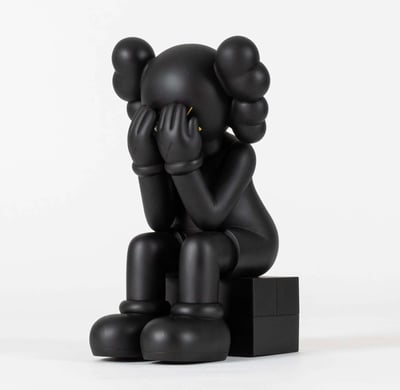
KAWS
Passing Through (Black), 2013
Sculpture / Object
Mixed Media
GBP 1,950
