Details
Artist
Styles
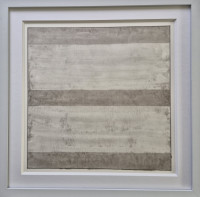
From Skowhegan Suite. Linocut, on Fabriano Tiepolo paper. Signed and numbered. Image: 14 1/4 x 16 3/4 in. (36.2 x 42.5 cm). Sheet: 20 1/2 x 22 3/4 in. (52.1 x 57.8 cm). Published by The Skowhegan School of Painting and Sculpture, Maine, with Oberon Press, New York blindstamp. Literature: Samantha Rippner p. 52 Comet (1992) by Vija Celmins is a linocut that reflects the artist’s long-standing fascination with natural phenomena such as night skies, oceans, and desert surfaces. Known for her meticulous and meditative approach, Celmins creates images that appear both observational and abstract. The composition presents a vast, dark field filled with countless small, carefully rendered points of light, evoking a star-filled night sky. Subtly embedded within this field is a faint streak—a comet—barely distinguishable from the surrounding stars. This understated presence invites close, sustained viewing, encouraging the viewer to slow down and engage with the work’s quiet complexity. Celmins avoids dramatic contrast or narrative emphasis, instead focusing on repetition, detail, and surface. The image resists a clear focal point, creating a sense of infinite space and stillness. The viewer is drawn into a contemplative experience, where perception becomes gradual and immersive.
Comet, 1992
form
Medium
Size
52.1 x 57.8 cm
- Inches
- Centimeters
Edition
Price
- USD
- EUR
- GBP
Details
Artist
Styles
From Skowhegan Suite. Linocut, on Fabriano Tiepolo paper. Signed and numbered. Image: 14 1/4 x 16 3/4 in. (36.2 x 42.5 cm). Sheet: 20 1/2 x 22 3/4 in. (52.1 x 57.8 cm). Published by The Skowhegan School of Painting and Sculpture, Maine, with Oberon Press, New York blindstamp. Literature: Samantha Rippner p. 52 Comet (1992) by Vija Celmins is a linocut that reflects the artist’s long-standing fascination with natural phenomena such as night skies, oceans, and desert surfaces. Known for her meticulous and meditative approach, Celmins creates images that appear both observational and abstract. The composition presents a vast, dark field filled with countless small, carefully rendered points of light, evoking a star-filled night sky. Subtly embedded within this field is a faint streak—a comet—barely distinguishable from the surrounding stars. This understated presence invites close, sustained viewing, encouraging the viewer to slow down and engage with the work’s quiet complexity. Celmins avoids dramatic contrast or narrative emphasis, instead focusing on repetition, detail, and surface. The image resists a clear focal point, creating a sense of infinite space and stillness. The viewer is drawn into a contemplative experience, where perception becomes gradual and immersive.
- Recently Added
- Price (low-high )
- Price (high-low )
- Year (low-high )
- Year (high-low )

Vija Celmins
Comet, 1992
Limited Edition Print
Linocut
USD 32,500

Vija Celmins
Night Sky 1 ( Reversed ), 2002
Limited Edition Print
Mixed Media
USD 21,900

Vija Celmins
Spider-web, 2009
Limited Edition Print
Screen-print
USD 5,750
Related Artists



Related Articles

Artists - November 11, 2024
25 Living Icons: A Generation of Artists Defying Time
Celebrate 25 living legends redefining art! From Kusama to Hockney, explore their enduring creativity and groundbreaking contributions to modern art. Read More


What is minimalism?
Minimalism is a style in music and visual arts characterized by pared-down designs and simplicity. It began in Western art after World War II, gaining prominence particularly in American visual arts. Minimalism draws heavily on aspects of modernism and is often viewed as a reaction against Abstract Expressionism, as well as a precursor to post-minimal art practices. Prominent minimalist artists include Agnes Martin, Donald Judd, Robert Morris, Frank Stella, and Dan Flavin.