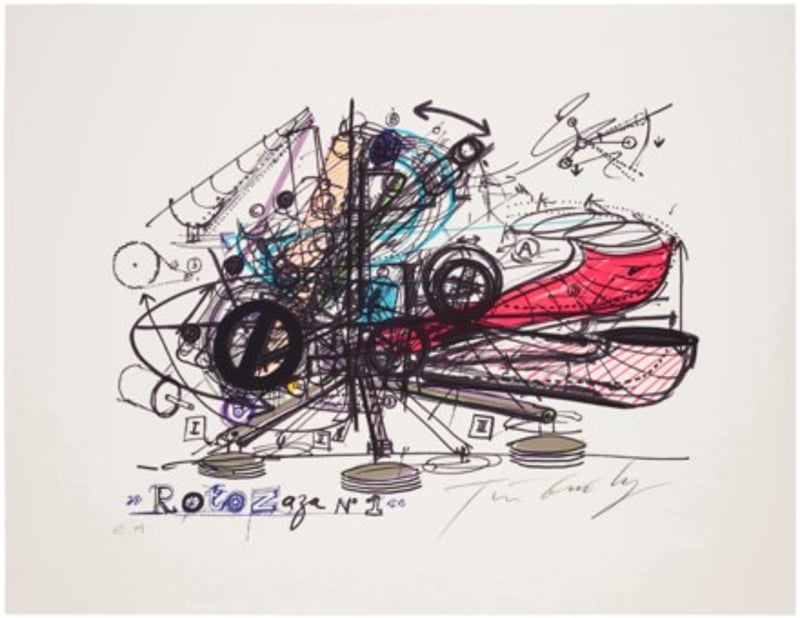
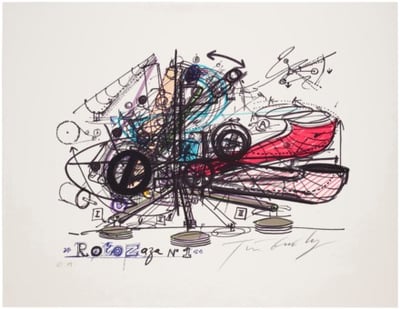
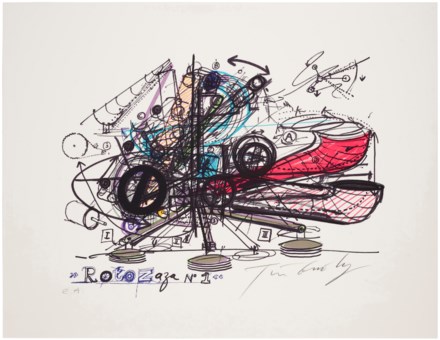
Jean Tinguely’s Roto Zaza No. 1 (1975) is a screen print that embodies his fascination with kinetic art and mechanical forms. The composition is a dynamic, chaotic assembly of abstract shapes, mechanical components, and lines that suggest movement and energy. Vivid colors, including bold reds and blacks, intertwine with sketch-like marks, evoking a machine-like structure that appears in constant motion. The overlapping forms and energetic lines reflect Tinguely's playful yet industrial aesthetic, encouraging viewers to imagine a machine that exists purely in the imagination, where functionality merges with artistic expression.
Artwork Copyright © Jean TinguelyJean Tinguely (Switzerland, 1925–1991) was a Swiss sculptor renowned for his kinetic art, creating mechanical sculptures that often satirized automation and the overproduction of material goods. His notable works include 'Homage to New York' (1960), a self-destructing sculpture exhibited at the Museum of Modern Art in New York.
Artwork Copyright © Jean TinguelyRoto Zaza No. 1, 1975
Form
Medium
Size
- Inches
- Centimeters
Edition
Price
Available works →
- Authenticity Guaranteed
- Insured Shipping
- Online Since 2005
●
●Inventory 8188
●Signed
●Comes with gallery invoice and certificate
●Sell Us a Similar Artwork. Learn more.
Jean Tinguely’s Roto Zaza No. 1 (1975) is a screen print that embodies his fascination with kinetic art and mechanical forms. The composition is a dynamic, chaotic assembly of abstract shapes, mechanical components, and lines that suggest movement and energy. Vivid colors, including bold reds and blacks, intertwine with sketch-like marks, evoking a machine-like structure that appears in constant motion. The overlapping forms and energetic lines reflect Tinguely's playful yet industrial aesthetic, encouraging viewers to imagine a machine that exists purely in the imagination, where functionality merges with artistic expression.
Artwork Copyright © Jean TinguelyJean Tinguely (Switzerland, 1925–1991) was a Swiss sculptor renowned for his kinetic art, creating mechanical sculptures that often satirized automation and the overproduction of material goods. His notable works include 'Homage to New York' (1960), a self-destructing sculpture exhibited at the Museum of Modern Art in New York.
Artwork Copyright © Jean TinguelyAvailability
Size
Form
Medium
SORT BY
Jean Tinguely
Meta – Matic N9, 1960
Drawing / Watercolor
Pen and ink
EUR 500
Jean Tinguely
Shooting paintings, 1970
Drawing / Watercolor
Ink
EUR 4,000
Jean Tinguely
Fontaine Joe Syffert from Eight by Eight, 1984
Limited Edition Print
Screen-print
USD 1,300
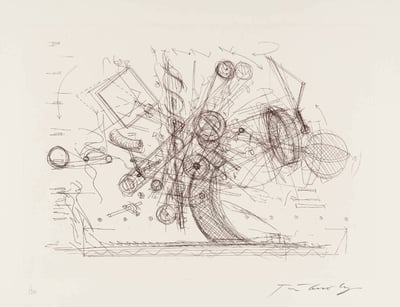
Jean Tinguely
Chaos I, 1973
Limited Edition Print
Etching
Currently Not Available
Jean Tinguely
Roto Zaza No. 1, 1975
Limited Edition Print
Screen-print
Currently Not Available
Related Artists


Related Articles

Popular, News, Artists - January 27, 2026
Gerhard Richter at Fondation Louis Vuitton: Why It Matters for Collectors
Art dealer Kris Ghesquière examines the Gerhard Richter exhibition at Fondation Louis Vuitton and its significance for collectors and the art market.Read More

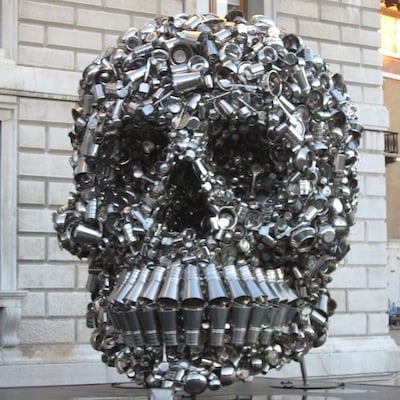
Artwork by Gupta
What is junk art?
Junk art is a form of art that demonstrates how any material or object can be used to create a wide range of paintings, sculptures, installations, and assemblages. Many Junk Art pieces are made using ordinary materials found in everyday life. By applying artistic knowledge and skills, artists can transform these common objects into remarkable works of art.

Jean Tinguely
Roto Zaza No. 1, 1975
49.9 x 64.8 cm


