Details
Artist
Styles
// Collage 1 - Z by Daniel Spoerri is a mixed media collage created in 2017. This artwork combines simple yet striking visual elements: a bold, sweeping pink brushstroke intersects with a small patch of fabric embroidered with a stylized blue letter Z. The interplay between the abstract brushwork and the textured textile element adds depth and invites tactile curiosity. The stamped text, reading Attention, Œuvre d'art, humorously comments on the concept of art as a collectible object, a recurring theme in Spoerri's oeuvre. Known for his work in the Nouveau Réalisme movement, Spoerri often explores everyday objects in unconventional compositions, creating an artwork that blurs the boundaries between ordinary materials and fine art.
Details
Artist
Styles
// Collage 1 - Z by Daniel Spoerri is a mixed media collage created in 2017. This artwork combines simple yet striking visual elements: a bold, sweeping pink brushstroke intersects with a small patch of fabric embroidered with a stylized blue letter Z. The interplay between the abstract brushwork and the textured textile element adds depth and invites tactile curiosity. The stamped text, reading Attention, Œuvre d'art, humorously comments on the concept of art as a collectible object, a recurring theme in Spoerri's oeuvre. Known for his work in the Nouveau Réalisme movement, Spoerri often explores everyday objects in unconventional compositions, creating an artwork that blurs the boundaries between ordinary materials and fine art.
- Recently Added
- Price (low-high )
- Price (high-low )
- Year (low-high )
- Year (high-low )

Daniel Spoerri
Collage 2 - E, 2017
Drawing / Watercolor
Collage
EUR 500
Related Artists


Related Articles

Popular, Artists - March 29, 2023
The Perky Ruminations of Nobuyoshi Araki: Highlights and Photographs from an Eros Diary
Explore the provocative world of Nobuyoshi Araki, Japan’s iconic photographer. Discover his captivating works blending eroticism, life, and cultural introspection. Read More

What is Nouveau Realism?
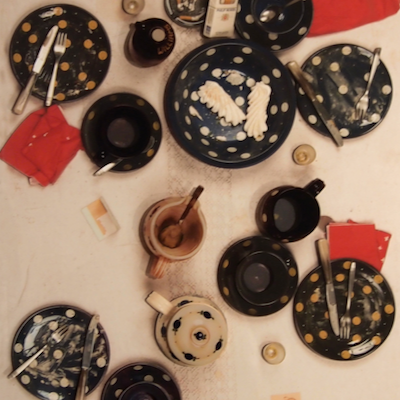
Nouveau Réalisme is an artistic movement founded in 1960 by art critic Pierre Restany and painter Yves Klein during a collective exhibition at a gallery in Milan. Restany wrote the original manifesto in April 1960, proclaiming the movement. In October of that year, nine artists, including Martial Raysse, Yves Klein, Daniel Spoerri, Jean Tinguely, Arman, Pierre Restany, and three Ultra-Lettrists—Jacques de la Villeglé, François Dufrêne, and Raymond Hains—signed the declaration. In 1961, the movement expanded to include Mimmo Rotella, Niki de Saint Phalle, Gérard Deschamps, and César. The movement emphasized a return to reality in art, often incorporating everyday objects and exploring the boundaries between art and life.