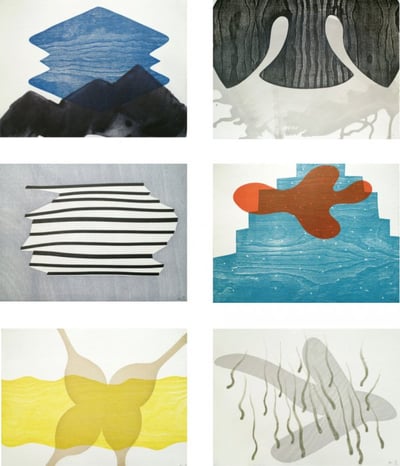
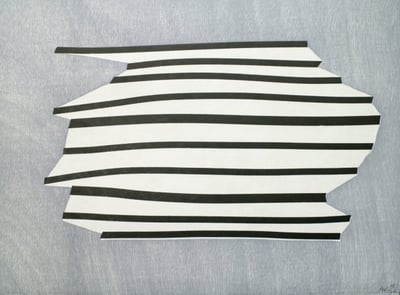
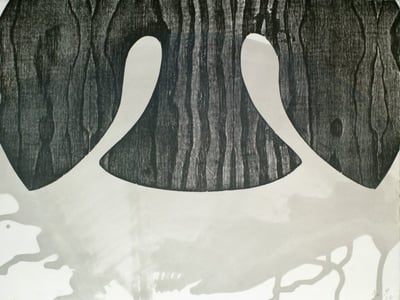
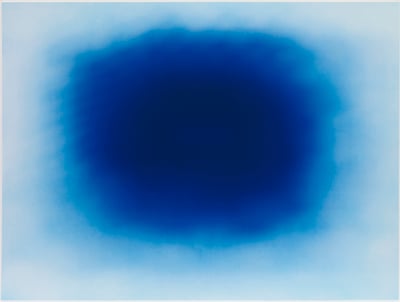
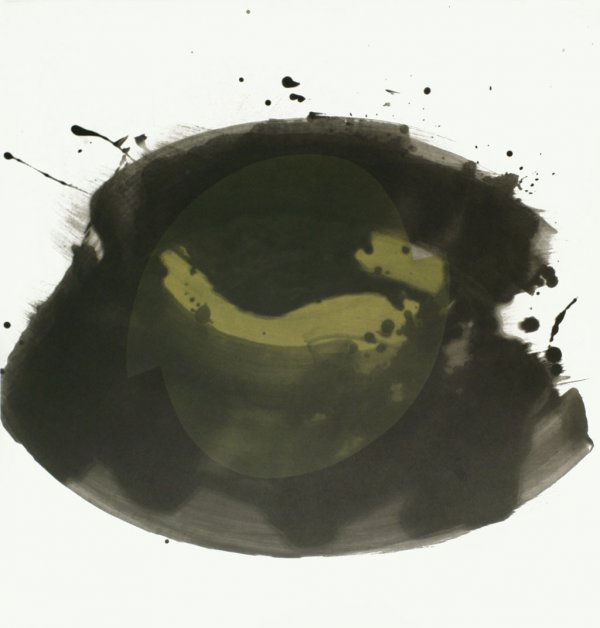
Direct bite and aquatint - 2 plates of 64 x 61 cm. Printed on Zerkall-Bu?tten, 300 gr. of 82 x 77 cm.
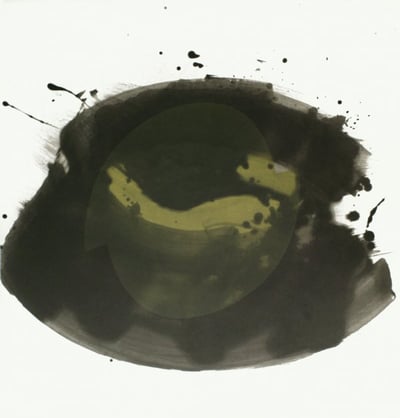
Alison Wilding's Out There (Spin) (2010) is an evocative aquatint print characterized by its organic and abstract form. The composition features a large, dark, circular shape with splattered edges, creating a sense of energy and fluidity. Within this dark form, a translucent yellow-green area subtly emerges, adding a layered complexity to the piece. The interplay between the dense black tones and the lighter, almost ethereal center gives the artwork a sense of depth and introspection. Printed on Zerkall-Bütten paper, Out There (Spin) showcases Wilding’s skill in balancing bold, expressive marks with softer, contemplative tones, inviting viewers to explore the mysterious central space.
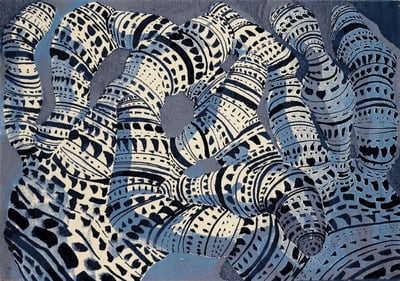
Ludwig Wilding (Germany, 1927–2010) was a pivotal figure in Op and Kinetic art. His three-dimensional works, often in black and white, created dynamic optical illusions that challenged visual perception. Exhibiting internationally, Wilding's art continues to influence contemporary explorations of movement and space.
AquatintIntaglio is a printmaking technique where the artist creates marks on a metal plate that hold ink or dye. The inked plate is then pressed onto paper, transferring the ink to the sheet. This process can be repeated multiple times depending on the technique. Intaglio methods, such as etching, often involve applying a mordant (acid) to the metal plate to create the design. Intaglio encompasses various techniques, including engraving, etching, and drypoint.
Direct bite and aquatint - 2 plates of 64 x 61 cm. Printed on Zerkall-Bu?tten, 300 gr. of 82 x 77 cm.
Alison Wilding's Out There (Spin) (2010) is an evocative aquatint print characterized by its organic and abstract form. The composition features a large, dark, circular shape with splattered edges, creating a sense of energy and fluidity. Within this dark form, a translucent yellow-green area subtly emerges, adding a layered complexity to the piece. The interplay between the dense black tones and the lighter, almost ethereal center gives the artwork a sense of depth and introspection. Printed on Zerkall-Bütten paper, Out There (Spin) showcases Wilding’s skill in balancing bold, expressive marks with softer, contemplative tones, inviting viewers to explore the mysterious central space.
Ludwig Wilding (Germany, 1927–2010) was a pivotal figure in Op and Kinetic art. His three-dimensional works, often in black and white, created dynamic optical illusions that challenged visual perception. Exhibiting internationally, Wilding's art continues to influence contemporary explorations of movement and space.
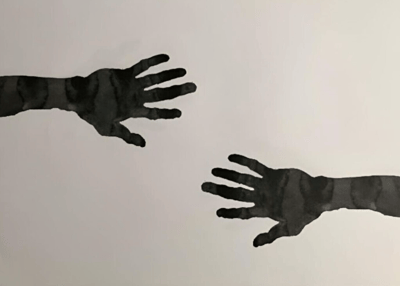
Different performances have different kinds of outcomes. I would say live bodies sometimes activate a space.
- Alison Wilding
Alison Wilding is a twentieth century English sculptor. She studied at Nottingham College of Art, the Ravensbourne College of Art and Design and finally at the Royal College of Art, where she left in 1973. Although she began her career specializing in multimedia artworks, she is perhaps best known for her abstract sculptures which she used a large array of materials to create. She has worked with wood, bronze, stone, wax, silk, steel and a whole host of other materials. One of her best known pieces of work is called Stormy Weather and beeswax, oil and pigment rubbed into steel. She was inventive and groundbreaking in her methodologies. She made one significant piece of public artwork which is located on the River Wear in Sunderland. The piece is calledAmbit and consists of a number of steel tubes which float on the river and are lit at night. Alison Wilding was nominated for the Turner Prize in 1988 and 1992.
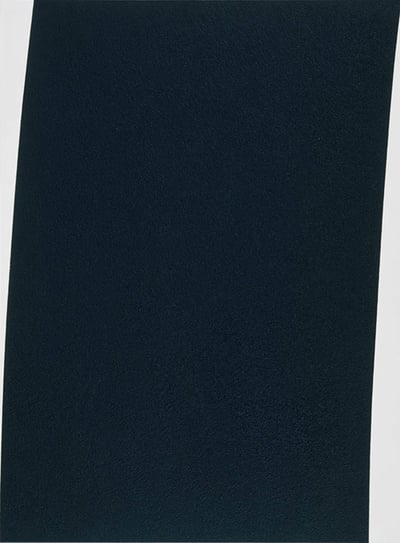
Minimalism is a style in music and visual arts characterized by pared-down designs and simplicity. It began in Western art after World War II, gaining prominence particularly in American visual arts. Minimalism draws heavily on aspects of modernism and is often viewed as a reaction against Abstract Expressionism, as well as a precursor to post-minimal art practices. Prominent minimalist artists include Agnes Martin, Donald Judd, Robert Morris, Frank Stella, and Dan Flavin.