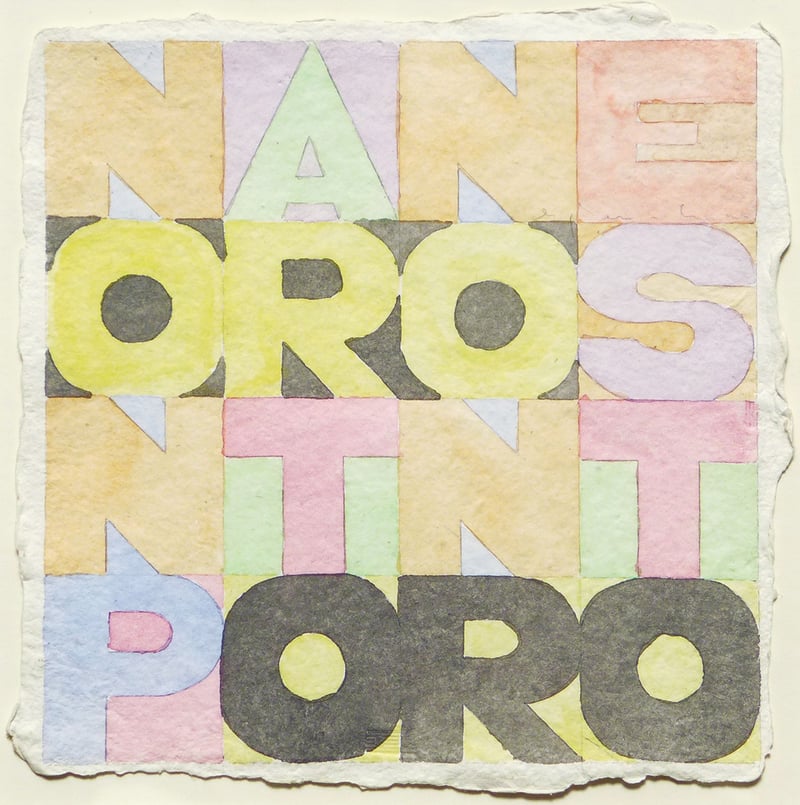
Watercolor on handmade paper
- Certificate from Archivio Alighiero Boetti, nº 10271
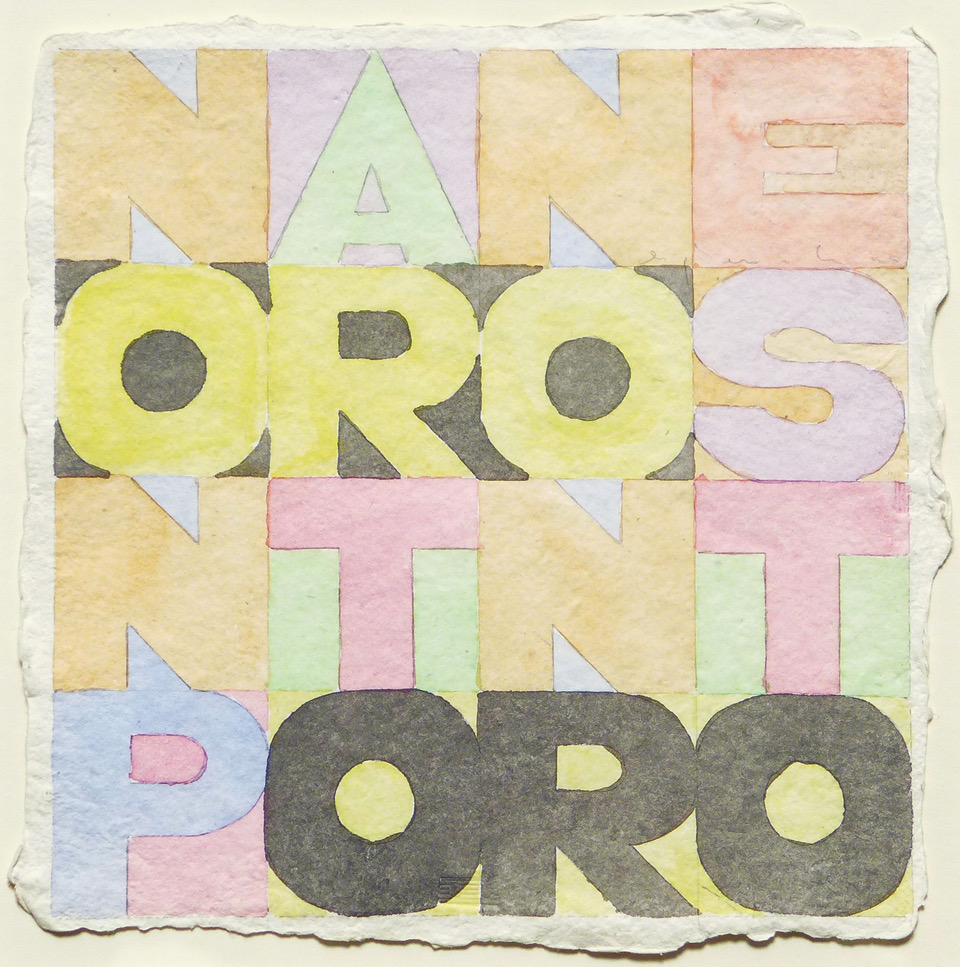
Alighiero Boetti's Non parto non resto (Nove quadrati), created in 1979, is a unique watercolor composition on handmade paper that measures 19.5 x 19 cm. This artwork, with its pastel shades of yellow, pink, green, and lavender, combines lettered squares in a grid, forming words that evoke the Italian phrase 'Non parto non resto,' meaning 'I do not leave, I do not stay.' The piece exemplifies Boetti's fascination with language, pattern, and symmetry, as well as his exploration of dualities and paradoxes in human experience. The irregular edges of the handmade paper enhance its organic feel, juxtaposed against the geometric arrangement of letters. The piece holds a certificate from Archivio Alighiero Boetti, No. 10271.
Artwork Copyright © Alighiero BoettiAlighiero Boetti (Italy, 1940–1994) was a key figure in the Arte Povera movement, celebrated for his conceptual and collaborative approach. Renowned for his embroidered maps and textual works, Boetti’s art often explored themes of duality, language, and global interconnectedness. His innovative practice blurred boundaries between artist and artisan.
Artwork Copyright © Alighiero BoettiNon parto non resto (Nove quadrati), 1979
Form
Medium
Size
- Inches
- Centimeters
Edition
Price
- Authenticity Guaranteed
- Insured Shipping
- Online Since 2005
●Inventory 15196
●Signed
●Comes with gallery invoice and certificate
●Sell Us a Similar Artwork. Learn more.
Watercolor on handmade paper
- Certificate from Archivio Alighiero Boetti, nº 10271
Alighiero Boetti's Non parto non resto (Nove quadrati), created in 1979, is a unique watercolor composition on handmade paper that measures 19.5 x 19 cm. This artwork, with its pastel shades of yellow, pink, green, and lavender, combines lettered squares in a grid, forming words that evoke the Italian phrase 'Non parto non resto,' meaning 'I do not leave, I do not stay.' The piece exemplifies Boetti's fascination with language, pattern, and symmetry, as well as his exploration of dualities and paradoxes in human experience. The irregular edges of the handmade paper enhance its organic feel, juxtaposed against the geometric arrangement of letters. The piece holds a certificate from Archivio Alighiero Boetti, No. 10271.
Artwork Copyright © Alighiero BoettiAlighiero Boetti (Italy, 1940–1994) was a key figure in the Arte Povera movement, celebrated for his conceptual and collaborative approach. Renowned for his embroidered maps and textual works, Boetti’s art often explored themes of duality, language, and global interconnectedness. His innovative practice blurred boundaries between artist and artisan.
Artwork Copyright © Alighiero Boetti- Recently Added
- Price (Low-High)
- Price (High-Low)
- Year (Low-High)
- Year (High-Low)
Alighiero Boetti
Non parto non resto (Nove quadrati), 1979
Drawing / Watercolor
Watercolor
Inquire For Price
Alighiero Boetti
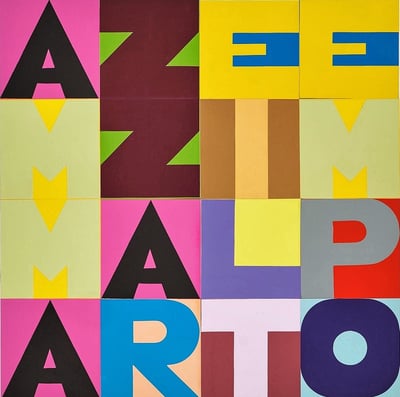
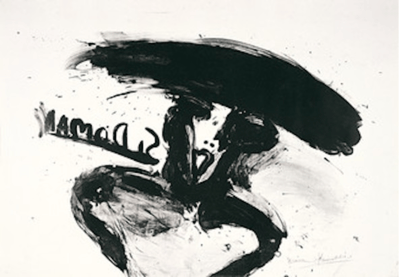
Ammazzare il tempo, 1983
Limited Edition Print
Serigraph
Currently Not Available
Alighiero Boetti
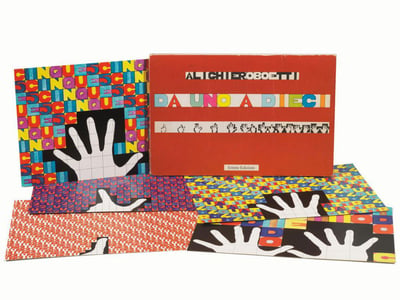
Da uno a dieci, 1980
Limited Edition Print
Offset Print
Currently Not Available
Related Artists

Related Articles
Popular, Art Movements - August 7, 2024
Art and Social Change: How Contemporary Artists Address Global Issues
Discover how contemporary artists drive social change! Explore impactful works addressing global issues like inequality, climate change, and human rights.Read More

Artwork by John Baldessari
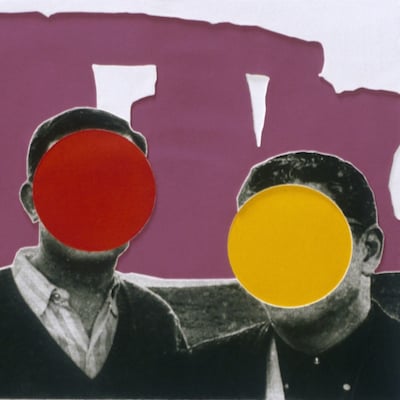
What is conceptual art?
Sometimes referred to as Conceptualism, this is an art form where the idea(s) or concept(s) behind the work take precedence over material concerns and traditional aesthetics. Many conceptual artworks can be created by anyone simply by following written instructions. The concept or idea is the most essential aspect of the artwork.

Alighiero Boetti
Non parto non resto (Nove quadrati), 1979
19.5 x 19 cm


