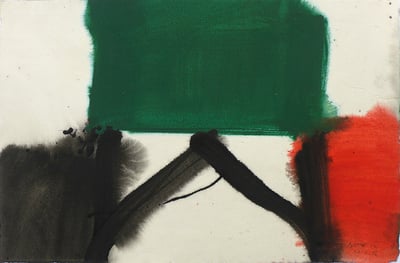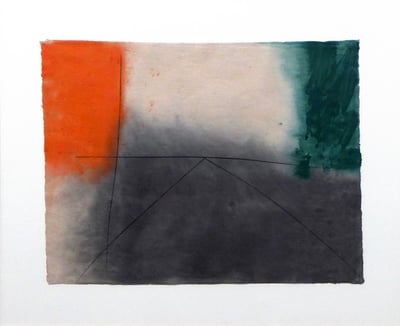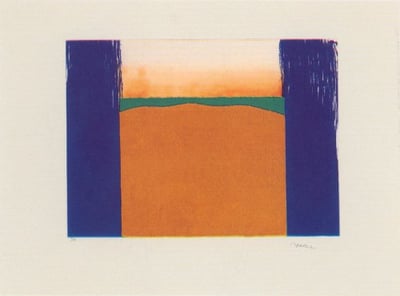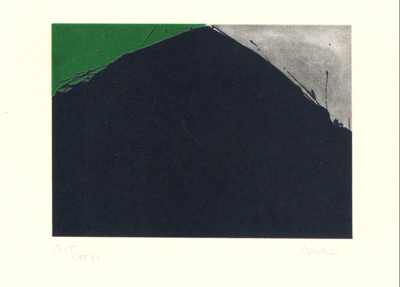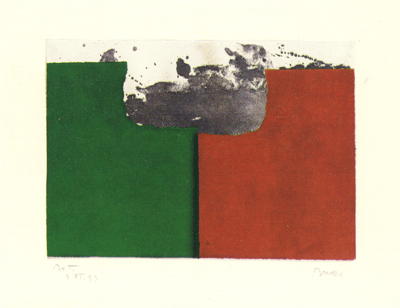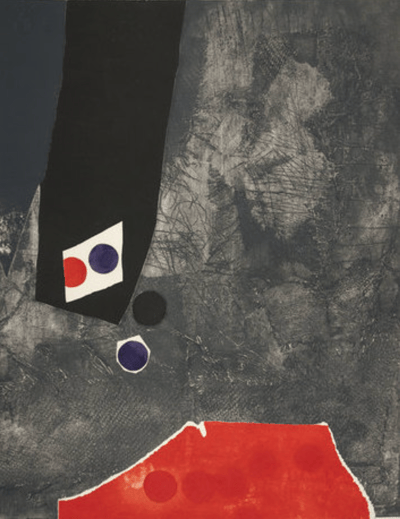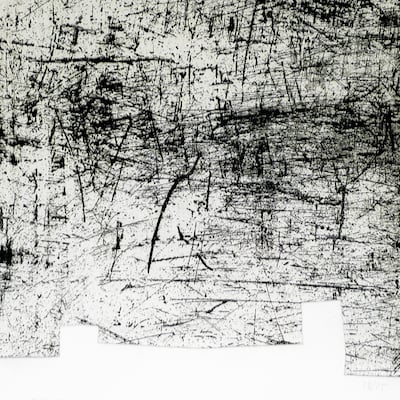
// Records de paisatge-3 by Alfons Borrell, a 1993 etching, uses bold abstraction to evoke the essence of a landscape. Two dark, monolithic shapes dominate the foreground, creating a powerful divide that draws the eye toward the vibrant red-orange backdrop. The intense color suggests a sunset or fiery sky, contrasting sharply with the deep black forms that resemble cliffs or mountainsides. The use of minimal linework and splatters within the red area adds texture and dynamism, evoking a sense of rugged, untamed nature. Borrell’s piece captures the drama and intensity of natural landscapes with a strikingly minimal yet evocative composition.
Alfons Borrell (Spain, 1931–2020) was a master of Catalan lyrical abstraction. Transitioning from figurative art to abstract expressionism, his work featured large monochromatic surfaces and geometric forms. Renowned for his focus on color and simplicity, Borrell’s art conveyed introspection and a search for purity in expression.
EtchingEtching is a technique where a design is created on a metal surface by using a strong acid or mordant to eat away the unprotected parts of the metal, leaving the desired pattern in relief (intaglio). In modern art and manufacturing, different chemicals may be used depending on the material being etched.
// Records de paisatge-3 by Alfons Borrell, a 1993 etching, uses bold abstraction to evoke the essence of a landscape. Two dark, monolithic shapes dominate the foreground, creating a powerful divide that draws the eye toward the vibrant red-orange backdrop. The intense color suggests a sunset or fiery sky, contrasting sharply with the deep black forms that resemble cliffs or mountainsides. The use of minimal linework and splatters within the red area adds texture and dynamism, evoking a sense of rugged, untamed nature. Borrell’s piece captures the drama and intensity of natural landscapes with a strikingly minimal yet evocative composition.
Alfons Borrell (Spain, 1931–2020) was a master of Catalan lyrical abstraction. Transitioning from figurative art to abstract expressionism, his work featured large monochromatic surfaces and geometric forms. Renowned for his focus on color and simplicity, Borrell’s art conveyed introspection and a search for purity in expression.
The eerily sobering works of Alfons Borrell have seen him rise as one of the most distinguished figures of abstract art in his home of Catalan. Borrell’s art style evolved and flourished throughout his years of painting. Graduating from the School of Fine Arts of Sant Jordi, he initially adapted a style within figuration. This quickly developed into abstract expressionism and gestural painting, with Borrell eventually landing on a unique style of his own. The stylistic nuances of Alfons Borrell’s work stir feelings of dysphoria and disassociation within the audience. Borrell asks questions through his work. In pieces such as his 1997 Illes 1, or 1990’s Espais 6¸ we see huge square masses of color imposing on the painting’s form. These massive shapes of color were not atypical for Borrell. Particularly in his later work, Borrell employs this technique to disrupt the traditional flow of abstraction. Alfons Borrel is a master of creating paintings that exist within a space of surrealism, detachment and deep expression.
Abstract art uses form, shape, line, and color to create a visual experience without attempting to represent external reality. The composition exists independently of the world's visual references, focusing on expressing ideas and emotions through non-representational means.