Details
Artist
Styles
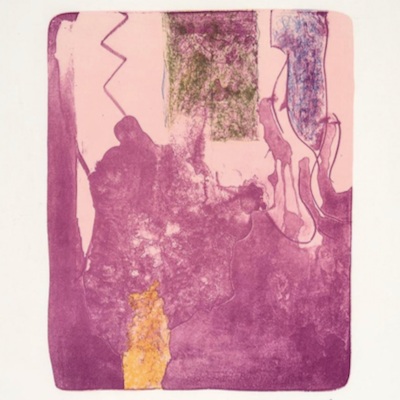
Color etching and aquatint on vellum paper. Signed, dated and numbered by the artist. Published by Galerie de France, Paris.// A luminous etching and aquatint in which Zao Wou-Ki conjures a brooding, atmospheric landscape suspended between East and West. Washes of olive green and grey dissolve into dark, calligraphic forms at the composition's base, evoking both the mists of traditional Chinese ink painting and the gestural freedom of post-war European abstraction. This 1974 print belongs to the artist's most sought-after graphic period, when his mastery of the aquatint medium reached its zenith.// Zao Wou-Ki's abstraction embodies lyrical gesture and gestural freedom, where etched marks and aquatint washes converge in rhythmic composition. The work exemplifies the artist's poetic abstraction—neither purely geometric nor representational—creating visual expression that privileges emotion and spontaneous mark-making.
Untitled (A. 246A), 1974
form
Medium
Size
26.8 x 20.9 cm
- Inches
- Centimeters
Edition
Range
- USD
- EUR
- GBP
Details
Artist
Styles
Color etching and aquatint on vellum paper. Signed, dated and numbered by the artist. Published by Galerie de France, Paris.// A luminous etching and aquatint in which Zao Wou-Ki conjures a brooding, atmospheric landscape suspended between East and West. Washes of olive green and grey dissolve into dark, calligraphic forms at the composition's base, evoking both the mists of traditional Chinese ink painting and the gestural freedom of post-war European abstraction. This 1974 print belongs to the artist's most sought-after graphic period, when his mastery of the aquatint medium reached its zenith.// Zao Wou-Ki's abstraction embodies lyrical gesture and gestural freedom, where etched marks and aquatint washes converge in rhythmic composition. The work exemplifies the artist's poetic abstraction—neither purely geometric nor representational—creating visual expression that privileges emotion and spontaneous mark-making.
- Recently Added
- Price (low-high )
- Price (high-low )
- Year (low-high )
- Year (high-low )

Zao Wou-Ki
Untitled (A. 246A), 1974
Limited Edition Print
Etching And Aquatint
EUR 4,500 - 6,000

Zao Wou-Ki
Sonnets De Shakespeare II, 1994
Limited Edition Print
Etching
EUR 2,800

Zao Wou-Ki
Sonnets De Shakespeare I, 1994
Limited Edition Print
Etching
EUR 2,800

Zao Wou-Ki
Composition, 1967
Limited Edition Print
Etching
EUR 3,750

Zao Wou-Ki
Untitled (Agerup 243), 1973
Limited Edition Print
Aquatint
EUR 5,400

Zao Wou-Ki
Album Internacional, 1973
Limited Edition Print
Lithograph
EUR 2,250

Zao Wou-Ki
Petit Jardin, 1956
Limited Edition Print
Lithograph
EUR 10,000

Zao Wou-Ki
Untitled (A. 127), 1960
Limited Edition Print
Lithograph
EUR 5,000

Zao Wou-Ki
Untitled (A.121), 1959
Limited Edition Print
Lithograph
EUR 10,000

Zao Wou-Ki
Untitled (A. 394), 1998
Limited Edition Print
Lithograph
EUR 6,000

Zao Wou-Ki
Untitled (A. 390), 1998
Limited Edition Print
Lithograph
EUR 6,000

Zao Wou-Ki
Paysage Au Soleil, 1950
Limited Edition Print
Etching
Currently Not Available
Related Artists


Related Articles

Popular, Art Movements - November 20, 2024
Understanding Abstract Expressionism: Emotion and Gesture
Explore the emotional depth of Abstract Expressionism! Discover how artists like Pollock and Rothko used gesture and color to convey human complexity. Read More

What is abstract expressionism?
Abstract Expressionism is an art movement that emerged in the United States during the 1940s and 1950s. Characterized by large, abstract canvases, the movement emphasized spontaneous, expressive brushwork and the use of color and form to convey emotion rather than represent reality. Artists like Jackson Pollock, Mark Rothko, and Willem de Kooning are key figures in this movement. Abstract Expressionism marked a shift in the art world, making New York City a center of the international art scene.