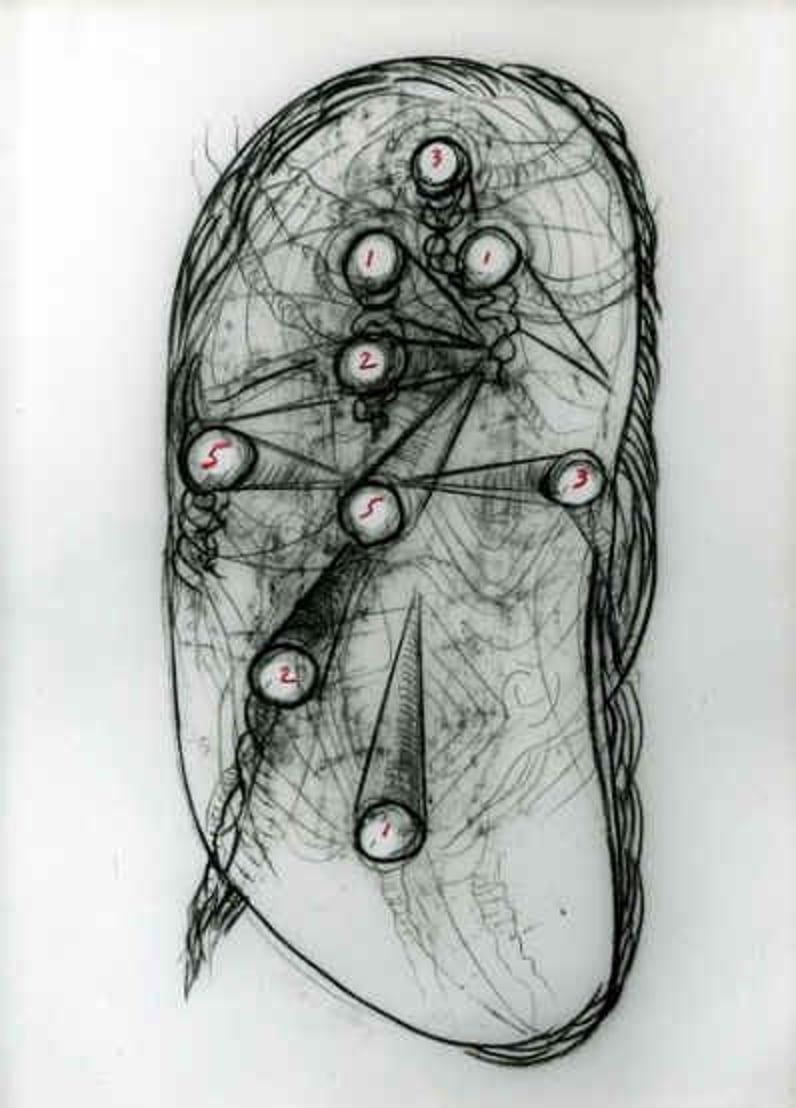
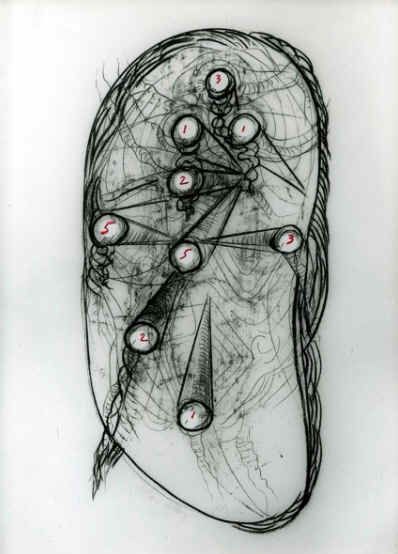
'La scala di Fibonacci' by Mario Merz is a lithograph measuring 87 × 62 cm, produced in 1988. Within an ovoid boundary of looping black lines, ten cylindrical tube-like forms are distributed across the composition, each bearing a red numeral. The numbers — 1, 1, 2, 3, 5, 3, 2, 1, and variants — follow the Fibonacci sequence, a recurring structural obsession in Merz's practice from the late 1960s onward. For Merz, the sequence was not mathematical decoration but a model of organic growth found in nature, aligning with Arte Povera's broader turn away from industrial and subjective modes toward phenomena rooted in physical reality. The dense cross-hatching and radiating lines connecting the nodes give the sheet the quality of a diagrammatic study — part anatomical drawing, part cosmological map.
La scala di Fibonacci, 1988
Form
Medium
Size
- Inches
- Centimeters
Edition
Price
- Authenticity Guaranteed
- Insured Shipping
- Online Since 2005
'La scala di Fibonacci' by Mario Merz is a lithograph measuring 87 × 62 cm, produced in 1988. Within an ovoid boundary of looping black lines, ten cylindrical tube-like forms are distributed across the composition, each bearing a red numeral. The numbers — 1, 1, 2, 3, 5, 3, 2, 1, and variants — follow the Fibonacci sequence, a recurring structural obsession in Merz's practice from the late 1960s onward. For Merz, the sequence was not mathematical decoration but a model of organic growth found in nature, aligning with Arte Povera's broader turn away from industrial and subjective modes toward phenomena rooted in physical reality. The dense cross-hatching and radiating lines connecting the nodes give the sheet the quality of a diagrammatic study — part anatomical drawing, part cosmological map.
- Recently Added
- Price (Low-High)
- Price (High-Low)
- Year (Low-High)
- Year (High-Low)

Mario Merz
Senza titolo, 1991
Limited Edition Print
Mixed Media
EUR 1,600
Mario Merz
La scala di Fibonacci, 1988
Limited Edition Print
Lithograph
Currently Not Available
Related Artists
Related Articles

News, Art Movements - July 28, 2023
The Conundrum of Technology's Experiment with Contemporary Art: A Mercurial Maiden Voyage
Discover how technology transforms contemporary art, blending innovation with creativity. Explore challenges of authenticity, access, and digital expression.Read More
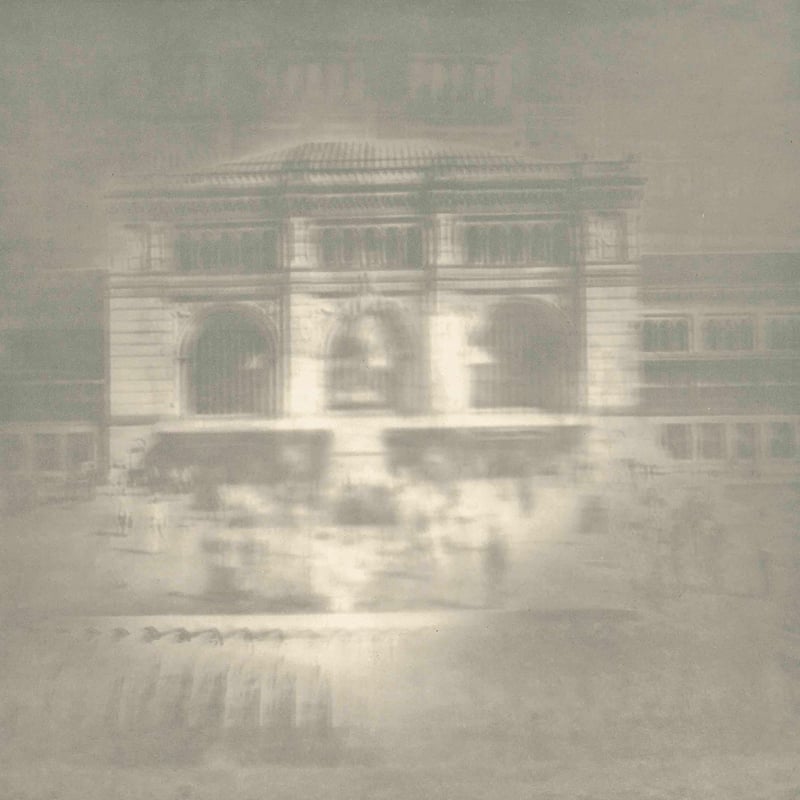
What is New Media Art?
New Media Art is a genre that includes all artworks created using new technologies, such as computer graphics, digital art, virtual art, internet art, computer animation, video games, 3D printing, and robotics. This genre often explores themes related to mass media, telecommunications, and digital electronics. The methods for presenting New Media Art range from installations and performances to virtual and conceptual art

Mario Merz
La scala di Fibonacci, 1988
87 x 62 cm


