Details
Artist
Styles
Framed // S/T - 3 Rosa by Luis Tomasello is a lithograph from 2013 that exemplifies the artist's expertise in kinetic and optical art. The composition consists of a meticulous grid of small, raised squares, each subtly tinted with a gentle pink hue along their edges. This layout creates a dynamic effect as light and shadow interact across the surface, producing an illusion of movement and depth. Tomasello's work often explores the relationship between light and form, inviting viewers to experience a changing perspective based on their position relative to the artwork. This piece, measuring 63 cm by 63 cm, demonstrates his mastery of creating rhythmic optical effects that are both minimalistic and captivating, blending simplicity with a sense of spatial complexity.
S/T - 3 Rosa, 2013
form
Medium
Size
63 x 63 cm
- Inches
- Centimeters
Edition
Price
- USD
- EUR
- GBP
Details
Artist
Styles
Framed // S/T - 3 Rosa by Luis Tomasello is a lithograph from 2013 that exemplifies the artist's expertise in kinetic and optical art. The composition consists of a meticulous grid of small, raised squares, each subtly tinted with a gentle pink hue along their edges. This layout creates a dynamic effect as light and shadow interact across the surface, producing an illusion of movement and depth. Tomasello's work often explores the relationship between light and form, inviting viewers to experience a changing perspective based on their position relative to the artwork. This piece, measuring 63 cm by 63 cm, demonstrates his mastery of creating rhythmic optical effects that are both minimalistic and captivating, blending simplicity with a sense of spatial complexity.
- Recently Added
- Price (low-high )
- Price (high-low )
- Year (low-high )
- Year (high-low )
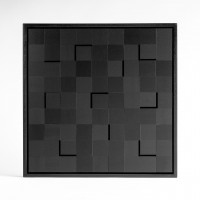
Luis Tomasello
Lumiere Noire Unique VI/X, 2011
Sculpture / Object
Mixed Media
EUR 3,500
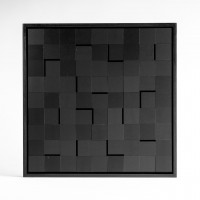
Luis Tomasello
Lumiere Noire Unique V/X, 2011
Sculpture / Object
Mixed Media
EUR 3,500
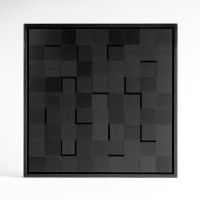
Luis Tomasello
Lumiere Noire Unique IV/X, 2011
Sculpture / Object
Mixed Media
EUR 3,500
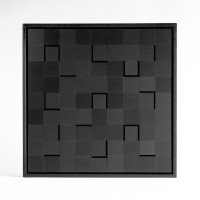
Luis Tomasello
Lumiere Noire Unique III/X, 2011
Sculpture / Object
Mixed Media
EUR 3,500
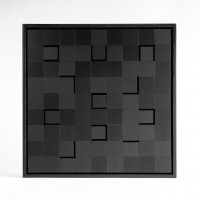
Luis Tomasello
Lumiere Noire Unique II/X, 2011
Sculpture / Object
Mixed Media
EUR 3,500
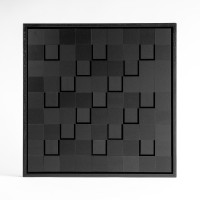
Luis Tomasello
Lumiere Noire Unique I/X, 2011
Sculpture / Object
Mixed Media
EUR 3,500

Luis Tomasello
S/T 1 - Verde, 2013
Limited Edition Print
Lithograph
EUR 3,000

Luis Tomasello
S/t 2, 2012
Sculpture / Object
Mixed Media
EUR 2,200

Luis Tomasello
S/t 3, 2012
Sculpture / Object
Mixed Media
EUR 2,200

Luis Tomasello
S/T - 3 Rosa, 2013
Limited Edition Print
Lithograph
EUR 3,000

Luis Tomasello
Grille Chromoplastique C, 2012
Sculpture / Object
Acrylic Sculpture
EUR 2,000

Luis Tomasello
Lumiere Noire, 2011
Sculpture / Object
Mixed Media
EUR 2,500

Luis Tomasello
ST 1, 2012
Sculpture / Object
Mixed Media
EUR 2,200

Luis Tomasello
S/T 4 - Verde , 2013
Limited Edition Print
Lithograph
EUR 3,000

Luis Tomasello
S/T 4 - Rosa , 2013
Limited Edition Print
Lithograph
EUR 3,000

Luis Tomasello
S/T 4 - Naranja , 2013
Limited Edition Print
Lithograph
EUR 3,000

Luis Tomasello
S/T 3 - Verde, 2013
Limited Edition Print
Lithograph
EUR 3,000

Luis Tomasello
S/T 3 - Naranja , 2013
Limited Edition Print
Lithograph
EUR 3,000

Luis Tomasello
S/T 2 - Verde, 2013
Limited Edition Print
Lithograph
EUR 3,000

Luis Tomasello
S/T 2 Rosa , 2013
Limited Edition Print
Lithograph
EUR 3,000

Luis Tomasello
S/T 2 - Naranja , 2013
Limited Edition Print
Lithograph
EUR 3,000

Luis Tomasello
S/T 1 - Rosa , 2013
Limited Edition Print
Lithograph
EUR 3,000

Luis Tomasello
S/T 1 - Naranja , 2013
Limited Edition Print
Lithograph
EUR 3,000

Luis Tomasello
Chromoplastique 1025, 2013
Sculpture / Object
Wood
EUR 4,000

Luis Tomasello
Grille Chromoplastique B, 2012
Sculpture / Object
Mixed Media
EUR 2,000

Luis Tomasello
Grille Chromoplastique A, 2012
Sculpture / Object
Object
EUR 2,000

Luis Tomasello
Cube Atmosphére Chromoplastique, 2011
Sculpture / Object
Wood
EUR 6,000
Related Artists



Related Articles
Popular, Collecting - July 23, 2025
Sculpture Care and Display: From Plinths to Pedestals in Your Home
Learn how to display and care for sculpture at home—from lighting tips to material care—so your art can truly shine in any space. Read More
What is constructivism?
Constructivism is an architectural and artistic philosophy of Russian origin that emerged as a rejection of the idea of autonomous art. The movement advocated for art to serve practical social purposes. Since its inception in 1919, Constructivism has evolved and significantly impacted 20th-century art movements, influencing major trends such as De Stijl and Bauhaus.