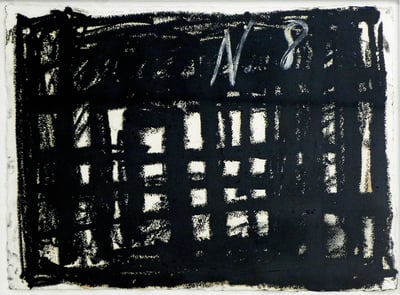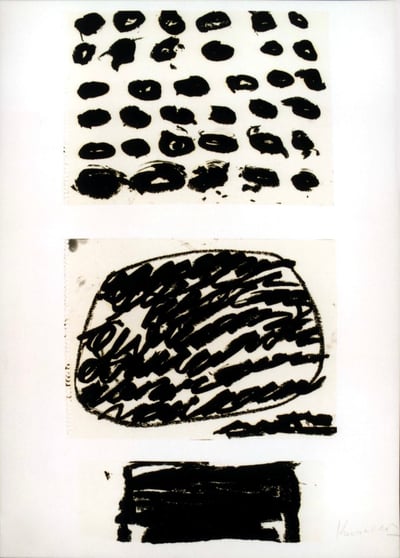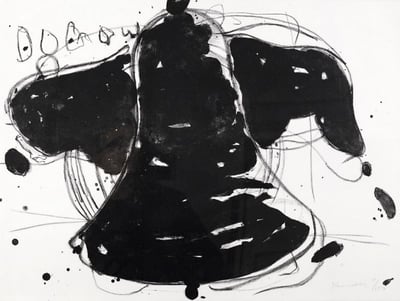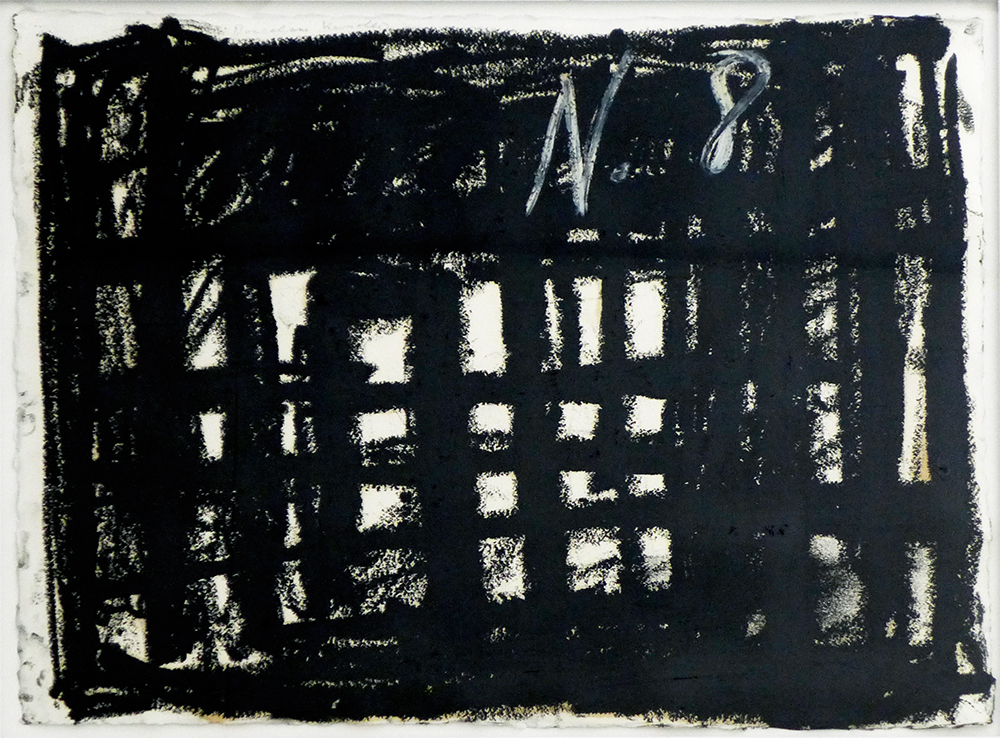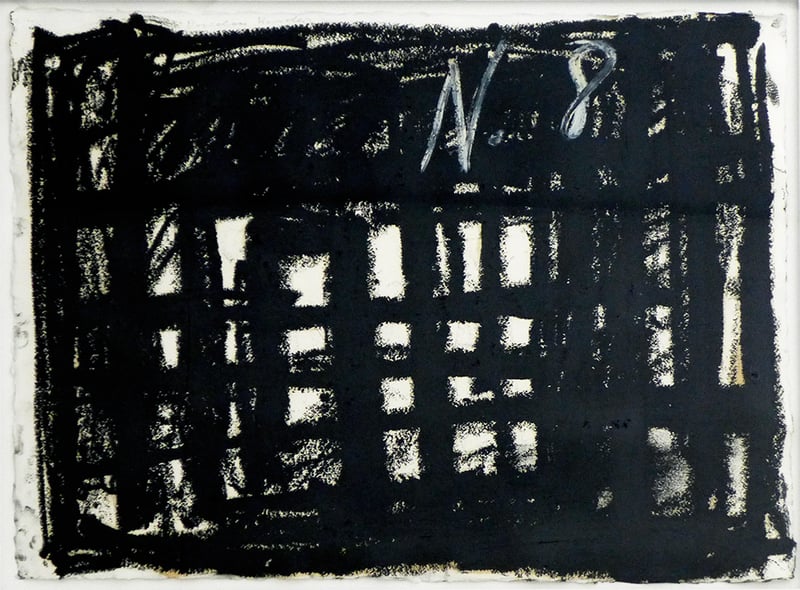
Barcelona II (N8) by Jannis Kounellis, created in 2003, is a mixed media work on paper that exemplifies the artist's raw, expressive approach to materials and composition. The piece is dominated by thick, rough black strokes that form an abstract grid-like structure, filling much of the surface with dense, textured marks. The chaotic, almost oppressive black forms contrast with patches of exposed white paper, creating a stark and powerful interplay of light and dark. The inscription N8 at the top adds a cryptic element, perhaps hinting at a sequence or a symbolic meaning within the work. Known for his association with Arte Povera, Kounellis often incorporated non-traditional materials and bold gestures in his art, emphasizing the physicality of his process. This piece evokes a sense of confinement or enclosure, inviting viewers to interpret its intense and visceral energy.
Jannis Kounellis (Greece, 1936–2017) was a pivotal figure in the Arte Povera movement, known for his innovative use of unconventional materials like coal, steel, burlap, and live animals. His installations and sculptures explored themes of history, memory, and industrialization, blending the poetic with the political in powerful visual narratives.
Mixed MediaMixed media refers to artwork that incorporates more than one medium within a single piece. Unlike multimedia art, which combines distinct forms of visual art and often includes elements like sound, video, or digital media, mixed media focuses on combining traditional art materials, such as paint, ink, and collage. Mixed media art allows artists to achieve a wide range of effects and textures by layering and blending different materials.
Barcelona II (N8) by Jannis Kounellis, created in 2003, is a mixed media work on paper that exemplifies the artist's raw, expressive approach to materials and composition. The piece is dominated by thick, rough black strokes that form an abstract grid-like structure, filling much of the surface with dense, textured marks. The chaotic, almost oppressive black forms contrast with patches of exposed white paper, creating a stark and powerful interplay of light and dark. The inscription N8 at the top adds a cryptic element, perhaps hinting at a sequence or a symbolic meaning within the work. Known for his association with Arte Povera, Kounellis often incorporated non-traditional materials and bold gestures in his art, emphasizing the physicality of his process. This piece evokes a sense of confinement or enclosure, inviting viewers to interpret its intense and visceral energy.
Jannis Kounellis (Greece, 1936–2017) was a pivotal figure in the Arte Povera movement, known for his innovative use of unconventional materials like coal, steel, burlap, and live animals. His installations and sculptures explored themes of history, memory, and industrialization, blending the poetic with the political in powerful visual narratives.
The vertical line is the only way to communicate with the universe.
- Jannis Kounellis
Greek painter and sculptor Jannis Kounellis was synonymous with the Arte Povera — Poor Art movement. After attending an art college in Athens, Kounellis relocated to Rome and studied at the Italian capital's Academia di Bella Art. Jannis Kounellis's early career was as a painter who created works inspired by simple images like street advertisements. However as he became immersed in Arte Povera, an artistic realm which challenged conventional political, societal and artistic norms Kounellis also branched out into sculpture and installation art. Jannis Kounellis’s public collections have been displayed in famous museums like the Tate in London, the Museum of Modern Art (MoMA) in New York City, the Solomon R. Guggenheim Museum, also in New York and the Centre Pompidou in Paris, France. Group displays of his Kounellis and other artists involved with the Arte Povera movement were seen in shows across Europe from the late 1960s through the mid-1980s. Jannis Kounellis, along with Alighiero Boetti, Luciano Fabro, Giulio Paolini, Pino Pascali and Emilio Prini were charter members of the Arte Povera movement.
A found object is a term used to describe a man-made or natural object, or a fragment of one, that an artist discovers or purchases and keeps for inspiration or as a work of art. The artist may also modify the object or incorporate it into a collage or assemblage, transforming it into a new piece of art.