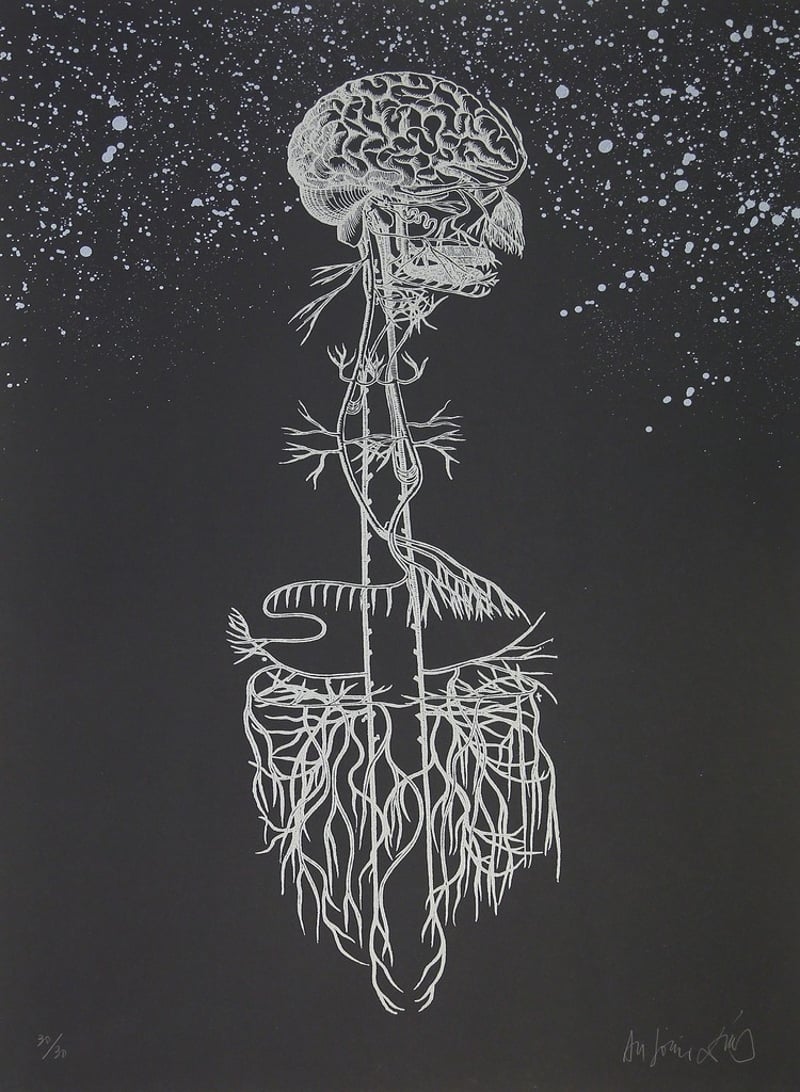
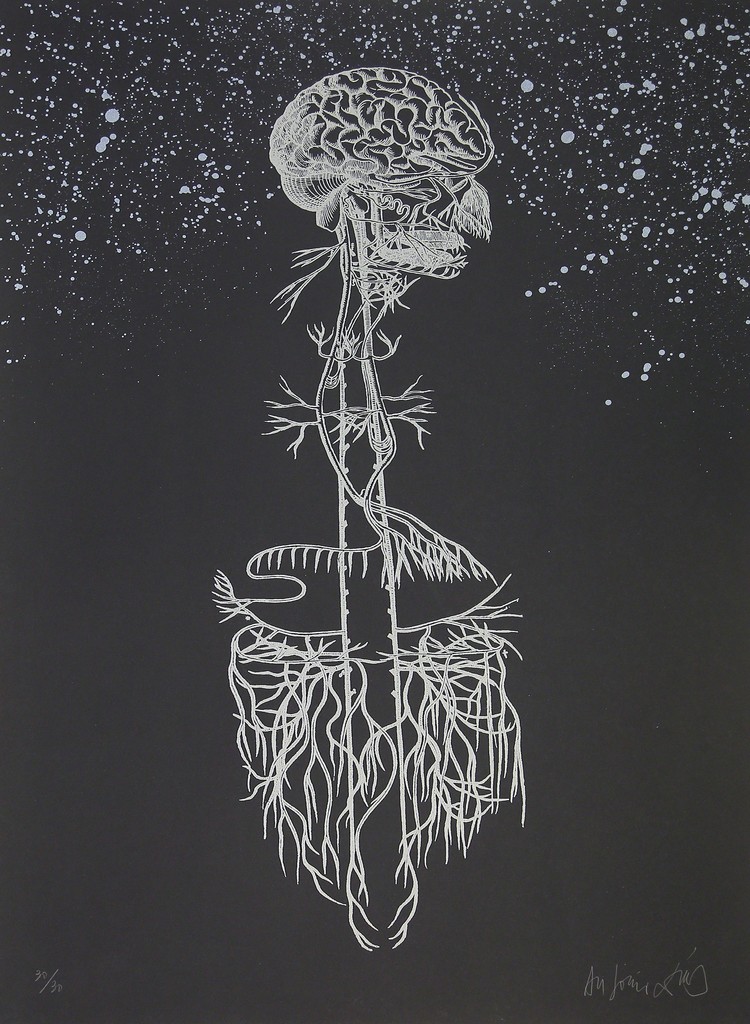
Navegador by Antonio Dias, a lithograph from 2015, is a hauntingly intricate depiction that blurs the boundaries between the organic and the cosmic. Set against a deep, star-studded black background, the artwork features an anatomical rendering of a human brain and nervous system, which cascades down in delicate, root-like structures. The composition suggests both a biological form and an otherworldly entity, as if the brain is tethered to the cosmos, navigating through an abstract space. The white, intricate lines of the nervous system resemble both roots and celestial connections, evoking themes of consciousness, interconnectedness, and the human experience within the universe. Part of an edition of 30, this lithograph reflects Dias's exploration of existence and introspection, merging scientific imagery with a sense of mystery and transcendence.
Artwork Copyright © Antonio DiasAntonio Dias (Brazil, 1944–2018) was a multifaceted artist whose work spanned painting, sculpture, and conceptual art. A prominent figure in the Tropicália movement, he critiqued political oppression and societal issues through his art. Dias's innovative use of materials and engagement with global art dialogues cemented his legacy in contemporary art.
Artwork Copyright © Antonio DiasNavegador, 2015
Form
Medium
Size
- Inches
- Centimeters
Edition
Price
- USD
- EUR
- GBP
- CHF
- Authenticity Guaranteed
- Insured Shipping
- Online Since 2005
●Inventory 4078
●Signed
●Comes with gallery invoice and certificate
●Any questions?
Navegador by Antonio Dias, a lithograph from 2015, is a hauntingly intricate depiction that blurs the boundaries between the organic and the cosmic. Set against a deep, star-studded black background, the artwork features an anatomical rendering of a human brain and nervous system, which cascades down in delicate, root-like structures. The composition suggests both a biological form and an otherworldly entity, as if the brain is tethered to the cosmos, navigating through an abstract space. The white, intricate lines of the nervous system resemble both roots and celestial connections, evoking themes of consciousness, interconnectedness, and the human experience within the universe. Part of an edition of 30, this lithograph reflects Dias's exploration of existence and introspection, merging scientific imagery with a sense of mystery and transcendence.
Artwork Copyright © Antonio DiasAntonio Dias (Brazil, 1944–2018) was a multifaceted artist whose work spanned painting, sculpture, and conceptual art. A prominent figure in the Tropicália movement, he critiqued political oppression and societal issues through his art. Dias's innovative use of materials and engagement with global art dialogues cemented his legacy in contemporary art.
Artwork Copyright © Antonio Dias- Recently Added
- Price (Low-High)
- Price (High-Low)
- Year (Low-High)
- Year (High-Low)

Antonio Dias
In Motion, 1975
Limited Edition Print
Silkscreen
EUR 6,000

Antonio Dias
Anywhere is My Land, 1975
Limited Edition Print
Silkscreen
EUR 6,000
Antonio Dias
Navegador, 2015
Limited Edition Print
Lithograph
EUR 2,500

Antonio Dias
Without title , 2015
Limited Edition Print
Etching
Currently Not Available
Related Artists


Related Articles

Popular, Artists, Collecting - August 25, 2026
Banksy’s Girl with Balloon, 2004: Signed vs Unsigned Prints
Compare Banksy’s 2004 Girl with Balloon signed and unsigned screenprints, edition sizes, Pest Control authentication, rare proofs and auction history.Read More
Popular, Artists, Collecting - September 1, 2026
KAWS Companion Editions: Vinyl, Four Foot and Dissected
A collector’s guide to KAWS Companion editions, from the 1999 Bounty Hunter vinyl figure to Four Foot, Dissected, Sorayama and Star Wars releases.Read More
Popular, News, Artists, Collecting - August 12, 2026
In Minor Keys: Finding Intimacy and Identity at the 61st Venice Biennale — and in Your Collection
Explore how Koyo Kouoh’s 61st Venice Biennale vision, In Minor Keys, is shifting contemporary collecting toward quiet introspection, memory, and personal identity.Read More
Artwork by Carlos Cruz-Diez
What is Latin American art?
Latin American Art is a style which takes inspiration from its culture, society, politics, native traditions, religions and landscape. Op-Art and Kinetic Art figure prominently in Latin artworks. Colors in Latin American compositions are often bold. Latin American artists work in all media and movements.

Antonio Dias
Navegador, 2015
106 x 70 cm


