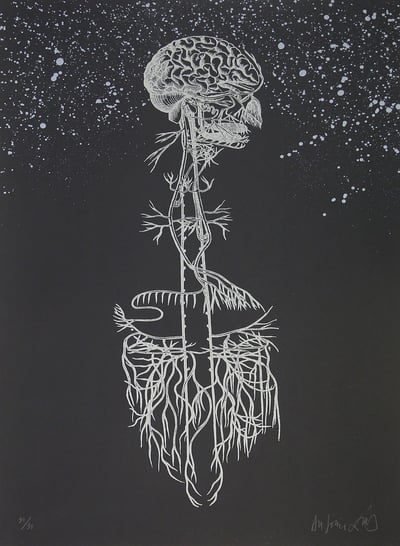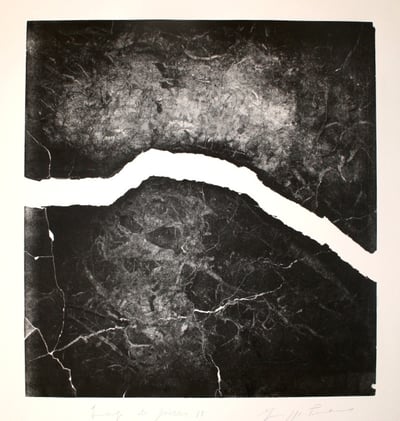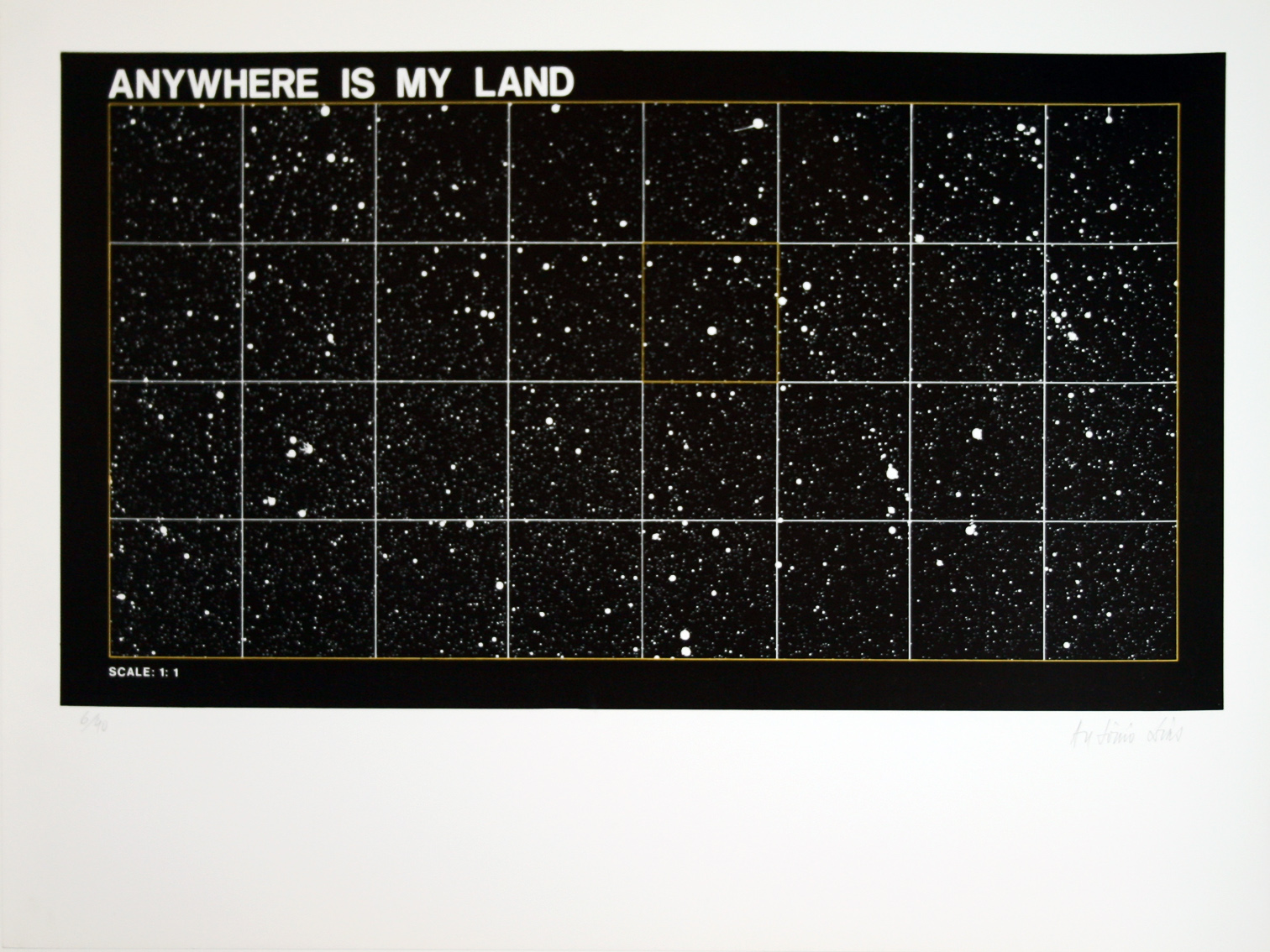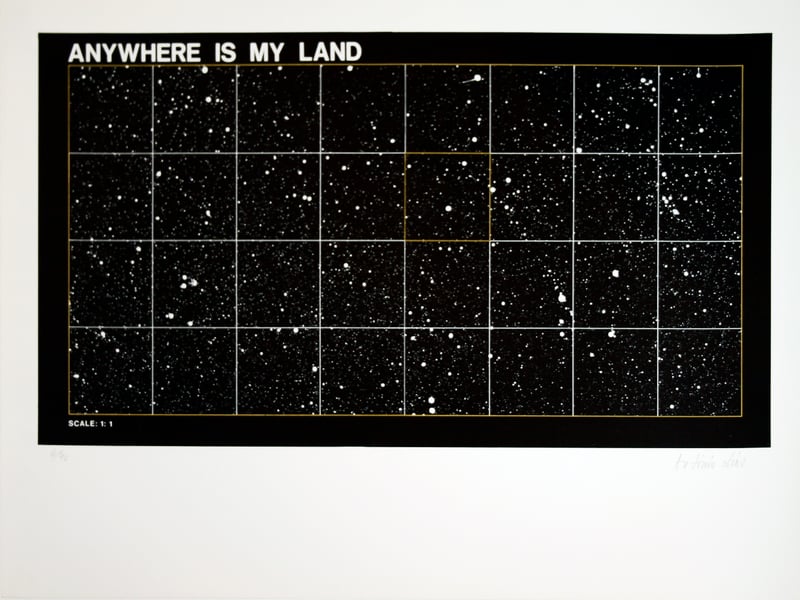
Anywhere is My Land by Antonio Dias, created in 1975, is a limited edition silkscreen print that reflects the artist’s engagement with political and conceptual art. Measuring 45 x 62 cm, the piece features a grid-like structure reminiscent of a star map or celestial chart. The black background is dotted with white specks, simulating stars or cosmic debris, while the title “ANYWHERE IS MY LAND” is boldly displayed at the top left, asserting a statement of universal belonging or borderlessness. The use of the grid suggests order and mapping, contrasting with the vast, chaotic appearance of the stars. Dias’s work challenges viewers to reflect on themes of territory, ownership, and identity, inviting a broader contemplation of freedom and space.
Antonio Dias (Brazil, 1944–2018) was a multifaceted artist whose work spanned painting, sculpture, and conceptual art. A prominent figure in the Tropicália movement, he critiqued political oppression and societal issues through his art. Dias's innovative use of materials and engagement with global art dialogues cemented his legacy in contemporary art.
SilkscreenSilkscreen is a printmaking method that uses a screen made of silk or other mesh fabric. The screen is treated with a substance that blocks ink in certain areas, allowing ink to pass through only in the desired sections. Each color in the print requires a separate screen.
Anywhere is My Land by Antonio Dias, created in 1975, is a limited edition silkscreen print that reflects the artist’s engagement with political and conceptual art. Measuring 45 x 62 cm, the piece features a grid-like structure reminiscent of a star map or celestial chart. The black background is dotted with white specks, simulating stars or cosmic debris, while the title “ANYWHERE IS MY LAND” is boldly displayed at the top left, asserting a statement of universal belonging or borderlessness. The use of the grid suggests order and mapping, contrasting with the vast, chaotic appearance of the stars. Dias’s work challenges viewers to reflect on themes of territory, ownership, and identity, inviting a broader contemplation of freedom and space.
Antonio Dias (Brazil, 1944–2018) was a multifaceted artist whose work spanned painting, sculpture, and conceptual art. A prominent figure in the Tropicália movement, he critiqued political oppression and societal issues through his art. Dias's innovative use of materials and engagement with global art dialogues cemented his legacy in contemporary art.
I always protest when I’m accused of being Pop—it’s not my part.
- Antonio Dias
Antonio Dias (b. 1944 Brazil, d. 2018 Brazil) was a pioneering Brazilian artist known for his multifaceted approach to conceptual art, painting, and installation. Dias's work is characterized by its engagement with political and social issues, often reflecting the turbulent political climate of Brazil in the 1960s and 1970s. His early works combine elements of Pop Art with political commentary, while his later pieces delve into themes of identity, eroticism, and the intersection of art and life. Dias was also a significant figure in the global art scene, spending time in Europe and Asia, where his work continued to evolve in response to different cultural contexts. His innovative approach and critical engagement with contemporary issues have made him a key figure in Latin American and global contemporary art. (Artist website)
Concrete Art is an art movement founded by the Dutch artist Theo van Doesburg in the 1930s. The movement emphasizes pure abstraction, focusing on geometric shapes and colors without any reference to the natural world or symbolic meaning. Unlike other forms of abstract art, Concrete Art is entirely non-representational and is based on mathematical principles and precise execution. It aims to create universal, timeless works by using simple, clear forms that emphasize objectivity and clarity.