Details
Artist
Styles
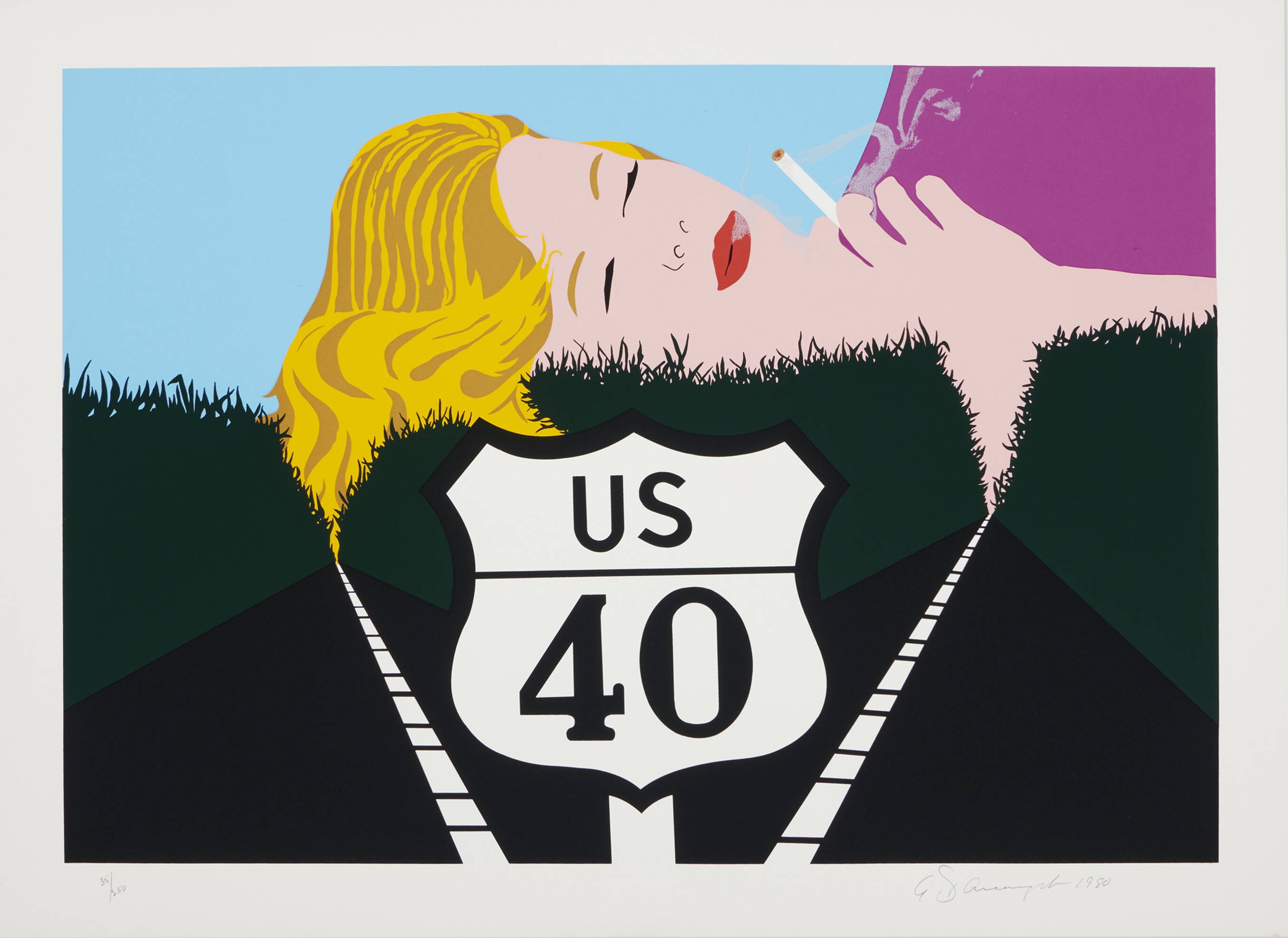
Signed, dated and numbered to lower margin. Image: 22 × 31.8 in (56 × 81 cm). Sheet: 26.1 × 35.75 w in (66 × 91 cm). Allan D’Arcangelo’s Smoke Dreams (1980) is a screenprint in colors that blends Pop Art clarity with surreal imagery. The composition places a bold US Route 40 highway sign in the foreground, framed by receding lanes of road. Above, a reclining blonde woman with closed eyes smokes a cigarette, her form seamlessly merging with the grassy landscape. The flat, vivid colors and simplified contours recall billboard aesthetics while introducing dreamlike disjunction between the road sign and the figure. Produced in an edition of 250, this work reflects D’Arcangelo’s fascination with American highways, symbols of mobility and escape, reimagined through irony and fantasy.
Details
Artist
Styles
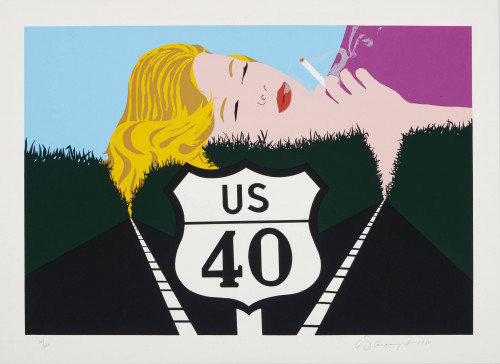
Signed, dated and numbered to lower margin. Image: 22 × 31.8 in (56 × 81 cm). Sheet: 26.1 × 35.75 w in (66 × 91 cm). Allan D’Arcangelo’s Smoke Dreams (1980) is a screenprint in colors that blends Pop Art clarity with surreal imagery. The composition places a bold US Route 40 highway sign in the foreground, framed by receding lanes of road. Above, a reclining blonde woman with closed eyes smokes a cigarette, her form seamlessly merging with the grassy landscape. The flat, vivid colors and simplified contours recall billboard aesthetics while introducing dreamlike disjunction between the road sign and the figure. Produced in an edition of 250, this work reflects D’Arcangelo’s fascination with American highways, symbols of mobility and escape, reimagined through irony and fantasy.
- Recently Added
- Price (low-high )
- Price (high-low )
- Year (low-high )
- Year (high-low )
Allan D'Arcangelo
Smoke Dreams, 1980
Limited Edition Print
Screen-print
Inquire For Price

Allan D'Arcangelo
Beginnings, 1975
Limited Edition Print
Mixed Media
USD 1,500

Allan D'Arcangelo
Title Unknown, 1966
Limited Edition Print
Lithograph
USD 2,400

Allan D'Arcangelo
Beginning, 1975
Limited Edition Print
Lithograph
Inquire For Price

Allan D'Arcangelo
Super Highway, 1969
Limited Edition Print
Silkscreen
USD 1,800

Allan D'Arcangelo
Icarus
Limited Edition Print
Serigraph
USD 4,500

Allan D'Arcangelo
The Holy Famil, 1980
Limited Edition Print
Serigraph
USD 2,800

Allan D'Arcangelo
Smoking Blond, 1990
Limited Edition Print
Serigraph
USD 4,000
Related Artists


Related Articles
Popular, Artists - October 16, 2025
Tracey Emin: Confessional Art on Display
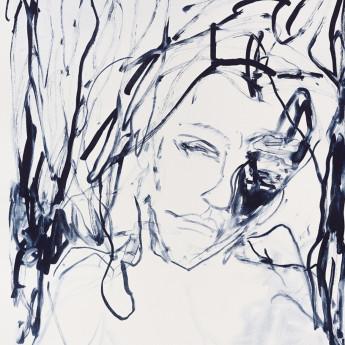
Tracey Emin turns raw emotion into art—confessional, intimate, and iconic. Discover how her life and work continue to challenge and connect. Read More


What is Surrealism?
Surrealism began in the 1920s as an art and literary movement with the goal of revealing the unconscious mind and unleashing the imagination by exploring unusual and dream-like imagery. Influenced by Sigmund Freud’s theories of psychoanalysis, Surrealist artists and writers sought to bring the unconscious into rational life, blurring the lines between reality and dreams. The movement aimed to challenge conventional perceptions and express the irrational aspects of the human experience.