Carl Andre
Carl Andre (USA, 1935–2024) was a pivotal figure in Minimalist art, celebrated for his floor-based sculptures and use of industrial materials. His modular works, often composed of metal, wood, or bricks, emphasized spatial relationships and viewer interaction. Andre's innovative approach redefined sculpture by focusing on simplicity, materiality, and the physical experience of space.
© Carl Andre. All rights reserved.
- Recently Added
- Price (Low-High)
- Price (High-Low)
- Year (Low-High)
- Year (High-Low)
Carl Andre
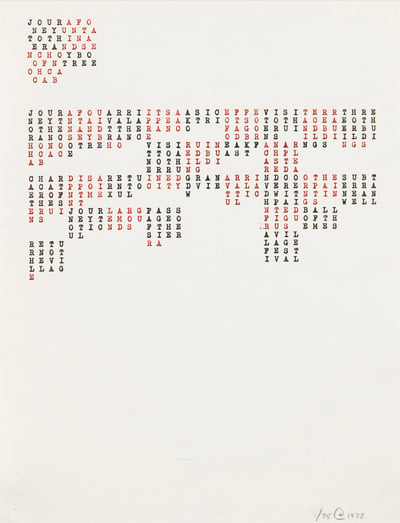
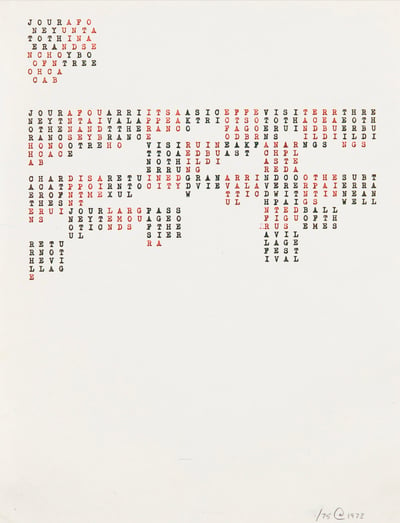
Untitled (Text Grid), 1973
Limited Edition Print
Screen-print
USD 6,500
Carl Andre
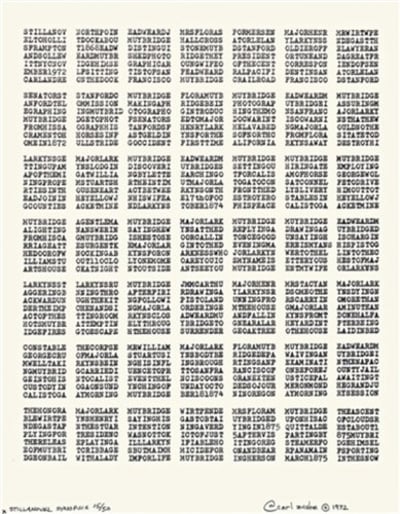
Still Novel Synopsis, 1972
Limited Edition Print
Inkjet print
Currently Not Available
No sold works to show.
Art is the exclusion of the unnecessary.
- Carl Andre
- Carl Andre
Carl Andre was an innovative American artist who became highly influential in the art of the 1960s and 1970s, when he was at the forefront of the Minimalist movement in the United States.
In the 1950s, after being introduced to the Romanian sculptor Constantin Brancusi, Carl Andre began creating geometric abstract sculptures from wood and Perspex. During the 1960s, he moved away from the tradition of vertical sculpture and started using industrial materials in his work. Andre reduced sculpture to its most essential form by placing blocks of material directly on the floor, arranging them into mathematical patterns, grids, and linear compositions on a horizontal plane.
In creating these works, Carl Andre used only standard, commercially available materials such as industrial bricks, wood, lead, steel, copper, magnesium, and aluminum. None of these materials were altered, allowing each component to retain its original character. He also experimented with bent pipes and scattered blocks, and created visual poems by arranging individual words and phrases on paper, emphasizing their visual appearance rather than their literal meaning.
In 1972, an article in a British newspaper sparked controversy over the nature of contemporary art focusing particularly on his work Equivalent III, an arrangement of firebricks. While on display at a major London art museum, the work was subsequently defaced by a member of the public. (Artist website)
In the 1950s, after being introduced to the Romanian sculptor Constantin Brancusi, Carl Andre began creating geometric abstract sculptures from wood and Perspex. During the 1960s, he moved away from the tradition of vertical sculpture and started using industrial materials in his work. Andre reduced sculpture to its most essential form by placing blocks of material directly on the floor, arranging them into mathematical patterns, grids, and linear compositions on a horizontal plane.
In creating these works, Carl Andre used only standard, commercially available materials such as industrial bricks, wood, lead, steel, copper, magnesium, and aluminum. None of these materials were altered, allowing each component to retain its original character. He also experimented with bent pipes and scattered blocks, and created visual poems by arranging individual words and phrases on paper, emphasizing their visual appearance rather than their literal meaning.
In 1972, an article in a British newspaper sparked controversy over the nature of contemporary art focusing particularly on his work Equivalent III, an arrangement of firebricks. While on display at a major London art museum, the work was subsequently defaced by a member of the public. (Artist website)
Related Artists

Related Articles
Popular, Art Movements - May 5, 2022
Minimalism in the XX Century: Simple Gestures and Essential Ideas.
Explore Minimalism in the 20th century, from art to architecture. Discover its evolution, pioneers like Donald Judd, and its impact on modern creativity.Read More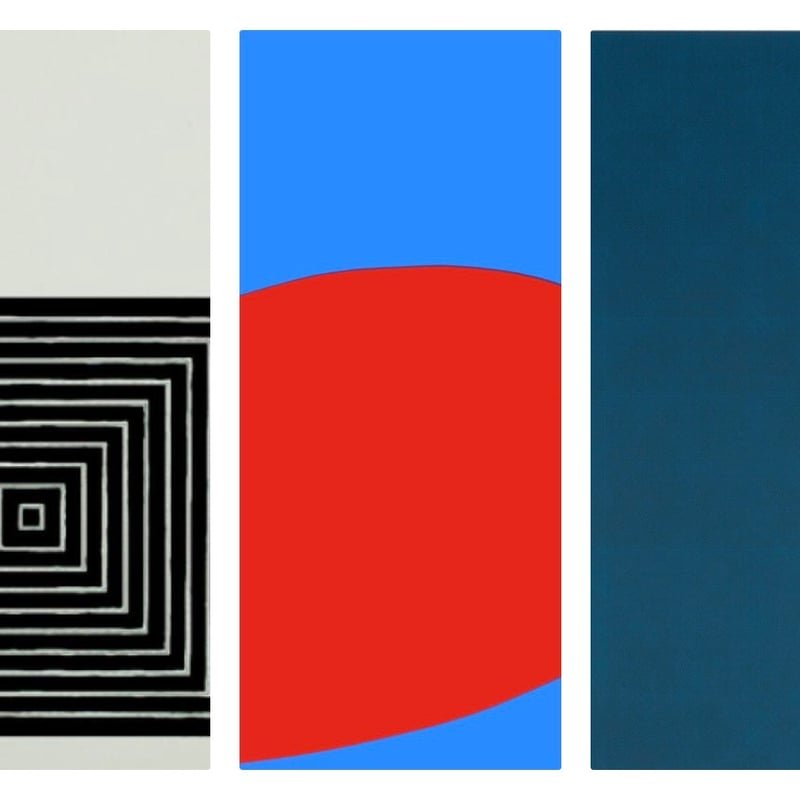

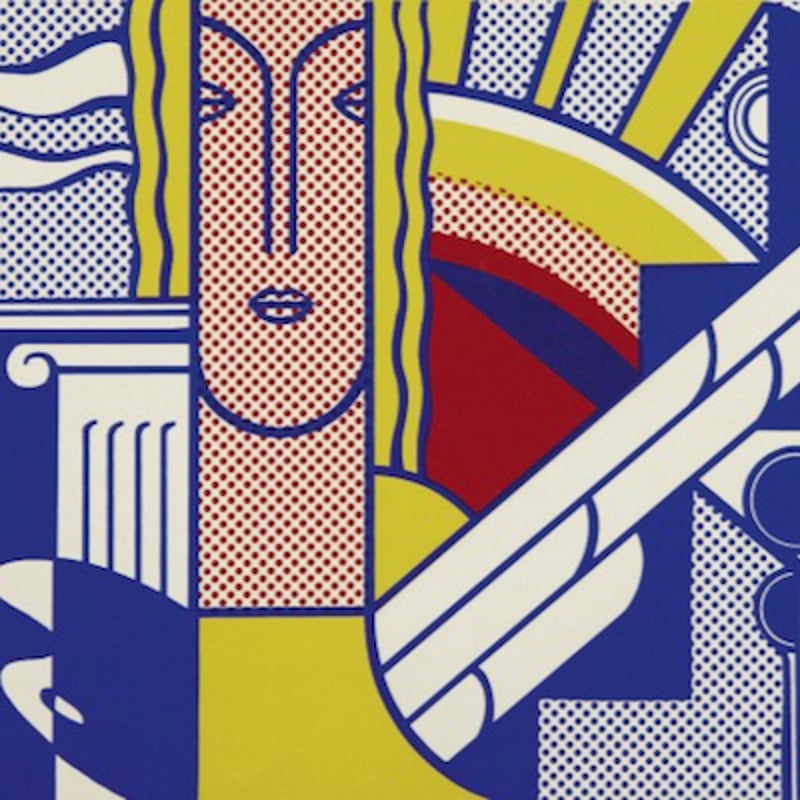 Artwork by Roy Lichtenstein
What is late modernism?
Late Modernism refers to the continuation and evolution of Modernist principles in art, architecture, and literature from the mid-20th century into the late 20th century. This movement maintains a focus on form, abstraction, and the rejection of traditional styles, but it often incorporates more complexity and ambiguity compared to early Modernism. Late Mode…
Explore »

