Details
Artist
Styles
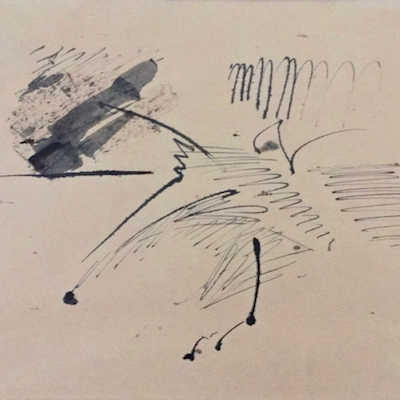
Etching on wove paper. Countersigned in pencil, lower right, and dated '94. Plate size: 35 × 28 cm. Image size: 29.5 × 21 cm. Printed by Atelier Lacourière et Frélaut, Paris. Published by Bibliophiles de France, Paris. // A tempest of ink unfolds across the sheet as bold, sweeping washes collide with delicate splatter and fine calligraphic traces. Zao Wou-Ki's etching for the Sonnets de Shakespeare portfolio channels the emotional intensity of the Bard's verse into pure gestural abstraction, bridging Chinese ink traditions with European printmaking. The composition surges from a dense upper register into an open, breathing expanse below, evoking the lyrical tension between passion and restraint. From an edition of 30, printed by Atelier Lacourière et Frélaut, this is a superb example of Zao's late graphic mastery.
sonnets de Shakespeare II, 1994
form
Medium
Size
35 x 28 cm
- Inches
- Centimeters
Edition
Price
- USD
- EUR
- GBP
Details
Artist
Styles
Etching on wove paper. Countersigned in pencil, lower right, and dated '94. Plate size: 35 × 28 cm. Image size: 29.5 × 21 cm. Printed by Atelier Lacourière et Frélaut, Paris. Published by Bibliophiles de France, Paris. // A tempest of ink unfolds across the sheet as bold, sweeping washes collide with delicate splatter and fine calligraphic traces. Zao Wou-Ki's etching for the Sonnets de Shakespeare portfolio channels the emotional intensity of the Bard's verse into pure gestural abstraction, bridging Chinese ink traditions with European printmaking. The composition surges from a dense upper register into an open, breathing expanse below, evoking the lyrical tension between passion and restraint. From an edition of 30, printed by Atelier Lacourière et Frélaut, this is a superb example of Zao's late graphic mastery.
- Recently Added
- Price (low-high )
- Price (high-low )
- Year (low-high )
- Year (high-low )

Zao Wou-Ki
Untitled (A. 246A), 1974
Limited Edition Print
Etching And Aquatint
EUR 4,500 - 6,000

Zao Wou-Ki
Sonnets De Shakespeare II, 1994
Limited Edition Print
Etching
EUR 2,800

Zao Wou-Ki
Sonnets De Shakespeare I, 1994
Limited Edition Print
Etching
EUR 2,800

Zao Wou-Ki
Composition, 1967
Limited Edition Print
Etching
EUR 3,700

Zao Wou-Ki
Paysage Au Soleil, 1950
Limited Edition Print
Etching
EUR 3,675

Zao Wou-Ki
Untitled (Agerup 243), 1973
Limited Edition Print
Aquatint
EUR 5,400

Zao Wou-Ki
Album Internacional, 1973
Limited Edition Print
Lithograph
EUR 2,250

Zao Wou-Ki
Petit Jardin, 1956
Limited Edition Print
Lithograph
EUR 10,000

Zao Wou-Ki
Untitled (A. 127), 1960
Limited Edition Print
Lithograph
EUR 5,000

Zao Wou-Ki
Untitled (A.121), 1959
Limited Edition Print
Lithograph
EUR 10,000

Zao Wou-Ki
Untitled (A. 394), 1998
Limited Edition Print
Lithograph
EUR 6,000

Zao Wou-Ki
Untitled (A. 390), 1998
Limited Edition Print
Lithograph
EUR 6,000

Zao Wou-Ki
Le Désordre, 2004
Limited Edition Print
Etching And Aquatint
Currently Not Available
Related Artists


Related Articles

Popular, Art Movements - November 20, 2024
Understanding Abstract Expressionism: Emotion and Gesture
Explore the emotional depth of Abstract Expressionism! Discover how artists like Pollock and Rothko used gesture and color to convey human complexity. Read More
What is Art Informel?
Art Informel is a French term referring to the gestural and improvisational techniques common in abstract painting during the 1940s and 50s. It encompasses various styles that dominated these decades, characterized by informal, spontaneous methods. Artists used this term to describe approaches that moved away from traditional structures and embraced more expressive, unstructured techniques.