Details
Artist
Styles
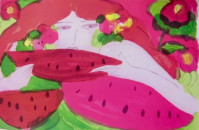
image size 31x39.5cm // I Love Cherries and Flowers by Walasse Ting, a vibrant lithograph from 1980, celebrates the artist's signature use of bold colors and expressive forms. This piece, measuring 31 x 39.5 cm, presents a lush arrangement of cherries and blossoms rendered in vivid pinks, oranges, and reds, set against a bright green background. The casual yet dynamic brushstrokes give the work an exuberant and lively feel, capturing the essence of nature’s beauty in an almost playful, childlike manner. Ting’s characteristic blend of Eastern and Western influences shines through in this limited edition print, part of an edition of 130 with 50 artist proofs, emphasizing the joy and simplicity of natural abundance.
I Love Cherries and Flowers, 1980
form
Medium
Size
61 x 77 cm
- Inches
- Centimeters
Edition
Price
Details
Artist
Styles
image size 31x39.5cm // I Love Cherries and Flowers by Walasse Ting, a vibrant lithograph from 1980, celebrates the artist's signature use of bold colors and expressive forms. This piece, measuring 31 x 39.5 cm, presents a lush arrangement of cherries and blossoms rendered in vivid pinks, oranges, and reds, set against a bright green background. The casual yet dynamic brushstrokes give the work an exuberant and lively feel, capturing the essence of nature’s beauty in an almost playful, childlike manner. Ting’s characteristic blend of Eastern and Western influences shines through in this limited edition print, part of an edition of 130 with 50 artist proofs, emphasizing the joy and simplicity of natural abundance.
- Recently Added
- Price (low-high )
- Price (high-low )
- Year (low-high )
- Year (high-low )

Walasse Ting
Lovely Nude, 1984
Limited Edition Print
Lithograph
EUR 1,100

Walasse Ting
Conversation, 1985
Limited Edition Print
Lithograph
EUR 990
Walasse Ting
Untitled WT EP 17, 1985
Limited Edition Print
Lithograph
EUR 1,450

Walasse Ting
Untitled WT EP 20, 1985
Limited Edition Print
Lithograph
EUR 1,490

Walasse Ting
Blue Horse, 1991
Limited Edition Print
Screen-print
Currently Not Available

Walasse Ting
I Love Cherries And Flowers, 1980
Limited Edition Print
Lithograph
Currently Not Available
Related Artists


Related Articles
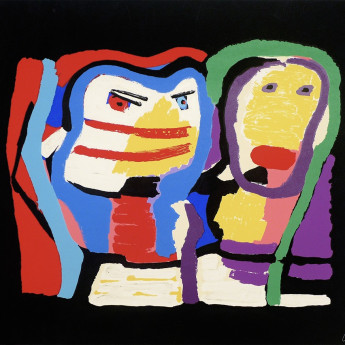
Art Movements - November 21, 2022
Botch, Blotch and Splotch: The Exuberant Maelstrom of the Cobra Art Movement.
Explore the CoBrA movement’s bold creativity, blending raw expression and experimentation. Discover its impact on post-war art and avant-garde traditions. Read More

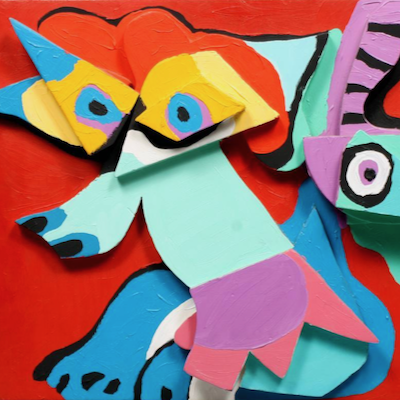
What is the CoBrA movement?
CoBrA stands for Copenhagen, Brussels, and Amsterdam; the group was formed with a desire to break away from the existing art movements of the time. Their critique of Western society led them to experiment and evolve into a significant international movement. CoBrA was founded on November 8, 1948, at the Notre Dame Café in Paris, where its manifesto was signed by Karel Appel, Joseph Noiret, Corneille, Christian Dotremont, Constant, and Asger Jorn. The group was united by a shared commitment to freedom in both form and color, and their work emphasized experimentation and spontaneity.