
Details
Artist
Styles
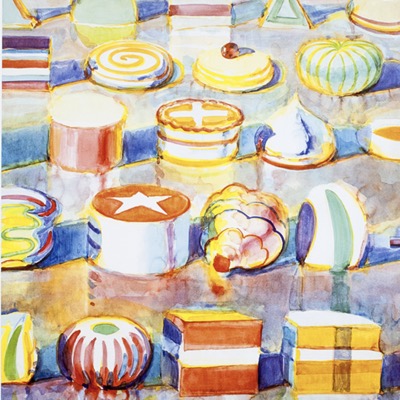
Color aquatint on wove paper - Hand-signed, dated and numbered in pencil - With publisher’s blind stamp // Wayne Thiebaud’s City Edge (1988) is an expressive aquatint print that captures the vibrant yet abstract essence of urban landscapes. The piece employs a palette of cool blues and warm yellows, creating a sense of contrast and depth. Thiebaud’s loose brushwork and use of thick lines provide a textured, painterly quality that enhances the architectural forms and perspectives of the city. The composition suggests a dynamic cityscape viewed from a unique angle, perhaps from an elevated perspective, showcasing Thiebaud’s fascination with geometry and urban structure. This limited edition print is signed, dated, and numbered by the artist, with a publisher’s blind stamp.
Details
Artist
Styles
Color aquatint on wove paper - Hand-signed, dated and numbered in pencil - With publisher’s blind stamp // Wayne Thiebaud’s City Edge (1988) is an expressive aquatint print that captures the vibrant yet abstract essence of urban landscapes. The piece employs a palette of cool blues and warm yellows, creating a sense of contrast and depth. Thiebaud’s loose brushwork and use of thick lines provide a textured, painterly quality that enhances the architectural forms and perspectives of the city. The composition suggests a dynamic cityscape viewed from a unique angle, perhaps from an elevated perspective, showcasing Thiebaud’s fascination with geometry and urban structure. This limited edition print is signed, dated, and numbered by the artist, with a publisher’s blind stamp.
- Recently Added
- Price (low-high )
- Price (high-low )
- Year (low-high )
- Year (high-low )

Thiebaud Wayne
Neapolitan Pie, 1990
Limited Edition Print
Lithograph
GBP 25,000 - 30,000

Thiebaud Wayne
Cut Cakes, 2015
Limited Edition Print
Mixed Media
USD 14,250

Thiebaud Wayne
Tulip Sundae, 2015
Limited Edition Print
Aquatint
USD 11,900

Thiebaud Wayne
Crown Tart, 2015
Limited Edition Print
Mixed Media
USD 11,900

Thiebaud Wayne
Trout Fishing In America, 1994
Limited Edition Print
Lithograph
USD 5,500

Thiebaud Wayne
Cigars, 1979
Limited Edition Print
Etching
Currently Not Available
Related Artists


Related Articles

Popular, News, Artists - February 27, 2026
The Sovereign Self: Tracey Emin’s A Second Life at Tate Modern (2026) and the Evolution of a Global Market
Tracey Emin’s A Second Life at Tate Modern (2026) redefines her legacy, signaling institutional canonisation and a maturing global market. Read More

What is Bay Area Figurative Art ?
The Bay Area Figurative Movement, which also goes by the names Bay Area Figurative School, Bay Area Figurative Art, or Bay Area Figuration, came to existence in San-Francisco Bay Area. This was in the mid-20th century, when a group of artists from the area stopped working on the then popular Abstract Expressionism for a preference to figuration in painting. The movement lasted a total of two decades during the 1950's and 1960's.