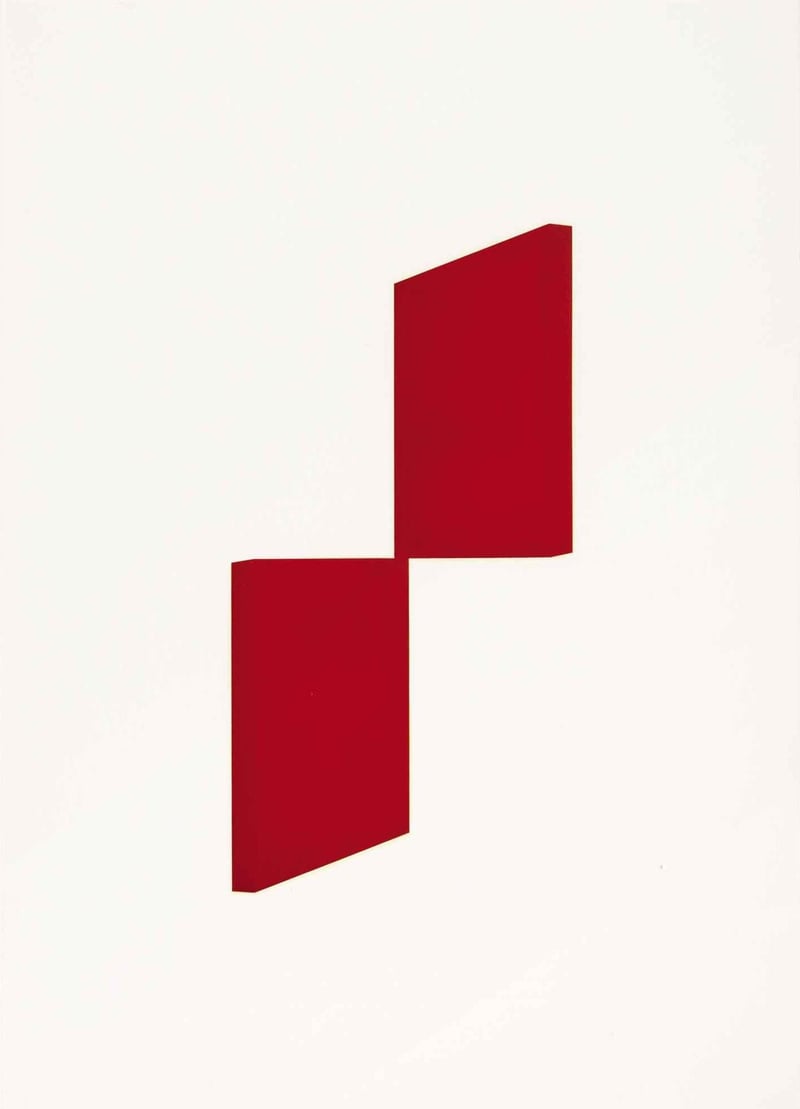
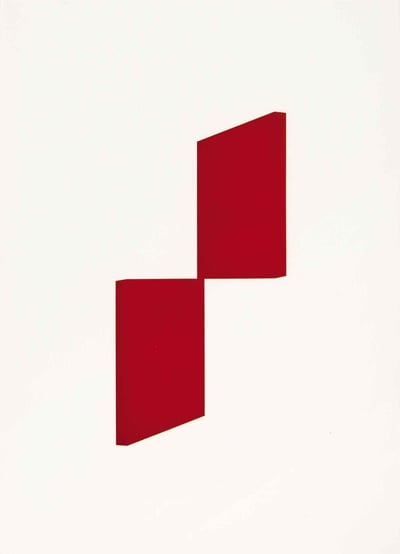
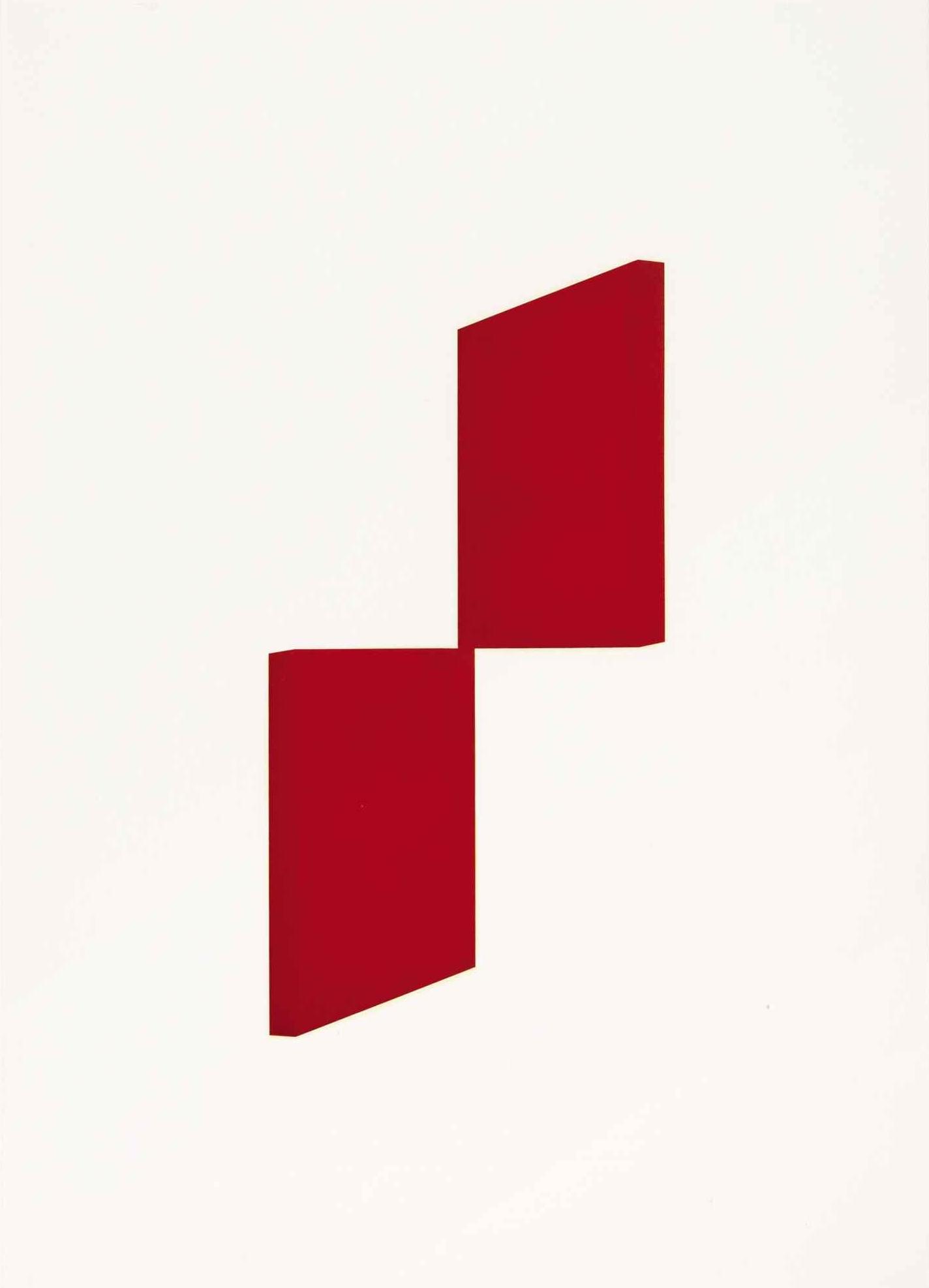
Untitled (Doors) by Robert Therrien is a minimalist aquatint print from 1996, showcasing Therrien's focus on simple forms and the subtle transformation of everyday objects. The composition features two red, rectangular shapes that resemble abstract doors, arranged in a staggered alignment against a white background. The stark color contrast and geometric simplicity create a sense of depth and balance, inviting viewers to engage with the form's architectural implications. Therrien’s work often blurs the line between abstraction and recognizable shapes, and in Untitled (Doors), he reduces the concept of a door to its most basic, symbolic representation. This piece, part of a limited edition of 25 with 10 artist proofs, exemplifies his refined approach to abstraction and form.
Artwork Copyright © Robert TherrienRobert Therrien (United States, 1947–2019) was an American artist renowned for transforming everyday objects into monumental sculptures. His works, such as oversized tables and chairs, challenge perceptions of scale and reality, inviting viewers into a whimsical, immersive experience.
Artwork Copyright © Robert TherrienUntitled (Doors), 1996
Form
Medium
Size
- Inches
- Centimeters
Edition
Price
Available works →
- Authenticity Guaranteed
- Insured Shipping
- Online Since 2005
●
●Inventory 6987
●Signed
●Comes with gallery invoice and certificate
●Sell Us a Similar Artwork. Learn more.
Untitled (Doors) by Robert Therrien is a minimalist aquatint print from 1996, showcasing Therrien's focus on simple forms and the subtle transformation of everyday objects. The composition features two red, rectangular shapes that resemble abstract doors, arranged in a staggered alignment against a white background. The stark color contrast and geometric simplicity create a sense of depth and balance, inviting viewers to engage with the form's architectural implications. Therrien’s work often blurs the line between abstraction and recognizable shapes, and in Untitled (Doors), he reduces the concept of a door to its most basic, symbolic representation. This piece, part of a limited edition of 25 with 10 artist proofs, exemplifies his refined approach to abstraction and form.
Artwork Copyright © Robert TherrienRobert Therrien (United States, 1947–2019) was an American artist renowned for transforming everyday objects into monumental sculptures. His works, such as oversized tables and chairs, challenge perceptions of scale and reality, inviting viewers into a whimsical, immersive experience.
Artwork Copyright © Robert Therrien- Recently Added
- Price (Low-High)
- Price (High-Low)
- Year (Low-High)
- Year (High-Low)
Robert Therrien
Untitled (Doors), 1996
Limited Edition Print
Aquatint
Currently Not Available
Related Artists

Related Articles
Popular, Artists, Collecting - August 20, 2026
Collecting Gerhard Richter Editions: A Guide for New and Seasoned Collectors
Learn how to collect Gerhard Richter editions: catalogue references, signatures, facsimile objects, condition, provenance and secondary-market buying.Read More
Artwork by Roger Raveel
What is new figuration?
Neo-Figurative Art is a collective term that refers to the revival of figurative art in America and Europe during the 1960s, following a period dominated by abstraction. Michel Ragon, a French art critic, argued that this resurgence of figuration occurred during a critical time of social and political upheaval in both regions.
Robert Therrien
Untitled (Doors), 1996
75 x 47 cm


