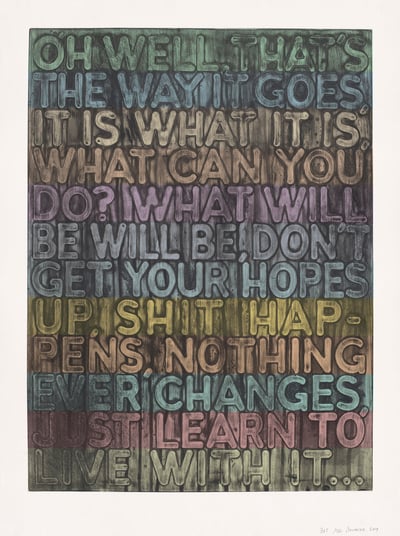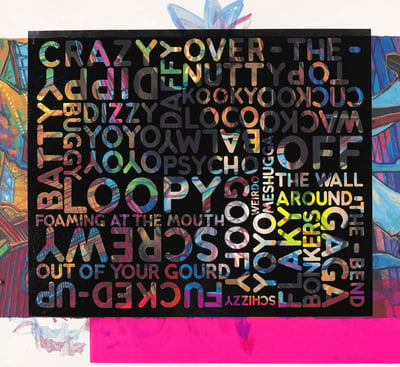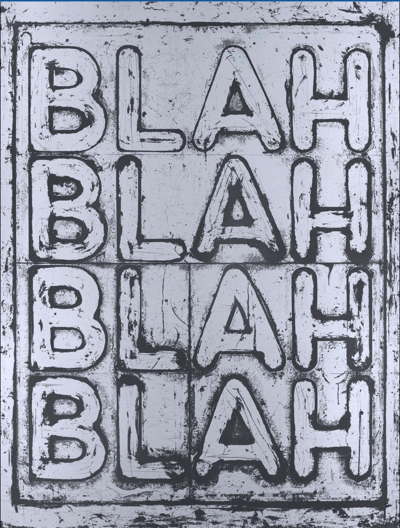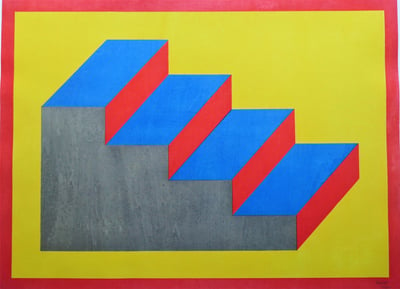
Original aquatint on paper - 5 from the rare limited artist proof edition of 6 - in excellent condition - Hand signed numbered and dated by Bochner
Day's Cove by Mel Bochner is an original aquatint print created in 1985, distinguished by its expressive abstract geometry. Limited to a rare edition of only 6 artist proofs, this piece features angular, crystalline structures in a stark monochromatic palette. The overlapping lines and dripping effects lend the image an organic yet fragmented appearance, suggesting both structure and disintegration. Bochner's use of bold, intersecting shapes and splatters captures a sense of movement, as if the forms are caught in a moment of explosive transformation. This piece reflects Bochner's exploration of form, texture, and the boundaries of structured abstraction, with a raw energy emphasized by the intense contrasts in black and white.
Mel Bochner (USA, 1940-2025) was a conceptual artist and pioneer in text-based art. Known for his bold use of language, color, and mathematical precision, his works explore the intersection of linguistics, perception, and visual art. Bochner’s influential practice challenges viewers to reconsider the relationship between words and images.
AquatintIntaglio is a printmaking technique where the artist creates marks on a metal plate that hold ink or dye. The inked plate is then pressed onto paper, transferring the ink to the sheet. This process can be repeated multiple times depending on the technique. Intaglio methods, such as etching, often involve applying a mordant (acid) to the metal plate to create the design. Intaglio encompasses various techniques, including engraving, etching, and drypoint.
Original aquatint on paper - 5 from the rare limited artist proof edition of 6 - in excellent condition - Hand signed numbered and dated by Bochner
Day's Cove by Mel Bochner is an original aquatint print created in 1985, distinguished by its expressive abstract geometry. Limited to a rare edition of only 6 artist proofs, this piece features angular, crystalline structures in a stark monochromatic palette. The overlapping lines and dripping effects lend the image an organic yet fragmented appearance, suggesting both structure and disintegration. Bochner's use of bold, intersecting shapes and splatters captures a sense of movement, as if the forms are caught in a moment of explosive transformation. This piece reflects Bochner's exploration of form, texture, and the boundaries of structured abstraction, with a raw energy emphasized by the intense contrasts in black and white.
Mel Bochner (USA, 1940-2025) was a conceptual artist and pioneer in text-based art. Known for his bold use of language, color, and mathematical precision, his works explore the intersection of linguistics, perception, and visual art. Bochner’s influential practice challenges viewers to reconsider the relationship between words and images.
The viewer should enter the idea through a visual or phenomenological experience rather than simply reading it.
- Mel Bochner
Regarded as one of the most influential and successful pioneers of Conceptual art,, Mel Bochner analyzed the relationship between language, physical space, and color through his text-based paintings. His work often featured expletives and derogatory words rendered in soft, pastel tones such as pink, while complimentary words appeared in sludgy brown or soiled black, subverting expected emotional responses.
One of Bochner’s most celebrated works was a series of thesaurus-based paintings, in which he filled walls with synonyms for a single word, encouraging viewers to reflect on the language they use and the meanings words carry. Throughout his career, he was vocal about his need to experiment with various materials and approaches as a means of fulfilling his artistic expression and creativity. He elaborated on this philosophy in his essay The Medium and the Tedium. (Artist website)
Sometimes referred to as Conceptualism, this is an art form where the idea(s) or concept(s) behind the work take precedence over material concerns and traditional aesthetics. Many conceptual artworks can be created by anyone simply by following written instructions. The concept or idea is the most essential aspect of the artwork.