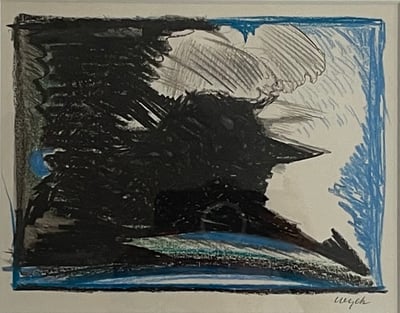
Gouache on paper.
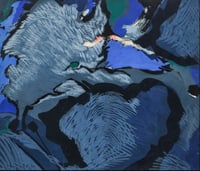
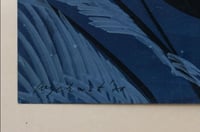
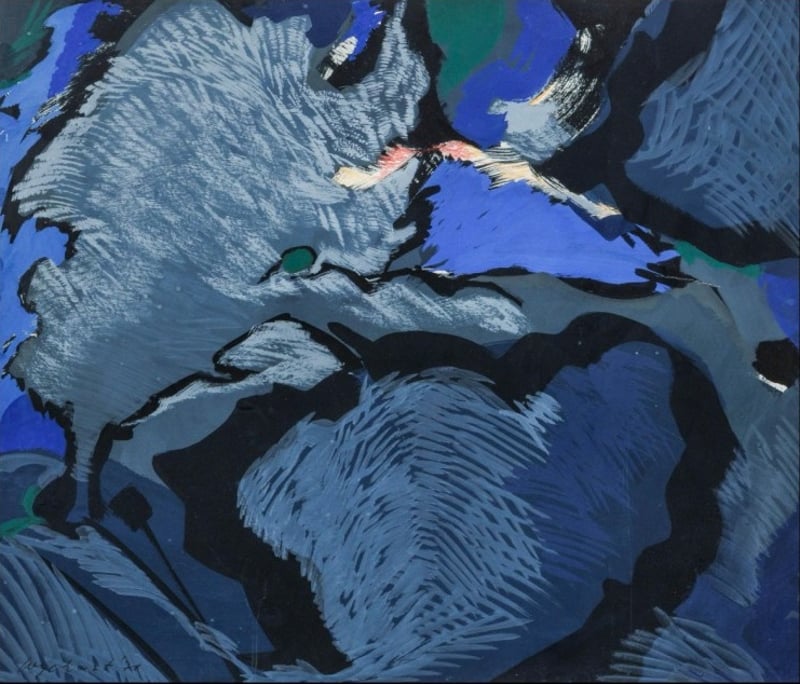
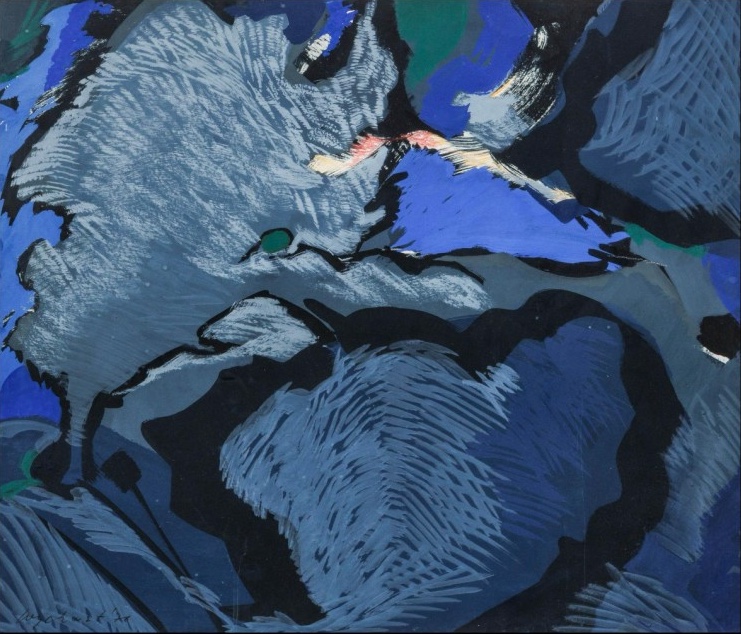
'Grisaille à trous bleus.' Signed and dated 1976.
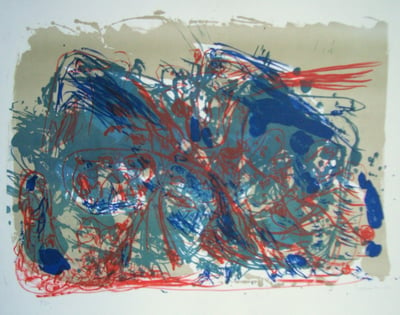
Maurice Wyckaert’s Sans titre (1976) is a gouache on paper that explores abstraction through layered, organic forms in a restrained palette of blues, greys, and black. The subtitle “Grisaille à trous bleus” reflects the interplay between muted tonal fields and vivid blue openings that punctuate the composition. Broad, gestural brushstrokes create textured surfaces resembling natural elements—rock, foliage, or flowing water—while sharp contrasts and irregular contours suggest movement and depth. Signed and dated by the artist, the work exemplifies Wyckaert’s post-Cobra interest in expressive landscapes distilled into semi-abstract visual rhythms.
Artwork Copyright © Maurice WyckaertMaurice Wyckaert (Belgium, 1923–1996) was an influential painter associated with the CoBrA movement and lyrical abstraction. Known for his colorful, expressive landscapes, Wyckaert’s work often blends elements of abstraction with vibrant natural forms, reflecting his deep connection to nature. His art captures an emotional intensity that has left a lasting impact on Belgian modernism.
Artwork Copyright © Maurice WyckaertSans titre, 1976
Form
Medium
Size
- Inches
- Centimeters
Edition
Price
- USD
- EUR
- GBP
- CHF
- Authenticity Guaranteed
- Insured Shipping
- Online Since 2005
●Inventory 16783
●Signed
●Comes with gallery invoice and certificate
●Sell Us a Similar Artwork. Learn more.
Gouache on paper.
'Grisaille à trous bleus.' Signed and dated 1976.
Maurice Wyckaert’s Sans titre (1976) is a gouache on paper that explores abstraction through layered, organic forms in a restrained palette of blues, greys, and black. The subtitle “Grisaille à trous bleus” reflects the interplay between muted tonal fields and vivid blue openings that punctuate the composition. Broad, gestural brushstrokes create textured surfaces resembling natural elements—rock, foliage, or flowing water—while sharp contrasts and irregular contours suggest movement and depth. Signed and dated by the artist, the work exemplifies Wyckaert’s post-Cobra interest in expressive landscapes distilled into semi-abstract visual rhythms.
Artwork Copyright © Maurice WyckaertMaurice Wyckaert (Belgium, 1923–1996) was an influential painter associated with the CoBrA movement and lyrical abstraction. Known for his colorful, expressive landscapes, Wyckaert’s work often blends elements of abstraction with vibrant natural forms, reflecting his deep connection to nature. His art captures an emotional intensity that has left a lasting impact on Belgian modernism.
Artwork Copyright © Maurice Wyckaert- Recently Added
- Price (Low-High)
- Price (High-Low)
- Year (Low-High)
- Year (High-Low)
Maurice Wyckaert
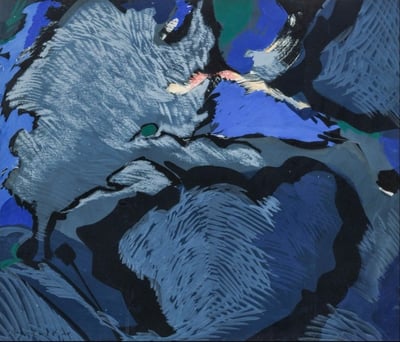
Sans titre, 1976
Drawing / Watercolor
Gouache
EUR 4,750
Maurice Wyckaert
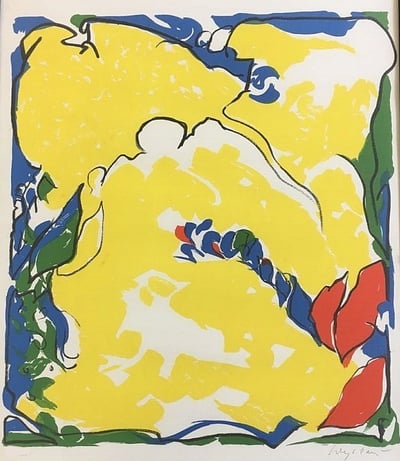
Untitled (unique)
Drawing / Watercolor
Mixed Media
EUR 1,875
Maurice Wyckaert
Compositie
Limited Edition Print
Lithograph
Currently Not Available
Related Artists
Related Articles
Art Movements - November 21, 2022
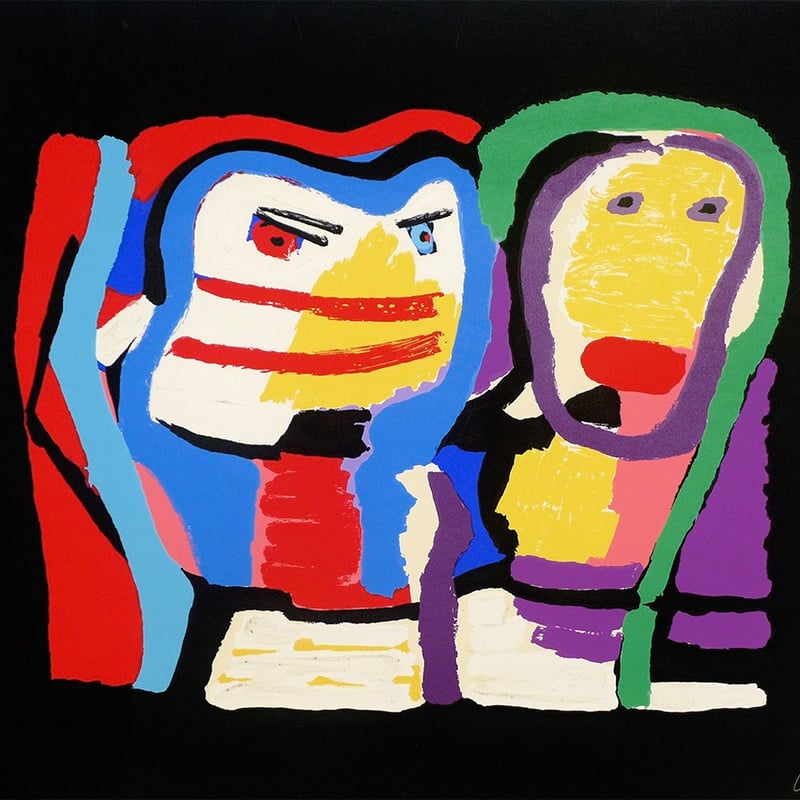
Botch, Blotch and Splotch: The Exuberant Maelstrom of the Cobra Art Movement.
Explore the CoBrA movement’s bold creativity, blending raw expression and experimentation. Discover its impact on post-war art and avant-garde traditions.Read More
Artwork by Eduardo Chillida
What is abstract art?
Abstract art uses form, shape, line, and color to create a visual experience without attempting to represent external reality. The composition exists independently of the world's visual references, focusing on expressing ideas and emotions through non-representational means.

Maurice Wyckaert
Sans titre, 1976
55 x 67 cm


