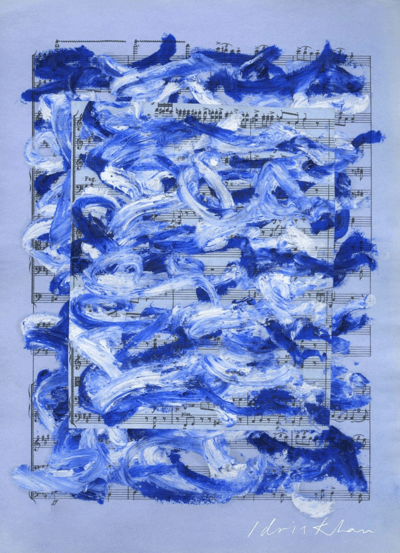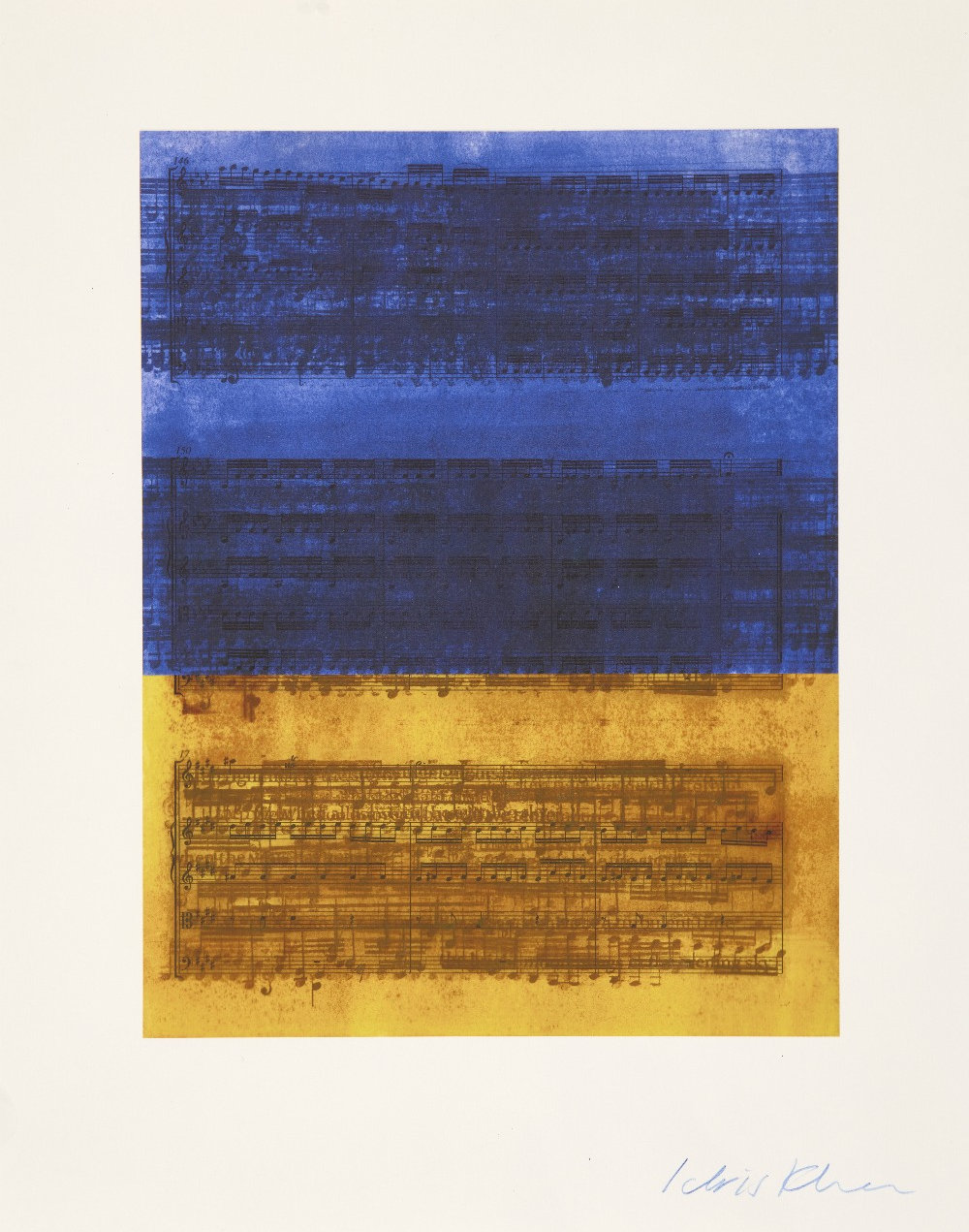
Collaged archival pigment print in colours.
Unknown edition size, from a timed-limited edition produced with Migrate Art in 2022.
Hand signed in crayon by Idris Khan.
Based on a collage created with music paper and watercolour in the colours of the Ukrainian flag.
Idris Khan’s I Thought We Had More Time (2022) is a collaged archival pigment print that layers musical notation into dense, atmospheric bands of color. The composition is structured in horizontal fields of deep blue and warm yellow, echoing the Ukrainian flag, while overlapping fragments of sheet music create a sense of compression and visual rhythm. The accumulation of lines and notes becomes almost abstract, suggesting memory, loss, and the passage of time rather than legible sound. Created in support of Migrate Art, the work reflects Khan’s ongoing exploration of repetition, erasure, and cultural resonance through layered imagery.
Idris Khan (United Kingdom, 1978) creates layered photographs, prints, and paintings that merge literature, music, and history into dense visual fields. Known for digitally superimposing texts, musical scores, and archival images, his work explores memory, time, and authorship, producing rhythmic, almost abstract compositions with conceptual depth.
Archival PrintAn archival print refers to a fine art reproduction of museum quality, created using the highest quality materials and methods. These prints are produced on the finest papers and with inks specifically designed to resist color fading over time. Drawings and paintings are reproduced using a fine art printer with exceptionally high resolution, ensuring longevity and preservation of the artwork.
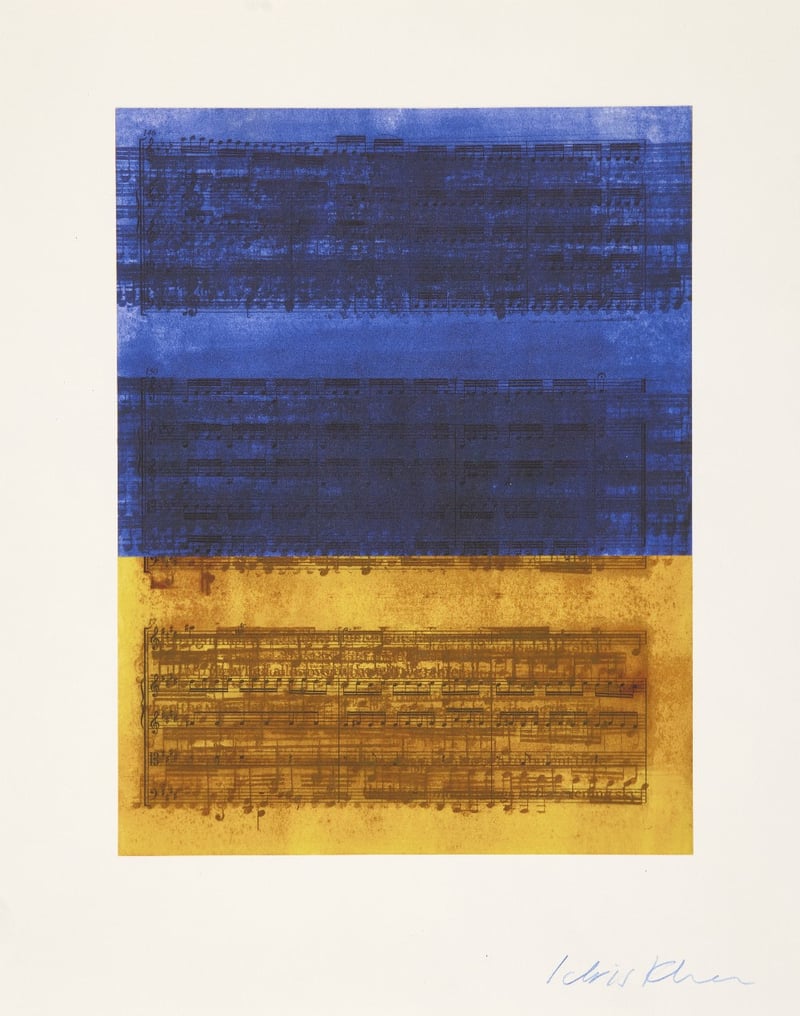
Collaged archival pigment print in colours.
Unknown edition size, from a timed-limited edition produced with Migrate Art in 2022.
Hand signed in crayon by Idris Khan.
Based on a collage created with music paper and watercolour in the colours of the Ukrainian flag.
Idris Khan’s I Thought We Had More Time (2022) is a collaged archival pigment print that layers musical notation into dense, atmospheric bands of color. The composition is structured in horizontal fields of deep blue and warm yellow, echoing the Ukrainian flag, while overlapping fragments of sheet music create a sense of compression and visual rhythm. The accumulation of lines and notes becomes almost abstract, suggesting memory, loss, and the passage of time rather than legible sound. Created in support of Migrate Art, the work reflects Khan’s ongoing exploration of repetition, erasure, and cultural resonance through layered imagery.
Idris Khan (United Kingdom, 1978) creates layered photographs, prints, and paintings that merge literature, music, and history into dense visual fields. Known for digitally superimposing texts, musical scores, and archival images, his work explores memory, time, and authorship, producing rhythmic, almost abstract compositions with conceptual depth.
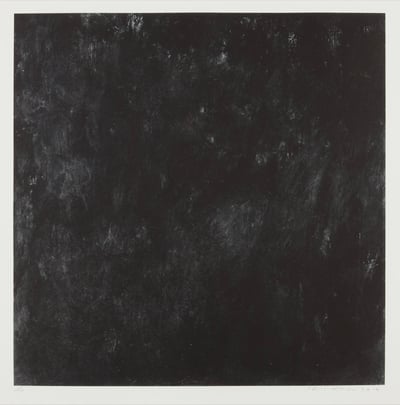
I'm not a political artist in any way, but if an idea takes me somewhere or something is emotionally impactful, I find a way to make a painting that encapsulates it.
— Idris Khan
Idris Khan (b. 1978 UK) is a British artist based in London, known for his layered visual language that merges photography, painting, and digital processes. Khan builds dense compositions by superimposing multiple images, texts, or musical scores into a single surface, creating works that explore memory, time, and authorship. His practice often references canonical figures from art, literature, and music, reinterpreting them through repetition and compression. The resulting images balance abstraction and legibility, inviting viewers to navigate between clarity and obscurity. Influenced by minimalism and conceptual art, Khan’s work reflects on how meaning accumulates and dissolves through reproduction. His large-scale pieces have been exhibited internationally, situating him within a contemporary discourse that examines the persistence of cultural history in the digital age.
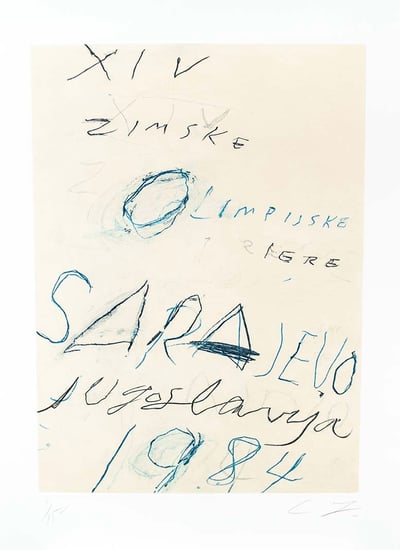
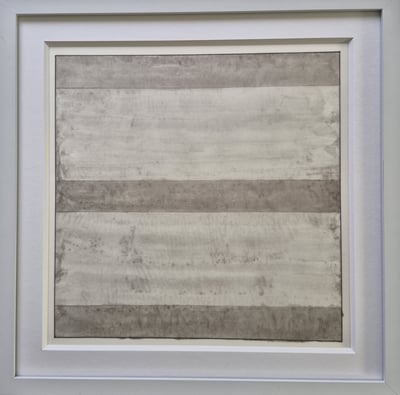
Minimalism is a style in music and visual arts characterized by pared-down designs and simplicity. It began in Western art after World War II, gaining prominence particularly in American visual arts. Minimalism draws heavily on aspects of modernism and is often viewed as a reaction against Abstract Expressionism, as well as a precursor to post-minimal art practices. Prominent minimalist artists include Agnes Martin, Donald Judd, Robert Morris, Frank Stella, and Dan Flavin.