Details
Artist
Styles
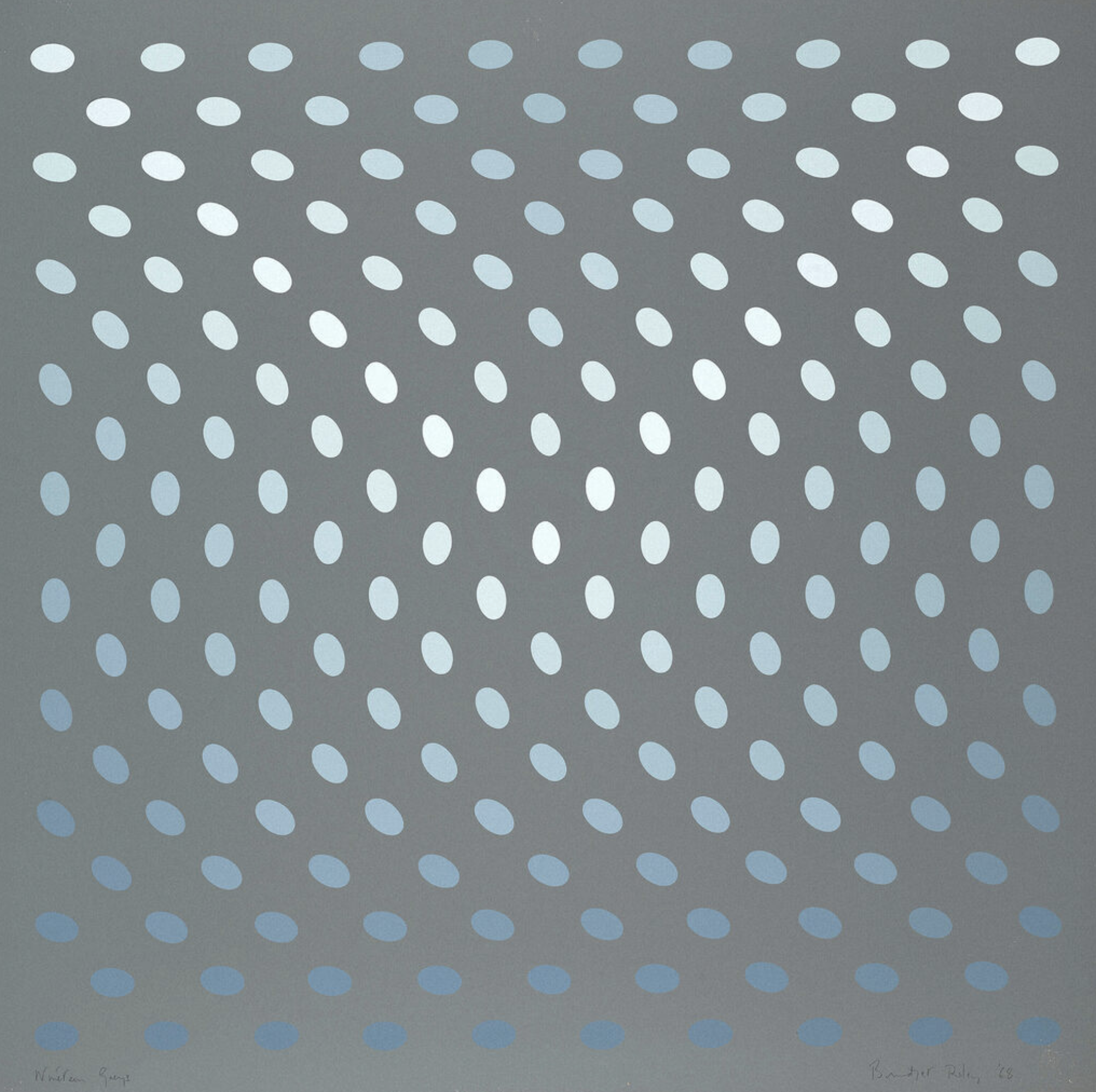
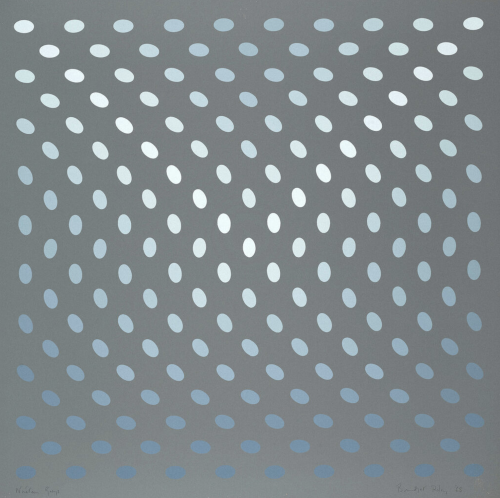
Nineteen Greys A (1968) by Bridget Riley is a key example of her early Op Art explorations, focusing on visual rhythm and perception through minimal means. This screenprint features a grid of uniformly spaced elliptical shapes that gradually shift in tone across nineteen variations of grey. Set against a darker grey background, the ellipses appear to pulsate and bend, creating a dynamic optical effect. The piece reflects Riley’s interest in how simple geometric elements, when precisely modulated, can produce movement and vibration within a static field. Produced in an edition of 75, it remains a seminal work in the history of optical abstraction.
Details
Artist
Styles
Nineteen Greys A (1968) by Bridget Riley is a key example of her early Op Art explorations, focusing on visual rhythm and perception through minimal means. This screenprint features a grid of uniformly spaced elliptical shapes that gradually shift in tone across nineteen variations of grey. Set against a darker grey background, the ellipses appear to pulsate and bend, creating a dynamic optical effect. The piece reflects Riley’s interest in how simple geometric elements, when precisely modulated, can produce movement and vibration within a static field. Produced in an edition of 75, it remains a seminal work in the history of optical abstraction.
- Recently Added
- Price (low-high )
- Price (high-low )
- Year (low-high )
- Year (high-low )

Bridget Riley
Sylvan, 2000
Limited Edition Print
Screen-print
GBP 13,000 - 17,000
Bridget Riley
Vista, 2017
Limited Edition Print
Screen-print
Inquire For Price
Bridget Riley
Nineteen Greys A, 1968
Limited Edition Print
Screen-print
Inquire For Price
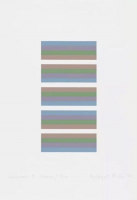
Bridget Riley
Intervals 3 - Orange / Blue, 2021
Limited Edition Print
Screen-print
Inquire For Price

Bridget Riley
Intervals 3 (Green/Purple), 2021
Limited Edition Print
Screen-print
GBP 7,000 - 10,000

Bridget Riley
Print For Chicago 8, 1971
Limited Edition Print
Screen-print
GBP 18,000 - 22,000

Bridget Riley
About Lilac, 2007
Limited Edition Print
Screen-print
GBP 9,000 - 12,000

Bridget Riley
Start, 2000
Limited Edition Print
Silkscreen
GBP 10,000 - 15,000

Bridget Riley
Two Blues, 2003
Limited Edition Print
Screen-print
GBP 10,000 - 15,000

Bridget Riley
Going Across, 2001
Limited Edition Print
Silkscreen
GBP 10,000 - 15,000

Bridget Riley
Coloured Greys (2), 1972
Limited Edition Print
Screen-print
GBP 12,000 - 15,000

Bridget Riley
Fold, 2004
Limited Edition Print
Screen-print
Inquire For Price

Bridget Riley
Intervals 3, Blue / Green, 2021
Limited Edition Print
Screen-print
Inquire For Price

Bridget Riley
Rose Rose, 2011
Limited Edition Print
Screen-print
GBP 17,500

Bridget Riley
La Lune, 1965
Limited Edition Print
Screen-print
GBP 20,000 - 25,000
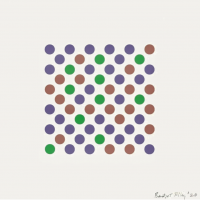
Bridget Riley
Measure For Measure, 2020
Limited Edition Print
Screen-print
GBP 11,900

Bridget Riley
One Small Step, 2009
Limited Edition Print
Screen-print
GBP 10,500
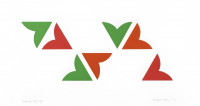
Bridget Riley
Opening Up, 2024
Limited Edition Print
Screen-print
Currently Not Available
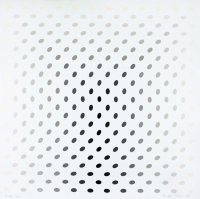
Bridget Riley
Nineteen Greys C, 1968
Limited Edition Print
Screen-print
Currently Not Available

Bridget Riley
Brouillard, 2003
Limited Edition Print
Screen-print
Currently Not Available
Related Artists



Related Articles

Artists - November 11, 2024
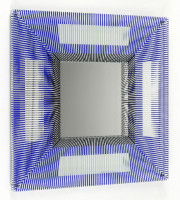
25 Living Icons: A Generation of Artists Defying Time
Celebrate 25 living legends redefining art! From Kusama to Hockney, explore their enduring creativity and groundbreaking contributions to modern art. Read More

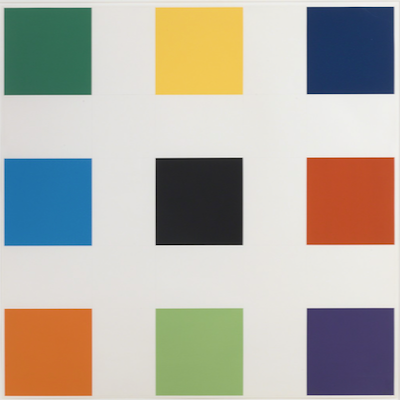
What is Hard Edge Art?
Hard Edge art is a style of abstract painting that became popular in the 1960s. It features areas of color separated by crisp, sharp edges that are painted with geometric precision. The term hard-edge painting was coined by art critic Jules Langsner to describe this approach, which contrasts with the softer, more fluid forms of other abstract styles.