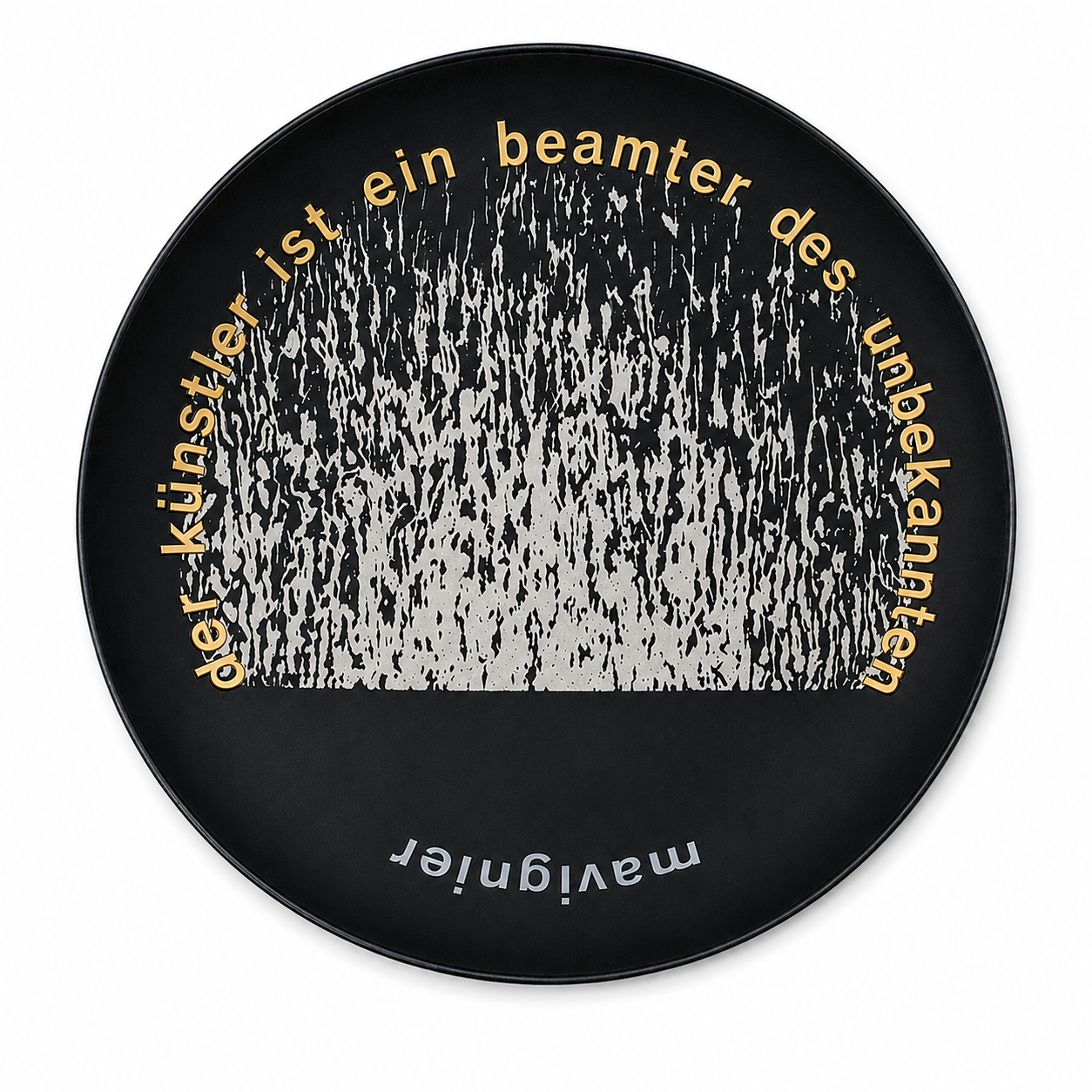
Rosenthal porcelain plate No. 14, 1979, Numbered, unsigned.
An extraordinary conceptual object, this black Rosenthal porcelain plate carries the gold inscription der kunstler ist ein beamter des unbekannten, the artist is a civil servant of the unknown, curving around its rim above Mavignier's signature. At the centre a domed field of black-and-white speckled texture rises like a thicket of marks, transposing his concrete-art principles onto everyday porcelain. Witty, philosophical and rigorously composed, it collapses the boundary between fine art and functional object. Numbered from the 1979 edition, it is a rare and characterful multiple from a leading figure of international concrete art.
Artwork Copyright © Almir MavignierAlmir Mavignier (Brazil, 1925–2018) was a pioneer of Op Art and Concrete Art, celebrated for his precise, geometric compositions. Using optical effects and vibrant colors, his works create dynamic visual experiences. Mavignier played a vital role in bridging Brazilian modernism with international art movements, influencing the development of abstract art worldwide.
Artwork Copyright © Almir Mavignierder künstler ist ein beamter....., 1979
Form
Medium
Size
- Inches
- Centimeters
Edition
Price
- USD
- EUR
- GBP
- CHF
- Authenticity Guaranteed
- Insured Shipping
- Online Since 2005
●Inventory 17565
●Unsigned
●Comes with gallery invoice and certificate
●Sell Us a Similar Artwork. Learn more.
Rosenthal porcelain plate No. 14, 1979, Numbered, unsigned.
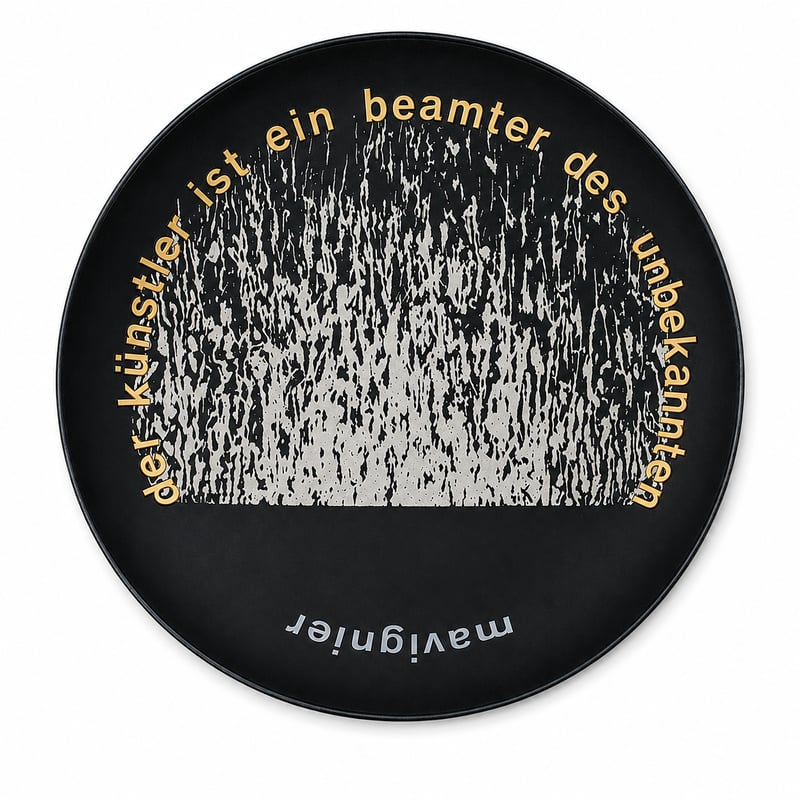
An extraordinary conceptual object, this black Rosenthal porcelain plate carries the gold inscription der kunstler ist ein beamter des unbekannten, the artist is a civil servant of the unknown, curving around its rim above Mavignier's signature. At the centre a domed field of black-and-white speckled texture rises like a thicket of marks, transposing his concrete-art principles onto everyday porcelain. Witty, philosophical and rigorously composed, it collapses the boundary between fine art and functional object. Numbered from the 1979 edition, it is a rare and characterful multiple from a leading figure of international concrete art.
Artwork Copyright © Almir MavignierAlmir Mavignier (Brazil, 1925–2018) was a pioneer of Op Art and Concrete Art, celebrated for his precise, geometric compositions. Using optical effects and vibrant colors, his works create dynamic visual experiences. Mavignier played a vital role in bridging Brazilian modernism with international art movements, influencing the development of abstract art worldwide.
Artwork Copyright © Almir Mavignier- Recently Added
- Price (Low-High)
- Price (High-Low)
- Year (Low-High)
- Year (High-Low)
Almir Mavignier
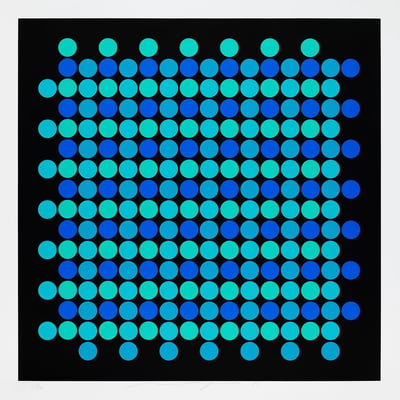
Untiteld from 9x5 Konkret Portfolio, 1979
Limited Edition Print
Screen-print
EUR 1,600
Almir Mavignier
der künstler ist ein beamter....., 1979
Sculpture / Object
Plate
EUR 980
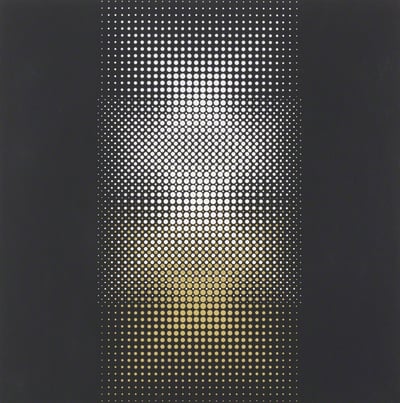
Almir Mavignier
Komposition VI, 1965
Limited Edition Print
Lithograph
Currently Not Available
Related Artists
Related Articles

Popular, Collecting - March 17, 2026
Why Buy from Composition Gallery
Why buy from Composition Gallery? Since 2005, the gallery offers curated works, clear provenance, fair pricing, and secure international shipping for confident art collecting.Read More
Artwork by Otto Piene
What is the Zero Movement?
ZERO was an art movement founded by Otto Piene and Heinz Mack, aiming to develop into a large international and cross-border movement. The name ZERO originated from a magazine founded by Heinz Mack in 1957, which became a platform for the group's ideas. The magazine was published for several years before ceasing in 1967. The ZERO movement sought to create a new beginning in art, emphasizing light, space, and movement, and became influential in post-war European art.