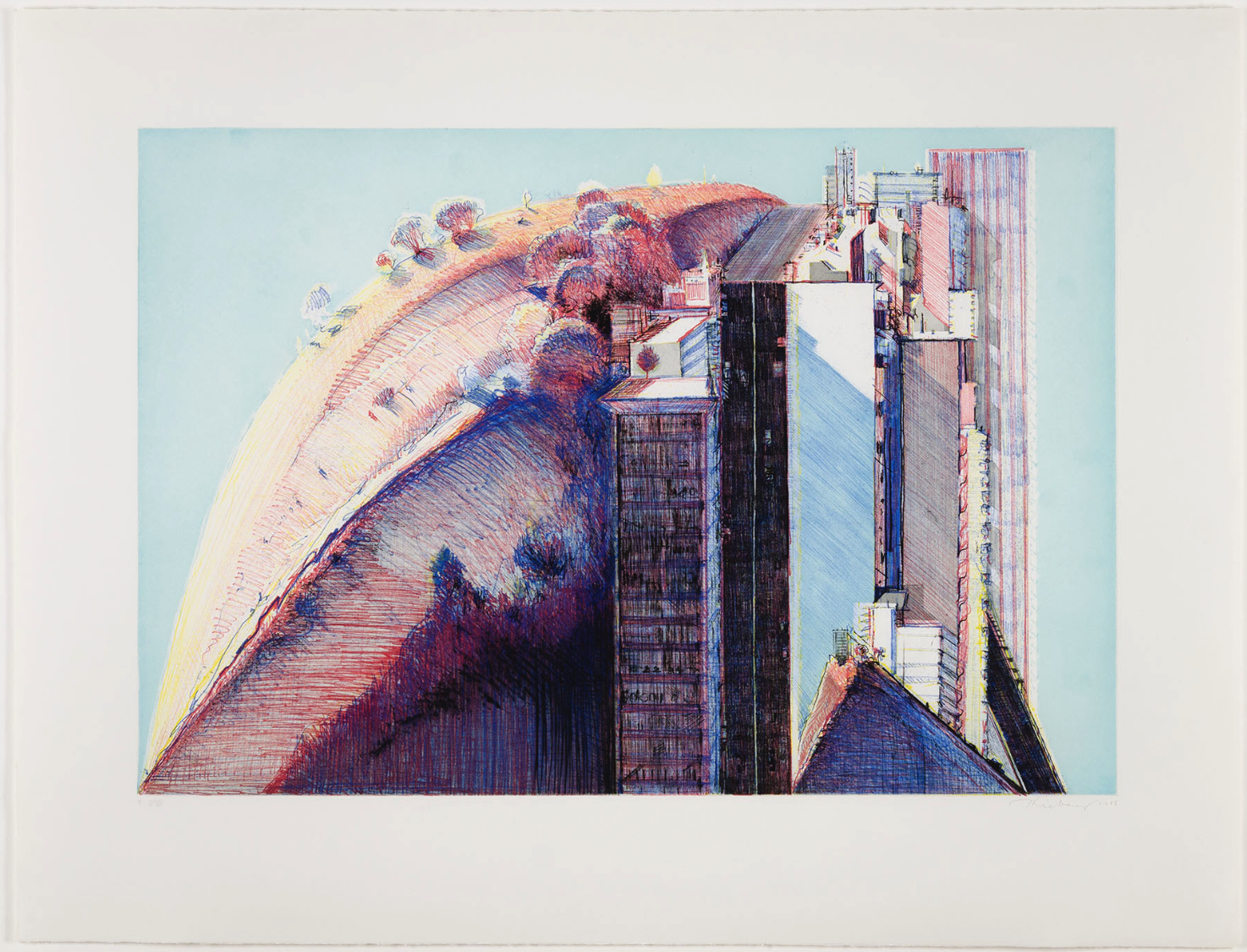
Original aquatint with softground etching and drypoint printed in colors on Somerset Satin wove paper.
Trial proof impression, apart from the numbered edition of 60, annotated in pencil lower left.
Sheet size: 77.5 x 103.5 cm (30 1/2 x 40 3/4 in)
Image size: 55.2 x 80.3 cm (21 3/4 x 31 5/8 in)
Frame size: 91.8 x 115.3 x 4.8 cm (36 1/8 x 45 3/8 x 1 7/8 in)
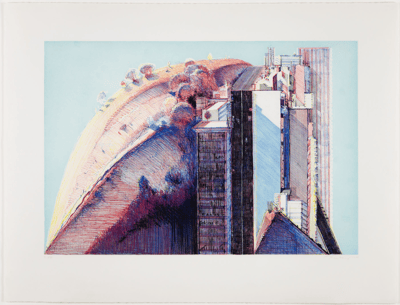
Country City is one of Thiebaud's most celebrated compositions, capturing the dramatic collision of rural landscape and urban geometry that defines the Sacramento region. On the left, a steep brown hillside crowned with pink-red trees drops away vertiginously; on the right, a dense grid of city blocks, rooftops, and facades rises in saturated colour. The aquatint, softground etching, and drypoint technique yields extraordinary textural richness, from the velvety earth tones of the hillside to the crisp architectural lines of the cityscape. This is a major work from the artist's most sought-after period, embodying the exhilarating tension between nature and civilisation that makes his vision so distinctive and enduring.
Wayne Thiebaud (USA, 1920–2021) was a celebrated painter known for his vibrant depictions of everyday objects like cakes, pies, and gumball machines. His textured brushwork and use of bold color captured the charm of Americana. A key figure in American art, Thiebaud bridged Pop Art and realism.
Mixed MediaMixed media refers to artwork that incorporates more than one medium within a single piece. Unlike multimedia art, which combines distinct forms of visual art and often includes elements like sound, video, or digital media, mixed media focuses on combining traditional art materials, such as paint, ink, and collage. Mixed media art allows artists to achieve a wide range of effects and textures by layering and blending different materials.
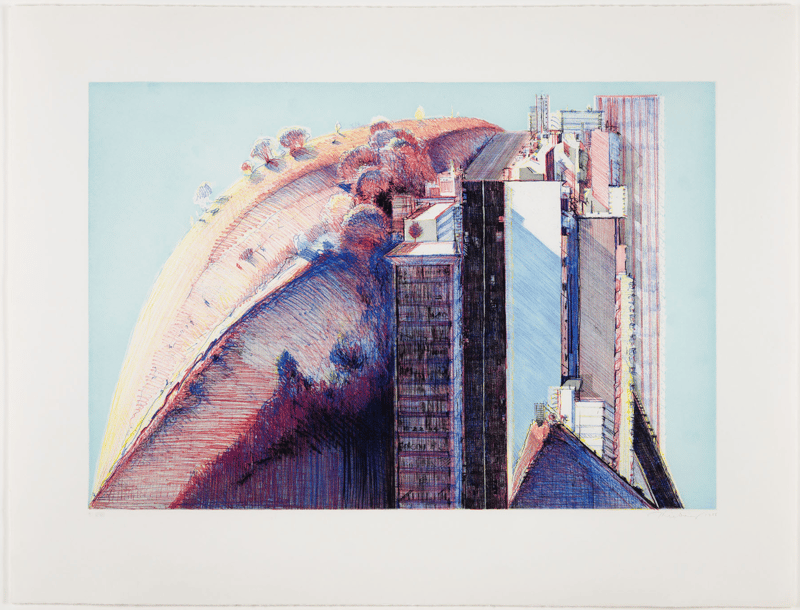
Original aquatint with softground etching and drypoint printed in colors on Somerset Satin wove paper.
Trial proof impression, apart from the numbered edition of 60, annotated in pencil lower left.
Sheet size: 77.5 x 103.5 cm (30 1/2 x 40 3/4 in)
Image size: 55.2 x 80.3 cm (21 3/4 x 31 5/8 in)
Frame size: 91.8 x 115.3 x 4.8 cm (36 1/8 x 45 3/8 x 1 7/8 in)
Country City is one of Thiebaud's most celebrated compositions, capturing the dramatic collision of rural landscape and urban geometry that defines the Sacramento region. On the left, a steep brown hillside crowned with pink-red trees drops away vertiginously; on the right, a dense grid of city blocks, rooftops, and facades rises in saturated colour. The aquatint, softground etching, and drypoint technique yields extraordinary textural richness, from the velvety earth tones of the hillside to the crisp architectural lines of the cityscape. This is a major work from the artist's most sought-after period, embodying the exhilarating tension between nature and civilisation that makes his vision so distinctive and enduring.
Wayne Thiebaud (USA, 1920–2021) was a celebrated painter known for his vibrant depictions of everyday objects like cakes, pies, and gumball machines. His textured brushwork and use of bold color captured the charm of Americana. A key figure in American art, Thiebaud bridged Pop Art and realism.
My sin as a painter is that I just want to paint anything I want to paint - and
repaint.
- Wayne Thiebaud
Wayne Thiebaud (b. 1920 USA, d. 2021 USA) was an American painter best known for his vibrant depictions of everyday objects, particularly his iconic paintings of cakes, pies, and other desserts. His work is celebrated for its rich use of color, thickly applied paint, and a keen sense of light and shadow, which give his subjects a three-dimensional, almost tactile quality. Thiebaud's style blends Pop art sensibilities with a deep appreciation for traditional American realism, creating works that are both nostalgic and visually striking. Although often associated with Pop Art due to his focus on consumer goods, Thiebaud's work is distinguished by its emotional depth and subtle commentary on the passage of time and the pleasures of life. His paintings have been widely exhibited in major museums, including the Whitney Museum of American Art and the San Francisco Museum of Modern Art, establishing him as a beloved figure in American art.
The Bay Area Figurative Movement, which also goes by the names Bay Area Figurative School, Bay Area Figurative Art, or Bay Area Figuration, came to existence in San-Francisco Bay Area. This was in the mid-20th century, when a group of artists from the area stopped working on the then popular Abstract Expressionism for a preference to figuration in painting. The movement lasted a total of two decades during the 1950's and 1960's.