Details
Artist
Styles
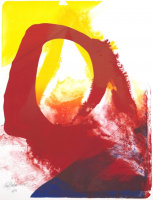
Color monoprint, on handmade TGL paper. Signed and dated in pencil. Published by Tyler Graphics, New York, and with their blindstamp. Four Winds (I) (1980) by Paul Jenkins is a striking color monoprint produced on handmade TGL paper and published by Tyler Graphics Ltd.. Known for his fluid approach to abstraction, Jenkins often allowed pigments to flow and interact organically on the paper, creating compositions that balance spontaneity with control. In this work, broad areas of luminous color—particularly the dominant yellow field—interact with bold black brush-like forms and vibrant areas of red, orange, and turquoise. The sweeping black gesture that cuts diagonally across the composition introduces movement and tension, guiding the viewer’s eye through the image. The layered pigments and irregular edges of color emphasize the physical process of the monoprint technique, in which each impression is unique. The title Four Winds suggests forces of nature or directional movement, reinforcing the dynamic energy of the composition. Jenkins frequently explored themes of flow, light, and natural phenomena, and this work reflects his interest in the expressive potential of color and gesture.
Four winds (I), 1980
form
Medium
Size
123.8 x 82.5 cm
- Inches
- Centimeters
Edition
Price
- USD
- EUR
- GBP
Details
Artist
Styles
Color monoprint, on handmade TGL paper. Signed and dated in pencil. Published by Tyler Graphics, New York, and with their blindstamp. Four Winds (I) (1980) by Paul Jenkins is a striking color monoprint produced on handmade TGL paper and published by Tyler Graphics Ltd.. Known for his fluid approach to abstraction, Jenkins often allowed pigments to flow and interact organically on the paper, creating compositions that balance spontaneity with control. In this work, broad areas of luminous color—particularly the dominant yellow field—interact with bold black brush-like forms and vibrant areas of red, orange, and turquoise. The sweeping black gesture that cuts diagonally across the composition introduces movement and tension, guiding the viewer’s eye through the image. The layered pigments and irregular edges of color emphasize the physical process of the monoprint technique, in which each impression is unique. The title Four Winds suggests forces of nature or directional movement, reinforcing the dynamic energy of the composition. Jenkins frequently explored themes of flow, light, and natural phenomena, and this work reflects his interest in the expressive potential of color and gesture.
- Recently Added
- Price (low-high )
- Price (high-low )
- Year (low-high )
- Year (high-low )

Paul Jenkins
Four Winds (I), 1980
Limited Edition Print
Monoprint
USD 4,200

Paul Jenkins
Untitled, 1960
Drawing / Watercolor
Watercolor
Inquire For Price

Paul Jenkins
Untitled (Black Strokes), 1971
Limited Edition Print
Lithograph
USD 1,580

Paul Jenkins
Untitled (Vibrant Currents), 1972
Limited Edition Print
Lithograph
USD 3,300

Paul Jenkins
Phenomena - Katherine Wheel, 1969
Limited Edition Print
Lithograph
USD 1,450

Paul Jenkins
Phenomena Wing Cut, 1979
Painting
Oil On Canvas
USD 11,900

Paul Jenkins
Phenomeana Parcinal Imperative, 1982
Drawing / Watercolor
Watercolor
USD 11,900
Paul Jenkins
Aspects D’Amadeus Et Les Autres, 1992
Limited Edition Print
Lithograph
USD 1,350
Related Artists


Related Articles

Popular, Art Movements - November 20, 2024
Understanding Abstract Expressionism: Emotion and Gesture
Explore the emotional depth of Abstract Expressionism! Discover how artists like Pollock and Rothko used gesture and color to convey human complexity. Read More

What is lyrical abstraction ?
Lyrical abstraction is a descriptive term characterizing a type of abstract painting closely related to Abstract Expressionism, in use from the 1940s to the present. The term can also describe two distinct but related trends in post-World War II modernist painting. This art movement originated in Paris, France, after the war, emphasizing personal expression, spontaneity, and the emotional use of color and form.