Hand-signed by Julian Schnabel.
Dated, with the publisher's blind stamp (Domberger Editionen, Germany).
A few small handling creases in the upper left area (see photo), otherwise very good condition.
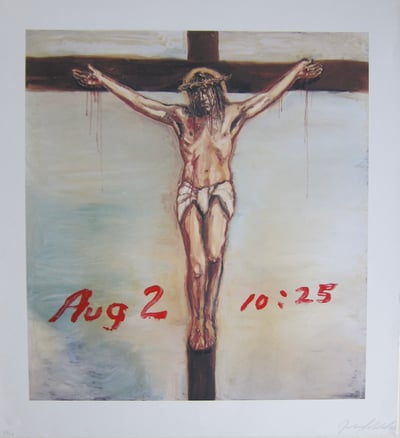
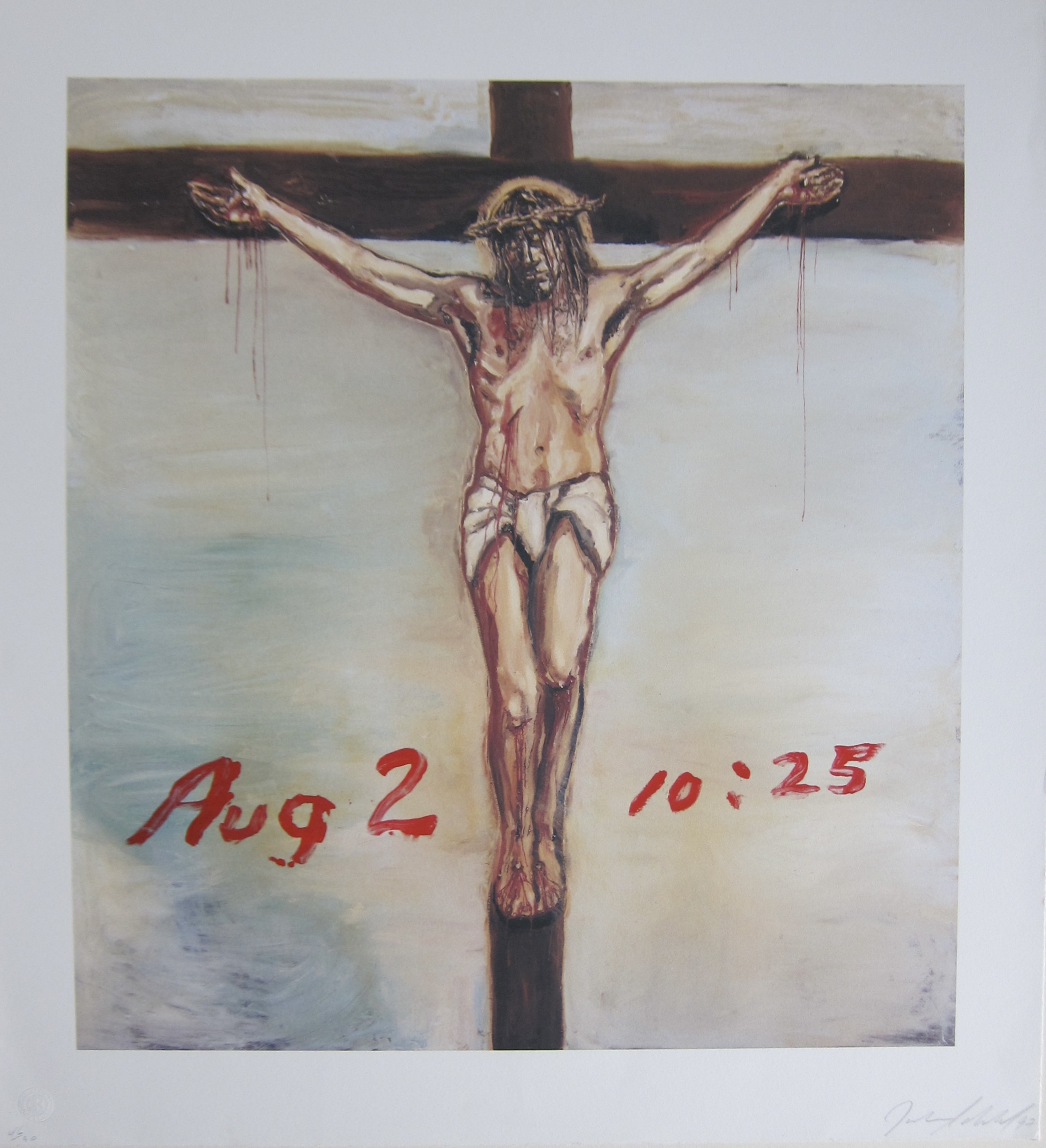
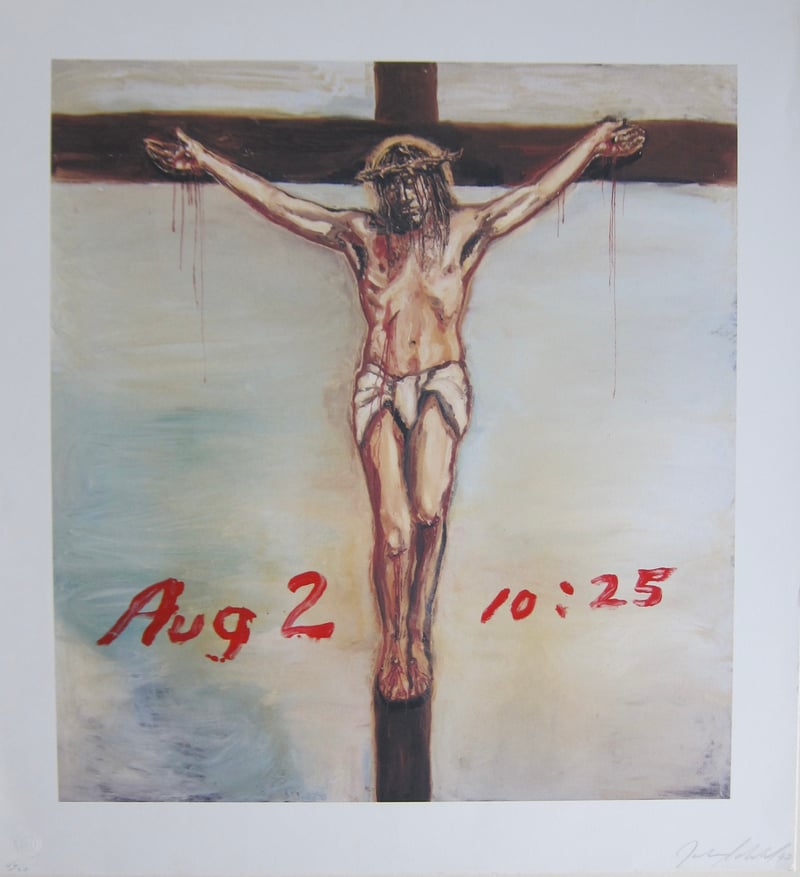
Julian Schnabel’s per non dimenticare (1997) is a lithograph that revisits the enduring image of the Crucifixion through the artist’s expressive, painterly language. Printed in a numbered edition of 90 and hand-signed, the composition centers on a solitary Christ figure affixed to a dark cross, his body rendered with loose, gestural modeling and visible brushlike contours. Thin streams of red suggest blood, echoed by the inscription “Aug 2 10:25,” which introduces a personal or commemorative dimension. The pale, atmospheric ground contrasts with the intense corporeality of the figure, heightening emotional tension. Published with the blind stamp of Domberger Editionen, Germany, the work reflects Schnabel’s engagement with memory, spirituality, and the material presence of paint translated into print.
Julian Schnabel (United States, 1951) is a multidisciplinary artist and filmmaker. He gained prominence in the 1980s with his 'plate paintings,' large-scale works incorporating broken ceramics. A leading figure in Neo-Expressionism, Schnabel's films, such as 'The Diving Bell and the Butterfly,' have received critical acclaim.
LithographLithography is a printing method based on the principle that water and oil do not mix. It can be used to print artwork or text onto paper or other suitable materials. Traditionally, an image was drawn with wax, fat, or oil onto a lithographic limestone surface or plate. Today, metal plates and other surfaces are also used in lithographic printing.
Hand-signed by Julian Schnabel.
Dated, with the publisher's blind stamp (Domberger Editionen, Germany).
A few small handling creases in the upper left area (see photo), otherwise very good condition.
Julian Schnabel’s per non dimenticare (1997) is a lithograph that revisits the enduring image of the Crucifixion through the artist’s expressive, painterly language. Printed in a numbered edition of 90 and hand-signed, the composition centers on a solitary Christ figure affixed to a dark cross, his body rendered with loose, gestural modeling and visible brushlike contours. Thin streams of red suggest blood, echoed by the inscription “Aug 2 10:25,” which introduces a personal or commemorative dimension. The pale, atmospheric ground contrasts with the intense corporeality of the figure, heightening emotional tension. Published with the blind stamp of Domberger Editionen, Germany, the work reflects Schnabel’s engagement with memory, spirituality, and the material presence of paint translated into print.
Julian Schnabel (United States, 1951) is a multidisciplinary artist and filmmaker. He gained prominence in the 1980s with his 'plate paintings,' large-scale works incorporating broken ceramics. A leading figure in Neo-Expressionism, Schnabel's films, such as 'The Diving Bell and the Butterfly,' have received critical acclaim.
There's been too much attention on marketing. Can't we just talk about the paintings?
- Julian Schnabel
Julian Schnabel is an American painter, artist, and filmmaker, who was born in Brooklyn, NY in October 1951. Julian Schnabel first gained notice as an artist via his first one-man show in 1979. He has had numerous subsequent solo exhibits all over the globe. In addition to his painting, Schnabel has also had much success in films, which he ventured into during the 1990s. The multi-talented artist is known as a"bad boy" of the art world. One of Julian Schnabel’s signatures is adding unusual elements (i.e. broken pottery) to his canvases. In fact, Schnabel received international recognition for his "plate paintings," which were large-scale paintings set on broken ceramic plates. The artist has played a pivotal role in the Neo-Expressionism movement and was part of a contingent of artists in the '80s, which included Jean-Michel Basquiat and David Salle, who endeavored to restore the art of painting to its pre-abstraction status. Their style stressed exuberance and expressivity in contrast to the pervasive intellectualism of Conceptualist and Minimalist art that was showcased at that time. They balanced the technical aspects with emotional resonance. As a Neo-Expressionist, Julian Schnabel reintroduced human emotion and sentiment to painting while banishing the idea of detachment as well as unconventional supports such as cardboard,black velvet, and weathered tarpaulins. In addition to painting, Julian Schnabel has also branched out into photography, music, and movies. Schnabel has garnered widespread critical acclaim as the director of films including Before Night Falls, The Diving Bell and the Butterfly, as well as the co-writer and director of the 1996 film Basquiat, which was based on the life of fellow artist Jean-Michel Basquiat. (Artist website)
Matter painting is a technique that involves blending thick impasto paints with materials like cement, mud, sand, or shells. The term first emerged in the 1950s to describe the works of Belgian and Dutch painters who explored the physical properties of painting materials and the different ways paint could be manipulated. This approach emphasizes texture and the tactile qualities of the surface, creating a sculptural effect on the canvas.