Details
Artist
Styles
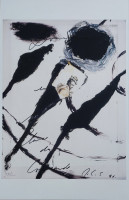
Hand-signed by Julian Schnabel. Dated, with the publisher's blind stamp (Domberger Editionen, Germany). A few small handling creases in the upper left area (see photo), otherwise very good condition. Julian Schnabel’s per non dimenticare (1997) is a lithograph that revisits the enduring image of the Crucifixion through the artist’s expressive, painterly language. Printed in a numbered edition of 90 and hand-signed, the composition centers on a solitary Christ figure affixed to a dark cross, his body rendered with loose, gestural modeling and visible brushlike contours. Thin streams of red suggest blood, echoed by the inscription “Aug 2 10:25,” which introduces a personal or commemorative dimension. The pale, atmospheric ground contrasts with the intense corporeality of the figure, heightening emotional tension. Published with the blind stamp of Domberger Editionen, Germany, the work reflects Schnabel’s engagement with memory, spirituality, and the material presence of paint translated into print.
per non dimenticare, 1997
form
Medium
Size
65 x 60 cm
- Inches
- Centimeters
Edition
Price
- USD
- EUR
- GBP
Details
Artist
Styles
Hand-signed by Julian Schnabel. Dated, with the publisher's blind stamp (Domberger Editionen, Germany). A few small handling creases in the upper left area (see photo), otherwise very good condition. Julian Schnabel’s per non dimenticare (1997) is a lithograph that revisits the enduring image of the Crucifixion through the artist’s expressive, painterly language. Printed in a numbered edition of 90 and hand-signed, the composition centers on a solitary Christ figure affixed to a dark cross, his body rendered with loose, gestural modeling and visible brushlike contours. Thin streams of red suggest blood, echoed by the inscription “Aug 2 10:25,” which introduces a personal or commemorative dimension. The pale, atmospheric ground contrasts with the intense corporeality of the figure, heightening emotional tension. Published with the blind stamp of Domberger Editionen, Germany, the work reflects Schnabel’s engagement with memory, spirituality, and the material presence of paint translated into print.
- Recently Added
- Price (low-high )
- Price (high-low )
- Year (low-high )
- Year (high-low )

Julian Schnabel
Per Non Dimenticare, 1997
Limited Edition Print
Lithograph
EUR 3,000
Julian Schnabel
Untitled, 1992-1999
Limited Edition Print
Inkjet Print
EUR 1,100

Julian Schnabel
Best Buddies, 1992
Limited Edition Print
Serigraph
USD 4,000 - 6,000

Julian Schnabel
Malfi (Set Of Three), 1998
Limited Edition Print
Silkscreen
USD 9,250

Julian Schnabel
Roy, 1998
Limited Edition Print
Silkscreen
USD 4,800

Julian Schnabel
Guiseppe (Brooding On The Vast Abyss), 1998
Limited Edition Print
Silkscreen
USD 4,800

Julian Schnabel
Bandini From View Of Dawn In The Tropics Series, 1998
Limited Edition Print
Silkscreen
USD 4,700

Julian Schnabel
Victor Hugo Demo, 1998
Limited Edition Print
Silkscreen
USD 5,200

Julian Schnabel
Nemo Librizzi, 1998
Limited Edition Print
Silkscreen
USD 3,600

Julian Schnabel
Allen (Cordial Love), 1998
Limited Edition Print
Silkscreen
USD 4,990

Julian Schnabel
A Boy From Naples Year, 1986
Limited Edition Print
Mixed Media
Currently Not Available
Related Artists


Related Articles
Popular, Artists - October 07, 2025
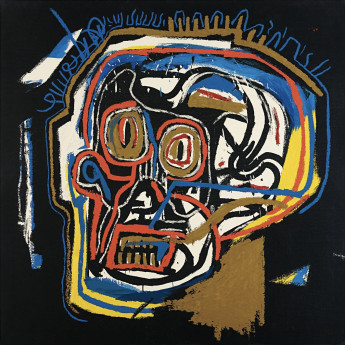
Jean-Michel Basquiat: From Graffiti to Auction Superstar – A Deep Dive into Basquiat’s Journey
Discover the legacy of Jean-Michel Basquiat—from graffiti poet to global icon. His art fused race, jazz, and rebellion into a lasting visual language. Read More

What is late modernism?
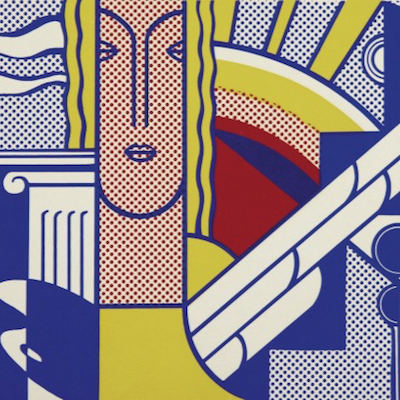
Late Modernism refers to the continuation and evolution of Modernist principles in art, architecture, and literature from the mid-20th century into the late 20th century. This movement maintains a focus on form, abstraction, and the rejection of traditional styles, but it often incorporates more complexity and ambiguity compared to early Modernism. Late Modernism explores themes such as alienation, identity, and the fragmentation of reality, reflecting the social and cultural shifts of the post-war period. It is seen in the works of architects like Louis Kahn and artists like Francis Bacon, who pushed the boundaries of Modernism while responding to the changing world around them.