Details
Artist
Styles
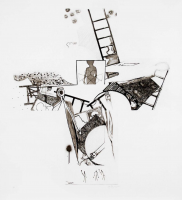
From the portfolio: Fragment - According to What,1971 (ULAE 95; G. 289) - Published by Gemini G.E.L. Los Angeles // Bent Stencil by Jasper Johns, part of the Fragment - According to What portfolio from 1971, is a limited edition lithograph published by Gemini G.E.L. in Los Angeles. Measuring 27.5 x 20 cm, the piece displays Johns' characteristic exploration of form, texture, and monochromatic palette. The composition features overlapping geometric shapes, primarily circles and stencils, rendered in shades of grey and white. The textured lower portion contrasts with the clean, crisp shapes above, evoking a sense of balance and fragmentation. The work reflects Johns' interest in perception, abstraction, and the interplay between art and everyday symbols, challenging viewers to engage with its subtle complexity.
Bent Stencil, 1971
form
Medium
Size
69.9 x 50.8 cm
- Inches
- Centimeters
Edition
Price
- USD
- EUR
- GBP
Details
Artist
Styles
From the portfolio: Fragment - According to What,1971 (ULAE 95; G. 289) - Published by Gemini G.E.L. Los Angeles // Bent Stencil by Jasper Johns, part of the Fragment - According to What portfolio from 1971, is a limited edition lithograph published by Gemini G.E.L. in Los Angeles. Measuring 27.5 x 20 cm, the piece displays Johns' characteristic exploration of form, texture, and monochromatic palette. The composition features overlapping geometric shapes, primarily circles and stencils, rendered in shades of grey and white. The textured lower portion contrasts with the clean, crisp shapes above, evoking a sense of balance and fragmentation. The work reflects Johns' interest in perception, abstraction, and the interplay between art and everyday symbols, challenging viewers to engage with its subtle complexity.
- Recently Added
- Price (low-high )
- Price (high-low )
- Year (low-high )
- Year (high-low )

Jasper Johns
Periscope, 1981
Limited Edition Print
Etching And Aquatint
USD 25,000 - 30,000

Jasper Johns
Cross Hatch, 1977
Limited Edition Print
Screen-print
USD 2,500

Jasper Johns
Untitled - Faces (ULAE 243), 1988
Limited Edition Print
Carborundum
USD 41,000 - 45,000

Jasper Johns
Untitled (Faces On Purple), 1988
Limited Edition Print
Carborundum
USD 21,000 - 30,000

Jasper Johns
Summer (Blue), 1985-91
Limited Edition Print
Lithograph
USD 4,500
Jasper Johns
The Season, 1990
Limited Edition Print
Etching
USD 14,000 - 17,000

Jasper Johns
Painting With Two Balls I, 1962
Limited Edition Print
Lithograph
USD 31,500

Jasper Johns
Souvenir I, 1972
Limited Edition Print
Lithograph
Inquire For Price

Jasper Johns
Zone, 1972
Limited Edition Print
Lithograph
Inquire For Price

Jasper Johns
Sun On Six, 2000
Limited Edition Print
Linocut
Inquire For Price

Jasper Johns
Hinged Canvas, 1971
Limited Edition Print
Lithograph
USD 5,000

Jasper Johns
Untitled (from The Geldzahler Portfolio), 1998
Limited Edition Print
Etching
USD 6,300

Jasper Johns
Valentine, 2010
Limited Edition Print
Etching And Aquatint
Inquire For Price

Jasper Johns
Untitled (Fragmented Frame), 1992
Limited Edition Print
Lithograph
USD 10,700

Jasper Johns
Untitled (Faded Impressions), 1992
Limited Edition Print
Lithograph
Inquire For Price

Jasper Johns
Untitled (Shattered Vessel), 1992
Limited Edition Print
Lithograph
Inquire For Price

Jasper Johns
Coathanger And Spoon, 1971
Limited Edition Print
Lithograph
Inquire For Price

Jasper Johns
Ventriloquist, 1985
Limited Edition Print
Lithograph
USD 13,000

Jasper Johns
Knee, 1974
Limited Edition Print
Lithograph
USD 7,350

Jasper Johns
Bent Stencil, 1971
Limited Edition Print
Lithograph
USD 7,650

Jasper Johns
Voice 2, 1982
Limited Edition Print
Lithograph
USD 7,670

Jasper Johns
Summer, 1985
Limited Edition Print
Etching And Aquatint
USD 5,250

Jasper Johns
Sketch From Untitled I, 1974
Limited Edition Print
Lithograph
USD 9,200

Jasper Johns
Ventriloquist, 1990
Limited Edition Print
Lithograph
USD 10,000 - 15,000

Jasper Johns
Untitled (Flag And Vase), 2000
Limited Edition Print
Linocut
Currently Not Available

Jasper Johns
Double Flags, 1979-80
Limited Edition Print
Lithograph
Currently Not Available

Jasper Johns
Technics And Creativity, 1971
Limited Edition Print
Mixed Media
Currently Not Available
Related Artists


Related Articles

Artists - November 11, 2024
25 Living Icons: A Generation of Artists Defying Time
Celebrate 25 living legends redefining art! From Kusama to Hockney, explore their enduring creativity and groundbreaking contributions to modern art. Read More

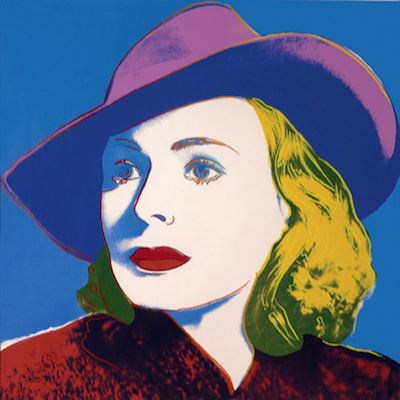
What is pop-art?
Pop Art is an art movement that began in Britain in 1955 and in the late 1950s in the U.S. It challenged traditional fine arts by incorporating imagery from popular culture, such as news, advertising, and comic books. Pop Art often isolates and recontextualizes materials, combining them with unrelated elements. The movement is more about the attitudes and ideas that inspired it than the specific art itself. Pop Art is seen as a reaction against the dominant ideas of Abstract Expressionism, bringing everyday consumer culture into the realm of fine art.