Details
Artist
Styles
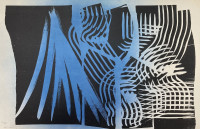
Original Lithograph in Colors on Paper - Suite: Farandole // Lithograph V from Farandole by Hans Hartung, created in 1971, is a limited edition lithograph that embodies Hartung’s abstract expressionist style. The composition features dynamic, sweeping lines that arc and intersect, creating a sense of motion and energy. The use of light and dark contrasts adds depth, with bold, curving white strokes standing out against a darker background. The rhythmic arrangement of these gestural marks gives the piece a sense of fluidity and spontaneity. As part of the Farandole suite, this work reflects Hartung’s exploration of abstraction and the expressive potential of line and form, resulting in a powerful visual that captures the viewer’s attention.
Lithograph V from Farandole, 1971
form
Medium
Size
50.8 x 76.2 cm
- Inches
- Centimeters
Edition
Price
- USD
- EUR
- GBP
Details
Artist
Styles
Original Lithograph in Colors on Paper - Suite: Farandole // Lithograph V from Farandole by Hans Hartung, created in 1971, is a limited edition lithograph that embodies Hartung’s abstract expressionist style. The composition features dynamic, sweeping lines that arc and intersect, creating a sense of motion and energy. The use of light and dark contrasts adds depth, with bold, curving white strokes standing out against a darker background. The rhythmic arrangement of these gestural marks gives the piece a sense of fluidity and spontaneity. As part of the Farandole suite, this work reflects Hartung’s exploration of abstraction and the expressive potential of line and form, resulting in a powerful visual that captures the viewer’s attention.
- Recently Added
- Price (low-high )
- Price (high-low )
- Year (low-high )
- Year (high-low )

Hans Hartung
Las Estampas De La Cometa 5, 1971
Limited Edition Print
Etching
EUR 1,550

Hans Hartung
Las Estampas De La Cometa 4, 1971
Limited Edition Print
Etching
EUR 1,550

Hans Hartung
Las Estampas De La Cometa 1, 1971
Limited Edition Print
Etching
EUR 1,550

Hans Hartung
L 1973-46, 1973
Limited Edition Print
Lithograph
EUR 2,050

Hans Hartung
G 1973-2, 1973
Limited Edition Print
Etching
EUR 2,250

Hans Hartung
Lithograph V From Farandole, 1971
Limited Edition Print
Lithograph
USD 1,280

Hans Hartung
Lithograph XII From Farandole, 1971
Limited Edition Print
Lithograph
USD 1,280
Hans Hartung
Lithograph XIV From Farandole, 1971
Limited Edition Print
Lithograph
Currently Not Available

Hans Hartung
L-1971-1, 1971
Limited Edition Print
Lithograph
Currently Not Available

Hans Hartung
L-19, 1974
Limited Edition Print
Lithograph
Currently Not Available
Related Artists


Related Articles

Popular, Art Movements - November 20, 2024
Understanding Abstract Expressionism: Emotion and Gesture
Explore the emotional depth of Abstract Expressionism! Discover how artists like Pollock and Rothko used gesture and color to convey human complexity. Read More


What is automatism?
Automatism refers to a technique in the creative process that accesses material from the unconscious or subconscious mind. It is based on Sigmund Freud’s psychoanalytic method of free association. Artists value this process for its ability to inspire creative thought and spontaneous creation.