Details
Artist
Styles
Offset lithograph in colors, on wove paper. Signed and numbered in pencil. Published by Harry N. Abrams Editions, New York. Image size: 13.75 x 11.25 in. (34.9 x 28.5 cm.) Sheet size: 15.75 x 11.8 in. (40 x 30 cm.) La Toilette by Fernando Botero, created in 1983, is a lithograph that reflects the artist's iconic style of exaggerated, voluminous forms. A nude woman is seen seated on a bed, fixing her hair while gazing into a handheld mirror. The mirror on the wall multiplies the scene, adding depth and a touch of voyeuristic tension. Botero’s use of rounded forms and soft color gradients imbues the scene with a sense of intimacy and quiet humor. The foreground includes a still life of fruit, reinforcing the domestic setting and Botero's classical influences.
Details
Artist
Styles
Offset lithograph in colors, on wove paper. Signed and numbered in pencil. Published by Harry N. Abrams Editions, New York. Image size: 13.75 x 11.25 in. (34.9 x 28.5 cm.) Sheet size: 15.75 x 11.8 in. (40 x 30 cm.) La Toilette by Fernando Botero, created in 1983, is a lithograph that reflects the artist's iconic style of exaggerated, voluminous forms. A nude woman is seen seated on a bed, fixing her hair while gazing into a handheld mirror. The mirror on the wall multiplies the scene, adding depth and a touch of voyeuristic tension. Botero’s use of rounded forms and soft color gradients imbues the scene with a sense of intimacy and quiet humor. The foreground includes a still life of fruit, reinforcing the domestic setting and Botero's classical influences.
- Recently Added
- Price (low-high )
- Price (high-low )
- Year (low-high )
- Year (high-low )

Fernando Botero
Pedrito, 1975
Limited Edition Print
Offset Print
EUR 6,600
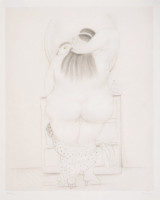
Fernando Botero
Dessins Et Aquarelles: One Plate, 1984
Limited Edition Print
Offset Print
USD 6,300

Fernando Botero
La Toilette, 1983
Limited Edition Print
Offset Print
Inquire For Price

Fernando Botero
Profile De Jeune Homme, 1992
Drawing / Watercolor
Pen And Ink
USD 17,900

Fernando Botero
Hunter, 1980
Drawing / Watercolor
Pencil
USD 29,000 - 35,000

Fernando Botero
Fumador De Cigarrillos, 1975 -1980
Limited Edition Print
Lithograph
Currently Not Available

Fernando Botero
Dessins Et Aquarelles (2), 1984
Limited Edition Print
Lithograph
Currently Not Available

Fernando Botero
The Dancers, 1983
Limited Edition Print
Lithograph
Currently Not Available

Fernando Botero
Man And Woman, .
Sculpture / Object
Bronze
Currently Not Available
Related Artists


Related Articles

Popular, Art Movements - November 20, 2024
Understanding Abstract Expressionism: Emotion and Gesture
Explore the emotional depth of Abstract Expressionism! Discover how artists like Pollock and Rothko used gesture and color to convey human complexity. Read More

What is Postmodernism?
Postmodernism is an art movement that emerged as a reaction against authority and traditional boundaries, seeking to blur the lines between art and everyday life. It aimed to bridge the gap between the cultural elite and the general public by embracing eclectic mixtures of earlier conventions and styles. Postmodernist art often challenges established norms and celebrates diversity, irony, and pastiche, making it a movement that reflects the complexities of contemporary culture.