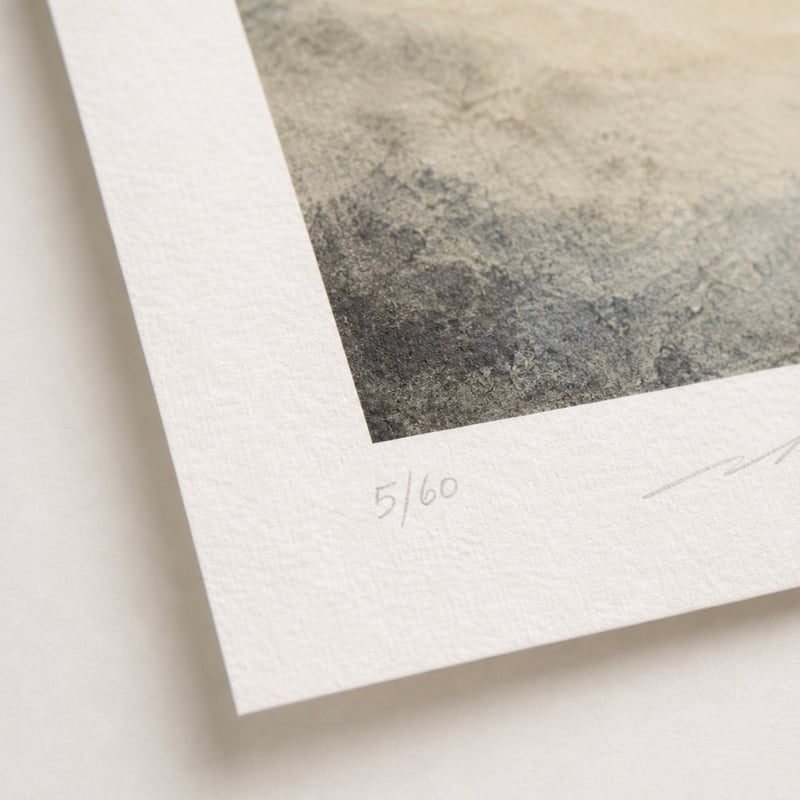
Offset lithograph on wove paper, signed and numbered in pencil.
Published by Editions de la Différence.
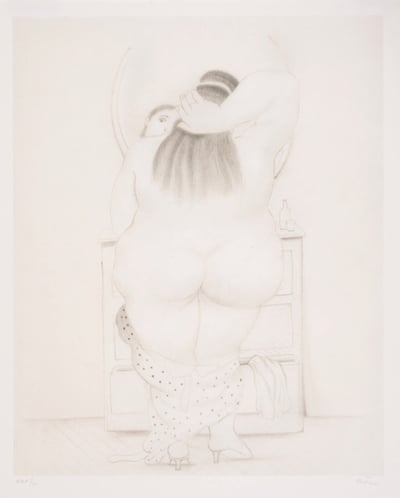
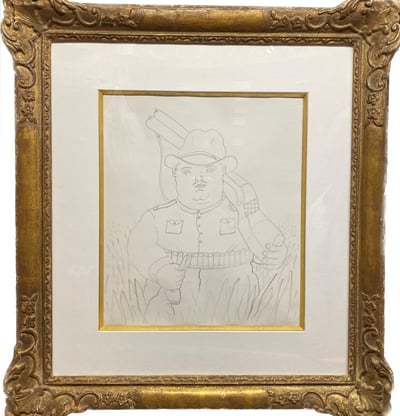
This offset lithograph by Fernando Botero, created in 1984 for Dessins et Aquarelles, exemplifies his iconic visual language of exaggerated, voluminous forms. The composition depicts a nude woman from behind, partially undressed, gazing at herself in the mirror. With delicate pencil-like shading and soft contours, Botero infuses the scene with humor, sensuality, and a quiet intimacy. The woman’s ample figure and the refined drawing style challenge conventional ideals of beauty while celebrating bodily presence. Signed in pencil and numbered in Roman numerals from an edition of L, the work was published by Editions de la Différence, Paris.
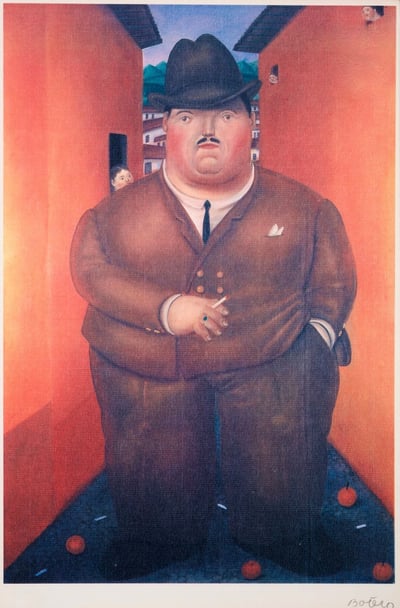
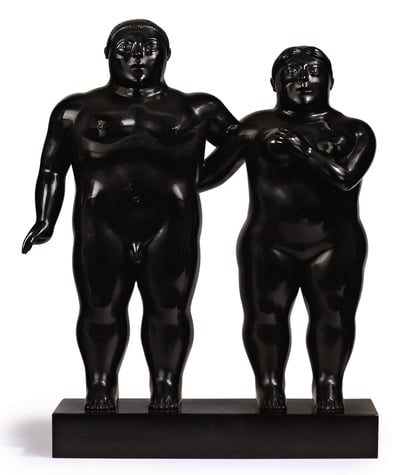
Fernando Botero (Colombia, 1932–2023) was a renowned artist known for his distinctive 'Boterismo' style, characterized by exaggerated, voluminous forms. His paintings and sculptures often depicted whimsical yet critical scenes of everyday life, politics, and religion, blending humor with social commentary. Botero’s works are celebrated for their unique blend of color, form, and satire.
Offset PrintOffset lithography is a printing technique where the inked image is first transferred (offset) from a plate to a rubber blanket and then to the printing surface. This method combines the lithographic process, which relies on the repulsion of water and oil, to keep non-printing areas ink-free by attracting a water-based film. Offset lithography was originally developed to reduce costs in reproducing artwork and is widely used for high-volume printing due to its efficiency and ability to produce sharp, consistent images.
Offset lithograph on wove paper, signed and numbered in pencil.
Published by Editions de la Différence.
This offset lithograph by Fernando Botero, created in 1984 for Dessins et Aquarelles, exemplifies his iconic visual language of exaggerated, voluminous forms. The composition depicts a nude woman from behind, partially undressed, gazing at herself in the mirror. With delicate pencil-like shading and soft contours, Botero infuses the scene with humor, sensuality, and a quiet intimacy. The woman’s ample figure and the refined drawing style challenge conventional ideals of beauty while celebrating bodily presence. Signed in pencil and numbered in Roman numerals from an edition of L, the work was published by Editions de la Différence, Paris.
Fernando Botero (Colombia, 1932–2023) was a renowned artist known for his distinctive 'Boterismo' style, characterized by exaggerated, voluminous forms. His paintings and sculptures often depicted whimsical yet critical scenes of everyday life, politics, and religion, blending humor with social commentary. Botero’s works are celebrated for their unique blend of color, form, and satire.
An artist is attracted to certain kinds of form without knowing why.
- Fernando Botero
Known for his instantly-recognisable, signature style labelled ‘Boterismo’ - a depiction of figures and people in a large, exaggerated fashion and a representation of both humour and socio-political criticism - Fernando Botero was one of the most successful artists of Latin America. His employment of flat, bright colours alongside distinctly outlined forms was heavily influenced by traditional Latin-America folk art, as well as the works of Francisco de Goya and Diego Velazquez; one of Botero’s most celebrated works is Mona Lisa, Age 12 a paraphrasing of Leonardo da Vinci’s original work with a twist that alluded to the aforementioned Goya and Velazquez. Botero captured the various walks of life to be found in his native Colombia throughout his work in sculpture and painting; Card Players and Death of Pablo Escobar are among the most celebrated of his artistic creations.
Naïve art describes a style of artwork that is simple and unsophisticated, often created by artists without formal training in an academy or art school. The style is characterized by a lack of advanced techniques, giving it a childlike appearance. Naïve art often features bright colors, simple shapes, and a straightforward approach to subject matter, reflecting the artist's untrained perspective.