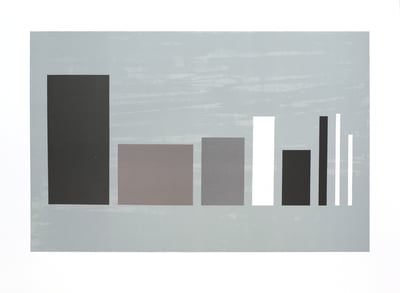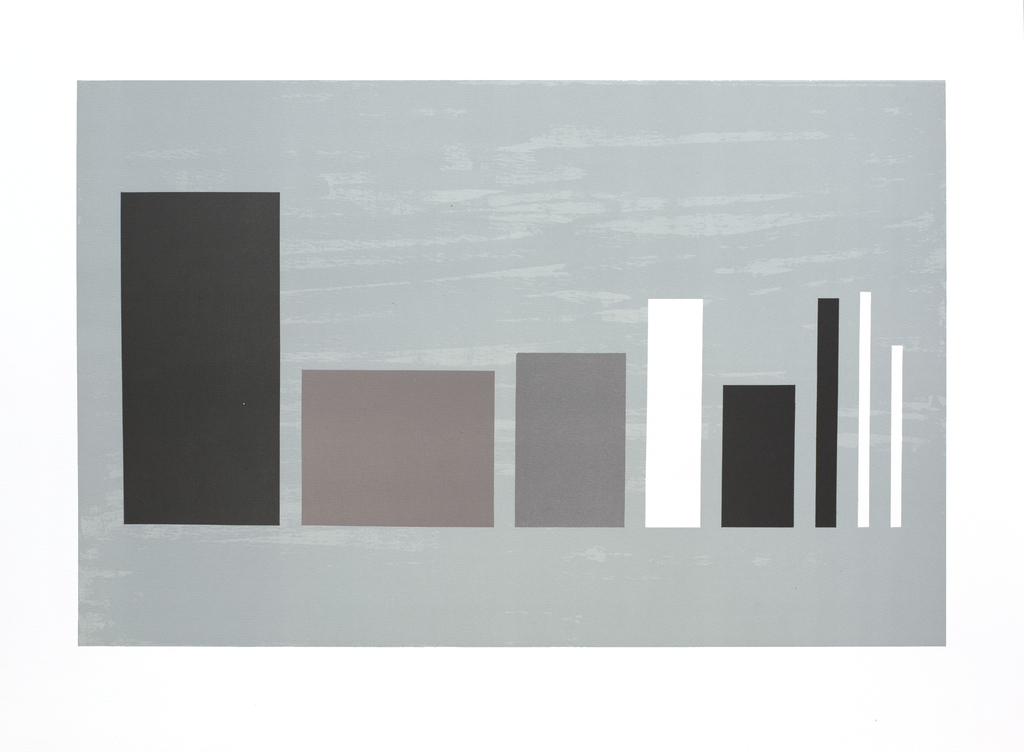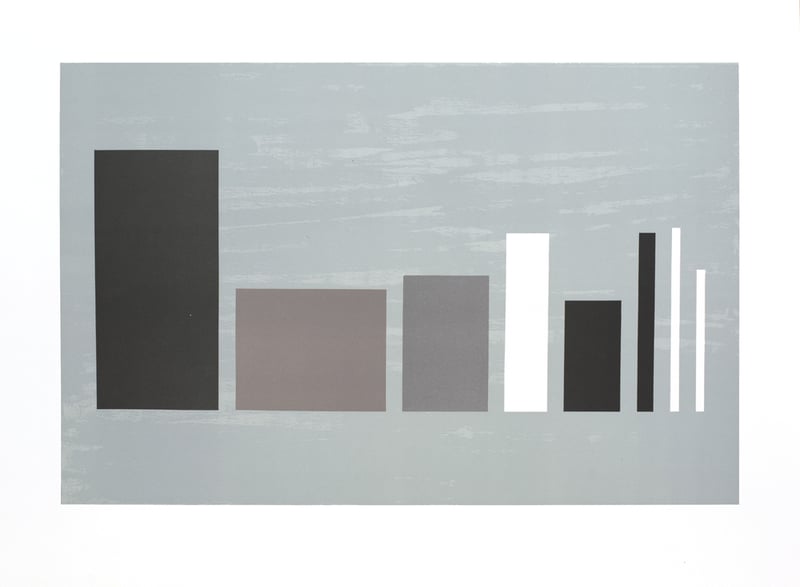
Berlin-Chair Unassembled 1 by David Diao, a 2019 lithograph, presents a minimalist arrangement of vertical rectangular shapes in a monochromatic gradient from black to white. Set against a light gray background, the progression of shapes varies in height and width, resembling an unassembled or deconstructed object, possibly inspired by Gerrit Rietveld’s iconic Berlin Chair. The composition plays with balance and proportion, offering an abstract representation of the chair’s components laid out systematically. Diao’s exploration of form and reductionism reflects his engagement with modernist design principles, celebrating the beauty of simplicity and structure.
David Diao (China/USA, 1943) is a Chinese-American artist known for his abstract paintings that blend minimalist aesthetics with personal and art historical narratives. His work often references modernist icons and explores themes of identity, displacement, and the art market. Diao's art has been exhibited internationally, including retrospectives at the Ullens Center for Contemporary Art in Beijing.
LithographLithography is a printing method based on the principle that water and oil do not mix. It can be used to print artwork or text onto paper or other suitable materials. Traditionally, an image was drawn with wax, fat, or oil onto a lithographic limestone surface or plate. Today, metal plates and other surfaces are also used in lithographic printing.
Berlin-Chair Unassembled 1 by David Diao, a 2019 lithograph, presents a minimalist arrangement of vertical rectangular shapes in a monochromatic gradient from black to white. Set against a light gray background, the progression of shapes varies in height and width, resembling an unassembled or deconstructed object, possibly inspired by Gerrit Rietveld’s iconic Berlin Chair. The composition plays with balance and proportion, offering an abstract representation of the chair’s components laid out systematically. Diao’s exploration of form and reductionism reflects his engagement with modernist design principles, celebrating the beauty of simplicity and structure.
David Diao (China/USA, 1943) is a Chinese-American artist known for his abstract paintings that blend minimalist aesthetics with personal and art historical narratives. His work often references modernist icons and explores themes of identity, displacement, and the art market. Diao's art has been exhibited internationally, including retrospectives at the Ullens Center for Contemporary Art in Beijing.
David Diao is renowned for his relentless attempts to refine the notions of form and configuration in his work. He systematically clarifies these ideas, by using pictorial frameworks and conventions, to create text and symbolic typography. Although his later period has been more clearly focussed, on developing a conversation with the great paintings of the Modernist period, Diao's earlier work was mostly based on abstract colour paintings. He'd embraced the aesthetic of the 'colour field movement', and developed a series of canvases where he would apply paint directly across large structures. He has always generously credited a small group of Abstract Expressionist painters such as Barnett Newman, and Ad Reinhardt, as his main influences during that period. He also heavily borrowed from Jackson Pollock's use of images from magazines, motifs from archives, and memorabilia as reference points. Diao's work started to gain recognition in the late 1960's New York art world. By using minimalist structures to simplify his paintings and installations, Diao has successfully managed to expand his interrogations about subject matter, to his current concern on the formalism and plasticity of abstraction. His approach no longer consists in attempting to fill open spaces with content, but rather to analyse how space can actually neutralize the environment delineated by a painting.
Lyrical abstraction is a descriptive term characterizing a type of abstract painting closely related to Abstract Expressionism, in use from the 1940s to the present. The term can also describe two distinct but related trends in post-World War II modernist painting. This art movement originated in Paris, France, after the war, emphasizing personal expression, spontaneity, and the emotional use of color and form.