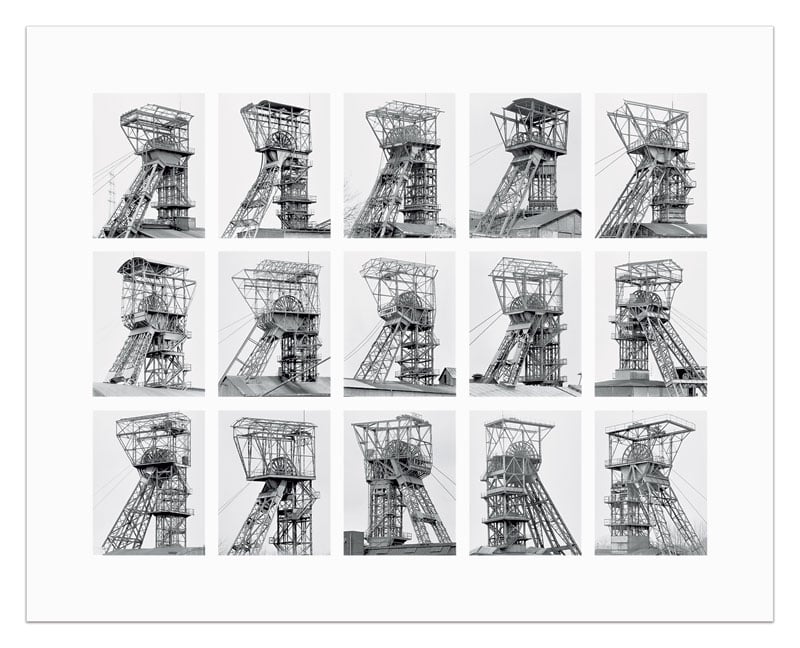
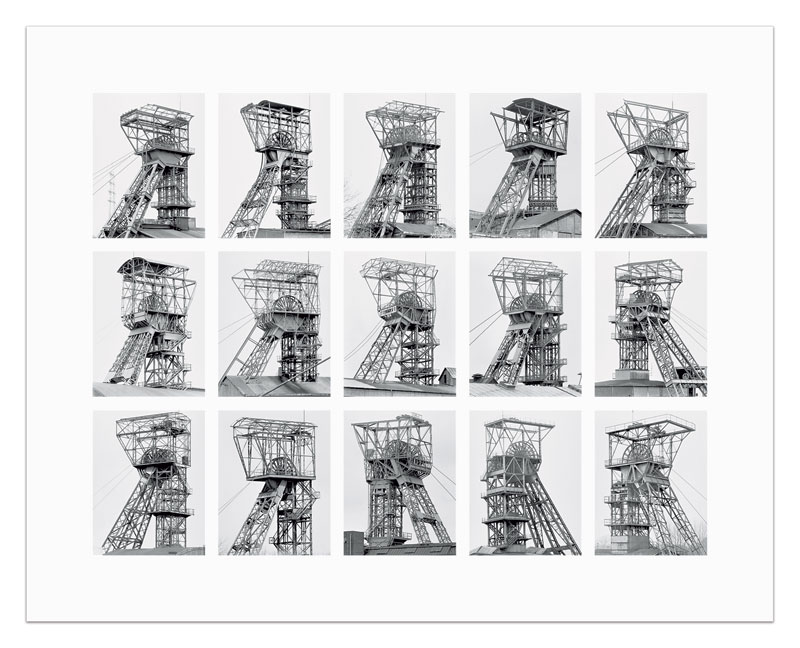
Fördertürme (Winding Towers), Image I from the series: Typologies, 2006
- Digital pigment print (Ditone) on digital paper ) Signed B Becher and Hilla Becher, numbered all on verso - Image size: 70.2 x 93 cm - Paper size: 90 x 113 cm
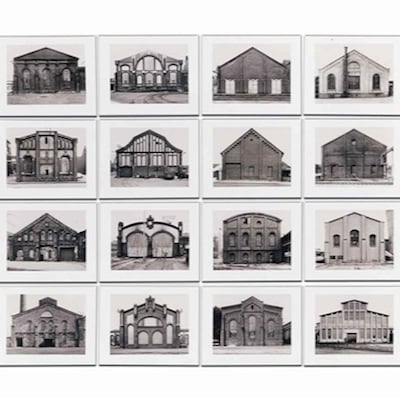
Fördertürme (Winding Towers) by Bernd and Hilla Becher is a limited edition digital print on paper, created in 2006 as part of their Typologies series. This piece exemplifies the Bechers’ methodical approach to industrial architecture photography, capturing multiple winding towers in a grid-like arrangement. Each tower is framed in isolation, allowing for close study of their structural details and variations. The monochromatic palette highlights the intricate steel frameworks and geometric forms, presenting these industrial structures as objects of both functionality and beauty. The Bechers’ work is known for its documentary style, showcasing architecture with an objective lens while also inviting viewers to reflect on the aesthetic qualities within utilitarian designs. This edition is part of a series limited to 40 copies, emphasizing its collectible nature.
Artwork Copyright © Bernd & Hilla BecherBernd and Hilla Becher (Germany, 1931–2007; 1934–2015) were pioneering photographers known for their typological studies of industrial architecture. Their stark black-and-white images of water towers, factories, and silos captured structural precision and uniformity. Founders of the Düsseldorf School of Photography, their work profoundly influenced generations of artists and shaped the visual language of modern photography.
Artwork Copyright © Bernd & Hilla BecherFördertürme, 2006
Form
Medium
Size
- Inches
- Centimeters
Edition
Price
Available works →
- Authenticity Guaranteed
- Insured Shipping
- Online Since 2005
●
●Inventory 2716
●Signed
●Comes with gallery invoice and certificate
●Sell Us a Similar Artwork. Learn more.
Fördertürme (Winding Towers), Image I from the series: Typologies, 2006
- Digital pigment print (Ditone) on digital paper ) Signed B Becher and Hilla Becher, numbered all on verso - Image size: 70.2 x 93 cm - Paper size: 90 x 113 cm
Fördertürme (Winding Towers) by Bernd and Hilla Becher is a limited edition digital print on paper, created in 2006 as part of their Typologies series. This piece exemplifies the Bechers’ methodical approach to industrial architecture photography, capturing multiple winding towers in a grid-like arrangement. Each tower is framed in isolation, allowing for close study of their structural details and variations. The monochromatic palette highlights the intricate steel frameworks and geometric forms, presenting these industrial structures as objects of both functionality and beauty. The Bechers’ work is known for its documentary style, showcasing architecture with an objective lens while also inviting viewers to reflect on the aesthetic qualities within utilitarian designs. This edition is part of a series limited to 40 copies, emphasizing its collectible nature.
Artwork Copyright © Bernd & Hilla BecherBernd and Hilla Becher (Germany, 1931–2007; 1934–2015) were pioneering photographers known for their typological studies of industrial architecture. Their stark black-and-white images of water towers, factories, and silos captured structural precision and uniformity. Founders of the Düsseldorf School of Photography, their work profoundly influenced generations of artists and shaped the visual language of modern photography.
Artwork Copyright © Bernd & Hilla Becher- Recently Added
- Price (Low-High)
- Price (High-Low)
- Year (Low-High)
- Year (High-Low)
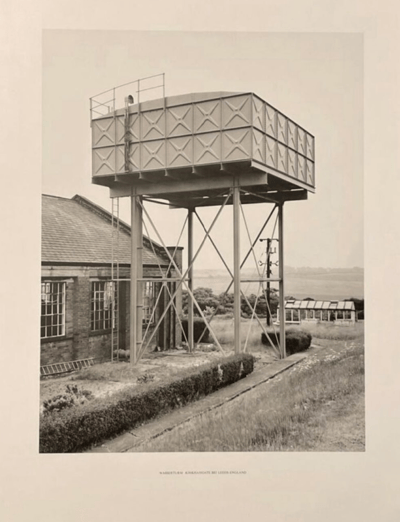
Bernd & Hilla Becher
Wasserturm Kirkhamgate, 1974
Photography
Offset Print
GBP 4,200
Bernd & Hilla Becher
Fördertürme, 2006
Limited Edition Print
Digital Print on paper
Currently Not Available
Related Artists


Related Articles

Art Movements - May 5, 2022
The Dusseldorf School and the birth of modern photography
Discover the Düsseldorf School of Photography, its roots in objectivity, and its legacy in modern art. Explore works by Gursky, Höfer, and the Bechers.Read More
Artwork by Bernd & Hilla Becher
What is New Topographics?
New Topographics is a term coined in 1975 by curator William Jenkins to describe a group of photographers whose work focused on formal black-and-white images of urban and industrial landscapes. Jenkins initially described their aesthetic as banal, but the photographers themselves argued that their compositions were as significant as those of natural landscapes, emphasizing the beauty in everyday, man-made environments.

Bernd & Hilla Becher
Fördertürme, 2006
90 x 113 cm


