Details
Artist
Styles
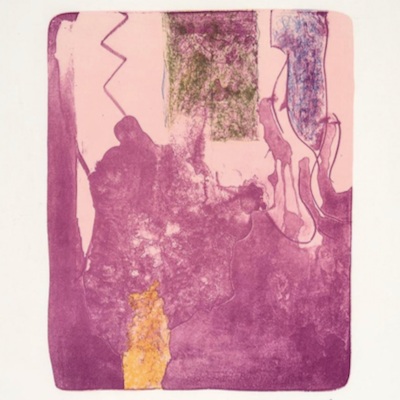
Bernard Frize’s Suite à onze (2009) is a drypoint print that reflects the artist’s sustained interest in systems, repetition, and the generative possibilities of simple rules. The composition consists of two adjacent geometric grids formed by interlacing colored lines that weave across the surface in a continuous rhythmic pattern. While the structure appears methodical and predetermined, subtle variations in line, color, and density introduce moments of visual complexity and unpredictability. Frize has long explored the balance between process and result, often allowing predefined procedures to shape the final image. In Suite à onze, the delicate network of intersecting lines evokes both mathematical precision and organic growth, inviting close observation of the relationships between order, variation, and perception.
Suite à onze, 2009
form
Medium
Size
57 x 57 cm
- Inches
- Centimeters
Edition
Price
- USD
- EUR
- GBP
Details
Artist
Styles
Bernard Frize’s Suite à onze (2009) is a drypoint print that reflects the artist’s sustained interest in systems, repetition, and the generative possibilities of simple rules. The composition consists of two adjacent geometric grids formed by interlacing colored lines that weave across the surface in a continuous rhythmic pattern. While the structure appears methodical and predetermined, subtle variations in line, color, and density introduce moments of visual complexity and unpredictability. Frize has long explored the balance between process and result, often allowing predefined procedures to shape the final image. In Suite à onze, the delicate network of intersecting lines evokes both mathematical precision and organic growth, inviting close observation of the relationships between order, variation, and perception.
- Recently Added
- Price (low-high )
- Price (high-low )
- Year (low-high )
- Year (high-low )

Bernard Frize
Suite à Onze, 2009
Limited Edition Print
Drypoint
EUR 2,000

Bernard Frize
Percy John Heawood Conjecture, 2005
Sculpture / Object
Mixed Media
EUR 5,450
Related Artists


Related Articles

Popular, Art Movements - November 20, 2024
Understanding Abstract Expressionism: Emotion and Gesture
Explore the emotional depth of Abstract Expressionism! Discover how artists like Pollock and Rothko used gesture and color to convey human complexity. Read More

What is abstract expressionism?
Abstract Expressionism is an art movement that emerged in the United States during the 1940s and 1950s. Characterized by large, abstract canvases, the movement emphasized spontaneous, expressive brushwork and the use of color and form to convey emotion rather than represent reality. Artists like Jackson Pollock, Mark Rothko, and Willem de Kooning are key figures in this movement. Abstract Expressionism marked a shift in the art world, making New York City a center of the international art scene.