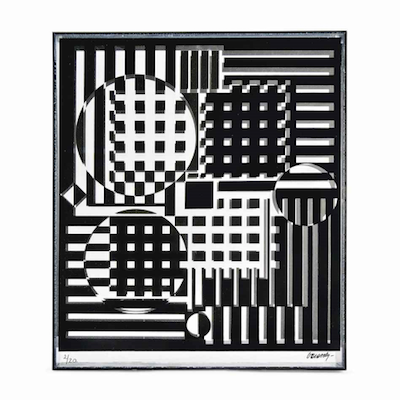
What is Op Art?
Op Art is a visual art style that uses optical illusions to create the impression of movement, vibrating patterns, flashing, or hidden images. The works are typically abstract, with many well-known pieces in black and white. The roots of Op Art can be traced back to earlier movements like Futurism, Constructivism, Dada, and Neo-Impressionism, particularly in their use of color effects and graphic design.
Show All
- Show All
- Established
- Discoveries
A,B,C
ARTWORKS RELATED TO OP ART

Felipe Pantone
Subtractive Variability Vitreum 3, 2025
Sculpture / Object
Acrylic sculpture
EUR 3,200

Felipe Pantone
Subtractive Variability Vitreum 2, 2025
Sculpture / Object
Acrylic sculpture
EUR 2,800

Felipe Pantone
Subtractive Variability Vitreum 1, 2025
Sculpture / Object
Acrylic sculpture
EUR 2,300

Antonio Asis
Asistype 20 – boule sur cercle, 2016
Sculpture / Object
Monotype
EUR 3,000

Antonio Asis
Asistype 19 – boule sur cercle, 2016
Sculpture / Object
Monotype
EUR 3,000

Antonio Asis
Asistype 18 – boule sur cercle, 2016
Sculpture / Object
Monotype
EUR 3,000

Antonio Asis
Asistype 17 – boule sur cercle, 2016
Sculpture / Object
Monotype
EUR 3,000

Antonio Asis
Asistype 16 – boule sur cercle, 2016
Sculpture / Object
Monotype
EUR 3,000

Antonio Asis
Asistype 15 – boule sur cercle, 2016
Sculpture / Object
Monotype
EUR 3,000

Antonio Asis
Asistype 14 – boule sur cercle, 2016
Sculpture / Object
Monotype
EUR 3,000

Antonio Asis
Asistype 13 – boule sur cercle, 2016
Sculpture / Object
Monotype
EUR 3,000

Antonio Asis
Asistype 11 – boule sur cercle, 2016
Sculpture / Object
Monotype
EUR 3,000

Antonio Asis
Vibration cercles mauve, rouge et turquoise, 2010
Sculpture / Object
Mixed Media
EUR 3,000

Antonio Asis
3 ovals noir et blanc, 2012
Sculpture / Object
Mixed Media
EUR 3,000

Bridget Riley
Sylvan, 2000
Limited Edition Print
Screen-print
GBP 13,000 - 17,000

Marina Apollonio
Dinamica Circolare Ellisse Prospettico, 1969-2025
Sculpture / Object
Wood
EUR 1,500
Related Articles

Artists - October 25, 2024
Julio Le Parc: Master of Kinetic Art and Optical Illusions
Explore Julio Le Parc’s mastery in kinetic and optical art. Discover his innovative use of motion, light, and perception that reshaped interactive art. Read More


Linocut is a printmaking technique similar to woodcut, where a sheet of linoleum is used as the relief surface. The design is carved into the linoleum using a V-shaped gouge or chisel, creating raised areas that form a mirror image of the final print. Ink is applied to the raised areas with a roller, and the linoleum sheet is then pressed onto fabric or paper. The printing can be done by hand or with a press.
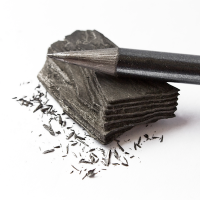
Graphite is a form of carbon commonly used as the core material in pencils. It can be compressed to various levels of hardness, allowing for different shading effects in drawing. In powdered form, graphite can be applied with a brush for broader, softer applications. Graphite erases easily and was first discovered in the 1500s in England's Lake District.