Ludwig Wilding

Alison Wilding (UK, 1948) is a contemporary sculptor known for her innovative use of materials and forms. Combining wood, metal, resin, and other elements, her works explore contrasts like light and shadow or fluidity and solidity. Wilding’s abstract sculptures often evoke a sense of mystery and poetic tension.

© Ludwig Wilding. All rights reserved.

Ludwig Wilding – SBST 2827, 1993 – Object

Ludwig Wilding

SBST 2827, 1993

Sculpture / Object

Object

EUR 1,500

Ludwig Wilding – SBST 2838, 2000 – Object

Ludwig Wilding

SBST 2838, 2000

Sculpture / Object

Object

EUR 1,500

Ludwig Wilding – SBST 2823, 1993 – Object

Ludwig Wilding

SBST 2823, 1993

Sculpture / Object

Object

EUR 1,500

Ludwig Wilding – SB II, 1986 – Object

Ludwig Wilding

SB II, 1986

Sculpture / Object

Object

EUR 1,500

Ludwig Wilding – SBST 2818, 1986 – Object

Ludwig Wilding

SBST 2818, 1986

Sculpture / Object

Object

EUR 1,500

Ludwig Wilding – SBT 2835, 1998 – Object

Ludwig Wilding

SBT 2835, 1998

Sculpture / Object

Object

EUR 1,500

Ludwig Wilding – SBST 2839, 2001 – Mixed Media

Ludwig Wilding

SBST 2839, 2001

Limited Edition Print

Mixed Media

EUR 1,500

No sold works to show.

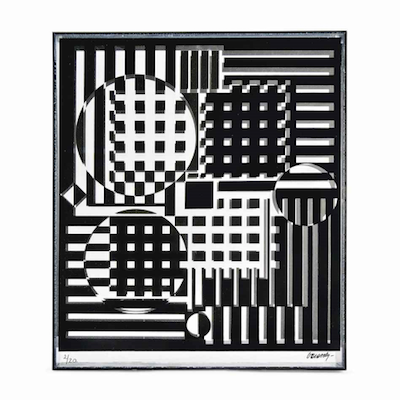
Ludwig Wilding was a German Op and Kinetic artist. He created three dimensional structures with shifting patterns using black and white designs. His work aimed at disorienting the viewer using tricks of where the eye would focus. 
Ludwig Wilding had always been interested in visual perception of space and creating illusions of depth in pictures. Ludwig Wilding's work was inspired by the Modernists and M.C. Escher and he is responsible for inventing the technology of using superimposition of interference which created three dimensional optical illusions. In the 1950's his "optical interference" identified and isolated the line using black and white as the primary structure in his work. By the 1960's Ludwig Wilding began to incorporate two and three dimensional images by constructing "interfering objects" where he then superimposed a network of lines to produce effects of optical vertigo. Ludwig Wilding's works question the interaction between the viewer's eye and brain. His patterns appear to shift and flicker as the viewer looks at them, confusing the eye. He often referred to his work as "irritating art" as he incorporated the limits of visual perception and viewers often have to rub their eyes as the patterns physically irritate them. Ludwig Wilding's works have appeared in museums across the globe including the United States and Germany.

Stay Updated on Ludwig Wilding

Subscribe to receive updates on new artworks, exhibitions and news about Ludwig Wilding.

We respect your privacy and protect your information.
What is concrete art?Artwork by Joseph Albers

What is concrete art?

Concrete Art is an art movement founded by the Dutch artist Theo van Doesburg in the 1930s. The movement emphasizes pure abstraction, focusing on geometric shapes and colors without any reference to the natural world or symbolic meaning. Unlike other forms of abstract art, Concrete Art is entirely non-representational and is based on mathematical principles…

Explore »

Est. 2005 — twenty years of collecting, online.